
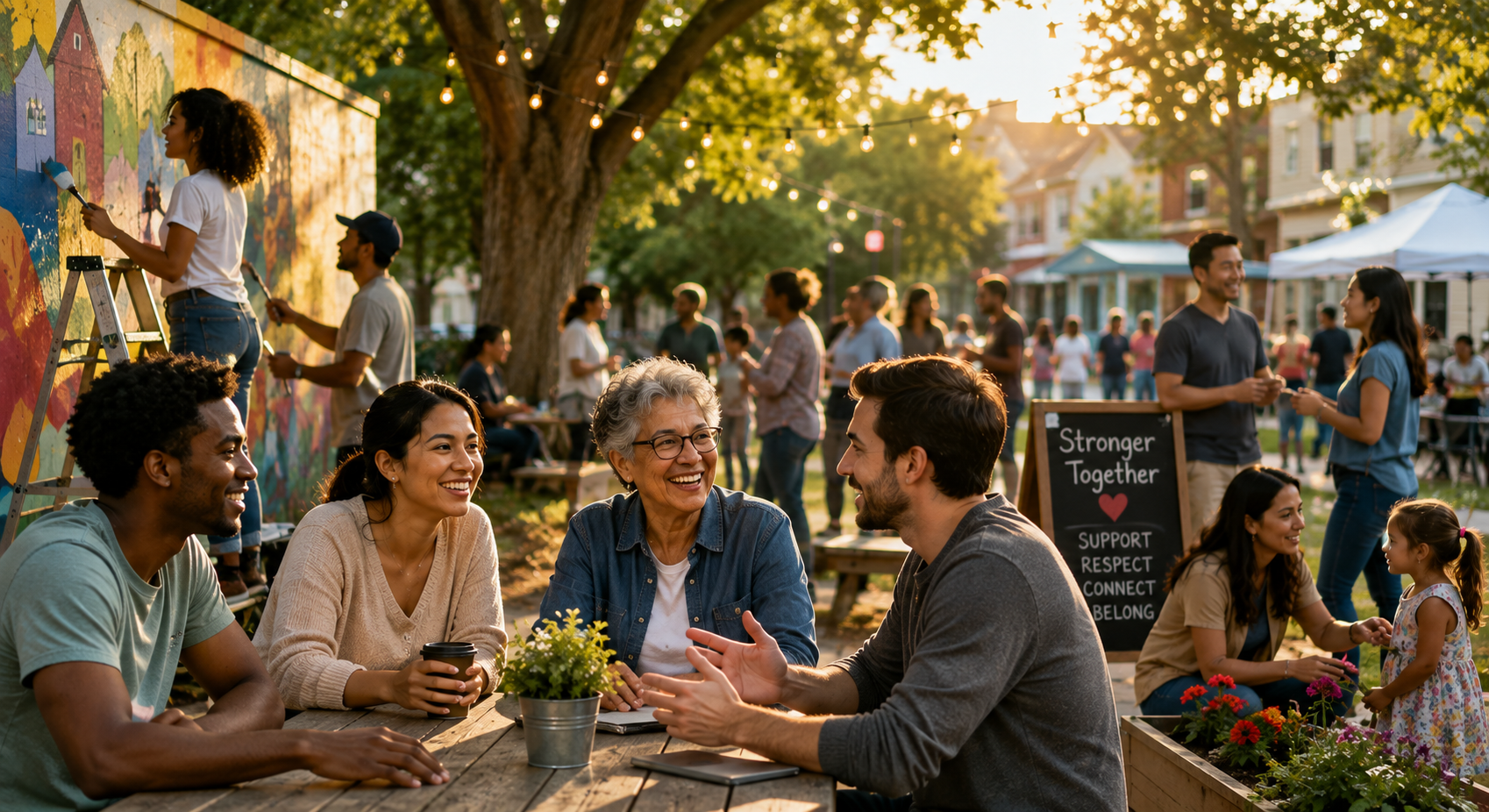
People rarely live completely independently. Families, friendships, workplaces, schools, neighborhoods, and community groups create networks that influence everyday experiences. Understanding how social connections shape communities helps explain why relationships matter far beyond companionship. They can affect cooperation, belonging, information sharing, and the ability to respond to challenges.
A strong community does not require everyone to know each other personally. Instead, people need enough trust and shared responsibility to live, work, and solve problems together.
These connections can develop in many places. Neighbors may help each other during emergencies. Parents can organize activities at a local school. Meanwhile, coworkers may share knowledge that helps new employees adjust.
Digital communication has expanded these networks further. People can maintain relationships across long distances and find communities around shared interests.
However, healthy communities need more than communication. Respect, participation, inclusion, and reliability turn individual relationships into meaningful social support.
Why Human Connection Matters
Humans depend on cooperation in countless ways. Even ordinary activities involve networks of people who provide services, information, care, education, transportation, and other forms of support.
This interdependence demonstrates how social connections shape communities through repeated everyday interactions.
Consider a neighborhood where residents recognize one another. They may exchange information about local events, notice unusual problems, or help someone who needs temporary assistance.
These relationships do not need to become close friendships to have value. Familiarity itself can make communication easier.
Connection also creates opportunities to learn from people with different experiences. Conversations can expose individuals to new ideas and perspectives.
However, social relationships vary greatly. Some are supportive, while others can create pressure or conflict. Therefore, simply having many connections does not guarantee a healthy community.
Quality, trust, and mutual respect matter.
Trust Helps Communities Work Together
Trust allows people to cooperate without constantly questioning one another’s intentions.
In communities, trust can develop when people behave consistently, keep commitments, communicate openly, and treat others fairly.
Trust is one reason social connections shape communities so strongly. People who trust each other may find it easier to share resources, organize projects, or respond collectively to local problems.
For example, residents may work together to maintain a shared space. Parents might coordinate transportation for school activities. Local organizations can collaborate on community events.
However, trust takes time to build and can disappear quickly.
Broken promises, discrimination, corruption, or poor communication can weaken confidence in individuals and institutions.
Repairing trust usually requires more than reassuring words. People need to see consistent changes in behavior.
Therefore, community trust should be treated as something that requires continuous care rather than a permanent condition.
Small Interactions Can Build Belonging
Not every meaningful social connection begins with a deep conversation.
Simple greetings, short conversations, and familiar faces can gradually create a sense of belonging.
These everyday interactions help explain how social connections shape communities at the local level.
A person who regularly visits the same café may become familiar with employees and other customers. Parents waiting outside a school may begin exchanging information. Neighbors walking their dogs can slowly get to know each other.
Such interactions appear minor, yet they make public spaces feel more familiar.
Belonging can become especially important for people who have recently moved to an area. Learning names, routines, and local customs can make an unfamiliar place feel more comfortable.
Communities can encourage these interactions through accessible public spaces, events, libraries, parks, markets, and recreational activities.
Connection often begins with repeated opportunities for people to simply encounter one another.
Families Form Important Social Networks
Families are among the earliest communities many people experience.
They can provide emotional support, practical assistance, cultural traditions, financial help, and shared responsibilities. However, family structures differ widely.
Family relationships show how social connections shape communities across generations.
Grandparents may help care for children. Adult children can support aging relatives. Siblings may share responsibilities during difficult periods.
Families also pass along languages, traditions, recipes, stories, beliefs, and social expectations.
However, family relationships are not always supportive. Conflict, distance, or difficult circumstances can weaken connections.
Therefore, communities should not assume everyone has a dependable family network.
Friends, neighbors, support organizations, and other relationships can also provide meaningful social support.
A healthy society recognizes many different forms of family and connection rather than treating one structure as universal.
Friendships Create Support Beyond Family
Friendships are voluntary relationships, which gives them a unique role in social life.
Friends can provide companionship, advice, practical help, and opportunities for shared experiences. They may also connect people with wider networks.
Friendship demonstrates how social connections shape communities beyond formal institutions.
A friend might introduce someone to a new hobby group, professional opportunity, neighborhood event, or volunteer organization.
These connections can gradually expand a person’s social world.
Friendships also change throughout life. School, work, relocation, parenthood, retirement, and other transitions can affect how often people see each other.
Maintaining relationships may therefore require intentional effort.
A short message, regular meal, shared activity, or scheduled call can help preserve connections when life becomes busy.
Strong friendships do not require constant communication. Instead, reliability and mutual respect often matter more than frequency alone.
Schools Connect More Than Students
Schools are educational institutions, but they also function as important community spaces.
Students meet peers, teachers work with families, and parents interact with other parents. Sports, performances, clubs, and meetings create additional connections.
Schools illustrate how social connections shape communities by bringing people together around shared responsibilities.
A school event can introduce families who otherwise might never meet. Parent groups can organize resources or activities. Teachers can connect families with educational and community services.
Students also learn social skills through cooperation, disagreement, teamwork, and friendship.
However, schools can reflect wider inequalities. Students may have different access to technology, transportation, extracurricular activities, or academic support.
Creating inclusive school communities therefore requires attention to these differences.
When families, educators, and local organizations cooperate, schools can become important centers of community participation.
Workplaces Create Social Networks
Adults often spend a large part of their week at work. Consequently, workplaces can become significant social environments.
Coworkers exchange knowledge, solve problems, provide feedback, and sometimes form lasting friendships.
Workplaces demonstrate another way social connections shape communities through shared goals.
A supportive colleague can help a new employee understand unfamiliar processes. Experienced workers may mentor younger team members. Meanwhile, informal conversations can improve cooperation.
Remote work has changed some of these interactions. Digital communication allows teams to collaborate across locations, but spontaneous conversations may occur less often.
Organizations can respond by creating purposeful opportunities for communication without forcing unnecessary social activity.
Healthy workplace relationships also require boundaries. Employees should not feel pressured to make their job their entire social identity.
Respectful professional relationships can strengthen teamwork while allowing people to maintain separate personal lives.
Public Spaces Encourage Interaction
Community design influences whether people have opportunities to meet.
Parks, sidewalks, libraries, plazas, community centers, sports facilities, and markets can create shared spaces for interaction.
This physical environment affects how social connections shape communities over time.
A walkable neighborhood may produce more casual encounters than an area where every trip requires a car. A public park can bring together families, runners, older adults, children, and other residents.
Libraries can provide particularly broad community value. Beyond books, many offer educational programs, internet access, meeting spaces, and local activities.
However, public spaces need to feel accessible and safe.
Poor maintenance, limited transportation, physical barriers, or exclusionary design can prevent some residents from participating.
Good community spaces do not force people to interact. Instead, they create natural opportunities for connection.
Local Organizations Turn Relationships Into Action
Community organizations can transform informal relationships into coordinated efforts.
Neighborhood associations, charities, cultural organizations, sports clubs, religious groups, and volunteer networks often bring people together around shared interests or needs.
These organizations show how social connections shape communities through collective action.
A volunteer group might organize food distribution. Residents may coordinate a cleanup project. Cultural organizations can preserve traditions and create opportunities for younger generations to participate.
Local groups can also communicate community concerns to government agencies or businesses.
However, organizations need inclusive leadership. A small group should not automatically claim to represent everyone in a diverse community.
Listening sessions, accessible meetings, transparent decisions, and multiple communication channels can help more residents participate.
The strongest community organizations create opportunities for people to contribute rather than simply receive instructions.
Volunteering Builds Connections Through Shared Purpose
Volunteering can help organizations accomplish useful work while connecting people who might not otherwise meet.
Participants may contribute time to environmental projects, food programs, education, animal welfare, emergency support, cultural events, or other causes.
Through shared activity, volunteers often see directly how social connections shape communities.
Working toward a practical goal can make conversation easier. Instead of entering a room solely to meet strangers, people already have a task to complete together.
Volunteering can also introduce participants to local issues they previously knew little about.
However, good volunteer programs should respect people’s time and skills. Organizations need clear roles, appropriate training, and realistic expectations.
Not everyone can volunteer regularly. Work schedules, caregiving, disabilities, transportation, and financial pressures can limit availability.
Community participation should therefore include different ways to contribute.
Digital Communities Expand Social Possibilities
The internet allows people to connect across geographic boundaries.
Someone with an uncommon hobby can find others who share that interest. People living far from family can maintain regular communication through messaging and video calls.
Digital spaces have therefore changed how social connections shape communities.
Online groups can provide education, professional networking, entertainment, friendship, and practical support.
They can be particularly valuable when local opportunities are limited.
However, digital communities also present challenges. Misunderstandings can happen easily when communication lacks tone or facial expressions. Harassment and misinformation can also spread quickly.
Moderation becomes important in larger groups.
Online relationships are not automatically less meaningful than offline ones. Still, different communication formats offer different strengths.
For many people, the most useful social life combines digital communication with appropriate in-person relationships.
Social Media Can Connect and Divide
Social platforms make communication fast and accessible. Users can maintain friendships, discover local events, organize projects, and share important information.
However, these platforms can also encourage conflict.
Understanding this tension is important when examining how social connections shape communities online.
Algorithms may prioritize content that attracts strong reactions. As a result, emotionally charged posts can receive more visibility than calm discussion.
People can also encounter misleading information or communities that reinforce existing beliefs without meaningful challenge.
Still, social media itself does not determine how every community behaves. Platform design, moderation, user behavior, and cultural norms all matter.
People can improve their experience by choosing communities carefully, verifying important information, and avoiding unnecessary arguments.
Digital connection works best when technology supports relationships rather than turning every interaction into competition for attention.
Diversity Can Strengthen Community Understanding
Communities often include people with different ages, cultures, professions, abilities, backgrounds, and experiences.
These differences can expand the range of knowledge available to a group.
Diversity therefore adds another dimension to how social connections shape communities.
People who interact only with others similar to themselves may encounter fewer perspectives. Meanwhile, diverse groups can introduce new approaches to shared problems.
However, diversity alone does not automatically produce inclusion.
People need opportunities to participate meaningfully. Language barriers, discrimination, inaccessible facilities, or economic inequality can prevent some residents from being heard.
Inclusive communities actively identify these barriers.
Respectful disagreement also matters. People do not need identical beliefs to cooperate on shared goals.
Learning to work across differences is one of the most valuable skills a community can develop.
Community Connections Matter During Emergencies
Disasters and emergencies reveal how important local relationships can become.
During floods, storms, fires, power outages, or other disruptions, neighbors may be among the first people available to provide practical help.
Emergencies clearly demonstrate how social connections shape communities under pressure.
Someone may check on an older neighbor, share information about evacuation routes, or help another household contact emergency services.
Community organizations can also distribute supplies and communicate local needs.
However, informal networks should complement professional emergency services rather than replace them.
Prepared communities can establish communication plans before emergencies occur. Residents may learn where official information will be published and which local organizations provide assistance.
People with disabilities, limited transportation, language barriers, or medical needs may require additional planning.
Strong social networks can improve communication and mutual support when ordinary routines suddenly disappear.
Economic Life Depends on Social Trust
Local economies also rely on relationships.
Customers need confidence that businesses will provide what they promise. Employers depend on workers, while employees expect fair compensation and safe conditions.
This everyday trust demonstrates how social connections shape communities economically.
Small businesses can become important neighborhood gathering places. Markets, cafés, salons, repair shops, and other establishments often create repeated interactions among residents.
Professional networks can also connect people with employment opportunities.
However, access to those networks is not equal. Someone with fewer professional connections may miss opportunities despite having appropriate skills.
Transparent hiring practices and accessible career resources can help reduce this disadvantage.
Economic relationships work best when trust is supported by fair rules and accountable institutions.
Social connections matter, but systems should not require people to know the right person simply to receive basic opportunities.
Isolation Can Weaken Community Participation
People can experience loneliness even when surrounded by others.
Relocation, retirement, remote work, caregiving, disability, language barriers, financial pressure, or loss of relationships can reduce opportunities for connection.
This highlights the importance of understanding how social connections shape communities and individual participation.
Communities can create more opportunities for low-pressure interaction. Libraries, recreational programs, public events, classes, and volunteer projects can help people meet others around shared activities.
Accessibility is essential. Events that are expensive, difficult to reach, or scheduled only at inconvenient times may exclude many residents.
Individuals can also take small steps. Joining one regular activity may feel more manageable than trying to create an entire social network immediately.
Persistent loneliness can be difficult, and people experiencing significant emotional distress may benefit from professional support.
Connection grows gradually, but communities can make that process easier.
Traditions Help Communities Maintain Identity
Shared traditions can connect generations and create a sense of continuity.
Festivals, food, music, storytelling, crafts, ceremonies, and local celebrations can preserve cultural knowledge.
Traditions are another example of how social connections shape communities across time.
Older community members may teach younger people skills or stories. New generations can then adapt traditions while maintaining meaningful connections with the past.
However, culture is never completely static. Communities change as people move, technologies develop, and new influences appear.
Healthy traditions can evolve without losing their significance.
It is also important to avoid assuming everyone within a cultural group has identical experiences or beliefs.
Community identity works best when people can participate voluntarily and interpret traditions in ways that remain meaningful to them.
Strong Communities Make Room for Disagreement
Connection does not require complete agreement.
Every community contains different interests, priorities, and opinions. Therefore, conflict is unavoidable.
The way people handle disagreement can determine whether social connections shape communities constructively or become sources of division.
Respectful discussion begins with listening. People should understand what others are actually saying before responding.
Shared goals can provide useful starting points. Residents may disagree about methods while still wanting safe streets, good schools, accessible services, or a healthy local economy.
Clear decision-making processes also matter. People are more likely to accept outcomes when they understand how decisions were made.
Personal attacks usually make cooperation harder.
Strong communities do not eliminate disagreement. Instead, they create ways to manage it without destroying relationships.
How to Build Stronger Connections Locally
Community building can begin with surprisingly small actions.
Introduce yourself to neighbors when appropriate. Attend a local event. Support community organizations or participate in activities that genuinely interest you.
These actions demonstrate in practical terms how social connections shape communities.
You can also share useful information. If a neighborhood event, public service, or local resource could help others, communicate it responsibly.
Supporting local businesses can create additional community interactions.
Meanwhile, volunteering provides opportunities to contribute while meeting people around a shared purpose.
Do not expect immediate results. Trust and familiarity develop through repetition.
Community building also requires curiosity. Ask people about their experiences instead of assuming you already understand their needs.
Most importantly, be dependable. Small promises matter.
When people repeatedly show that they can cooperate, listen, and contribute, stronger networks gradually emerge.
Conclusion
Understanding how social connections shape communities reveals that strong societies are built through thousands of ordinary relationships. Families, friends, neighbors, coworkers, schools, businesses, organizations, and public institutions all contribute to social life.
Trust makes cooperation easier. Shared spaces create opportunities for interaction, while volunteering and local organizations turn relationships into collective action.
Digital technology has expanded these possibilities. People can maintain relationships across distance and find communities built around shared interests. However, online connection also requires thoughtful communication and responsible information sharing.
Strong communities are not places where everyone agrees. Instead, they allow people with different backgrounds and perspectives to cooperate while managing disagreements respectfully.
Building that environment takes time.
A conversation with a neighbor, participation in a local event, support for a community project, or a reliable act of assistance may seem small. Yet repeated across many people, these actions create networks of trust and belonging.
Ultimately, communities become stronger when people see themselves not only as individuals sharing a location, but also as participants in a shared social environment.
FAQ
1. Why are social relationships important in a community?
Relationships help people exchange information, cooperate, develop trust, provide support, and create a stronger sense of belonging.
2. Can online communities provide meaningful relationships?
Yes. Digital communities can support friendship, learning, professional networking, and shared interests. Their value depends on how people communicate and participate.
3. How can neighborhoods encourage more interaction?
Accessible parks, libraries, community centers, events, walkable spaces, volunteer projects, and local organizations can create natural opportunities for residents to meet.
4. Does a strong community require everyone to agree?
No. Healthy communities can include substantial disagreement. Respectful communication, fair decision-making, and shared goals allow people with different views to cooperate.
5. What is one simple way to become more involved locally?
Choose one regular activity that genuinely interests you, such as a community event, class, volunteer project, neighborhood group, or recreational program.