
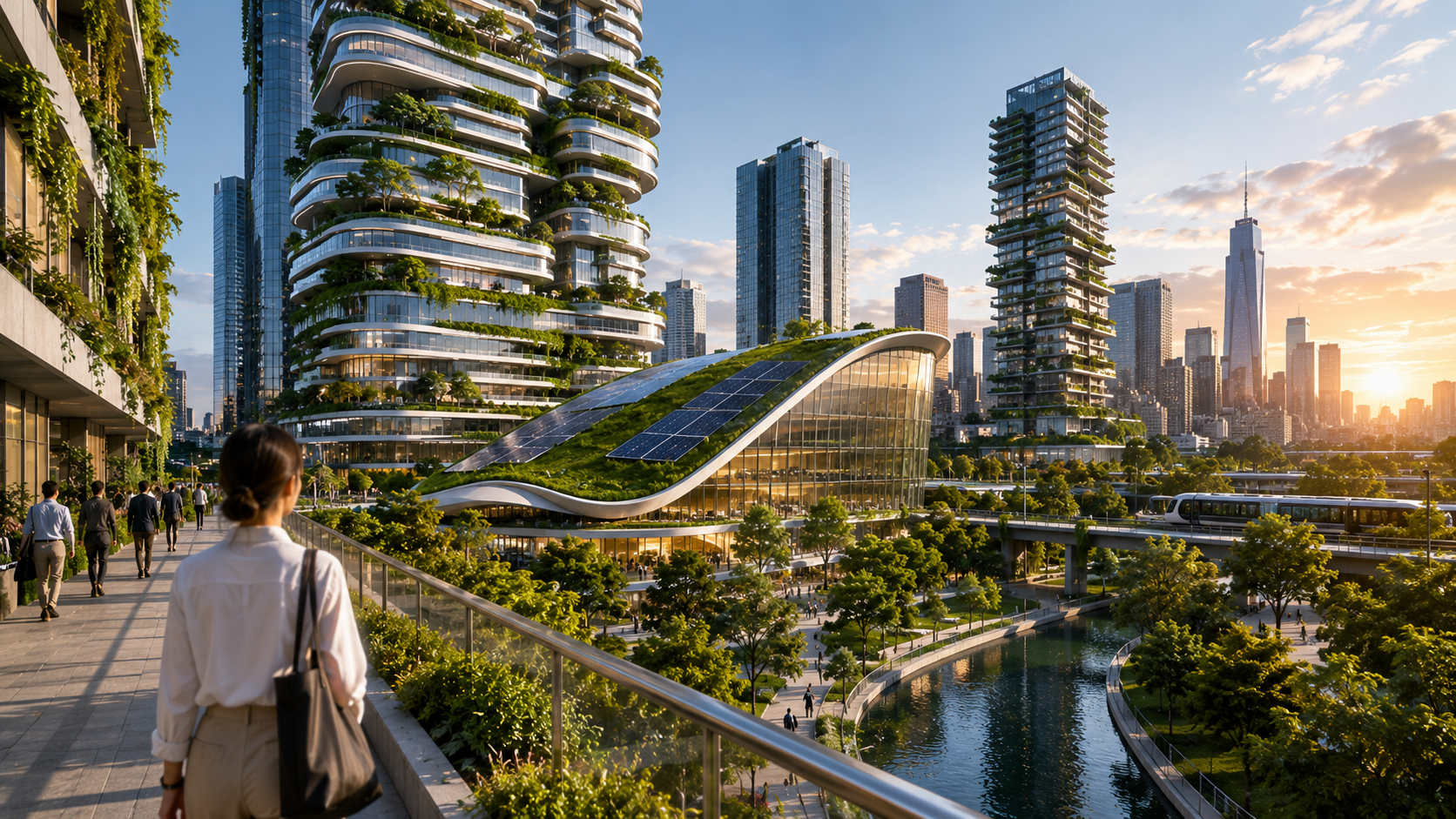
Cities are constantly changing. Population growth, climate pressures, new technology, and shifting lifestyles all influence how urban spaces develop. As a result, smart architecture is becoming an important approach to designing buildings that respond more effectively to people and their surroundings.
The idea goes beyond filling buildings with digital devices. A truly intelligent building starts with thoughtful design. It considers sunlight, ventilation, energy use, accessibility, materials, transportation, and the needs of occupants.
Technology can then improve how the building operates. Sensors may adjust lighting when rooms are empty. Building systems can monitor energy consumption. Meanwhile, digital controls can help facilities teams identify maintenance problems earlier.
However, technology alone cannot make a poorly designed building smart.
Good architecture still depends on human needs. People need comfortable temperatures, natural light, safe spaces, convenient movement, and places that support work, rest, learning, and social interaction.
When thoughtful design and useful technology work together, cities can become more efficient, adaptable, and enjoyable places to live.
What Makes Architecture Smart?
The word “smart” appears everywhere in modern technology. Phones, appliances, vehicles, and even household lighting can now connect to digital systems.
Buildings are no different.
However, smart architecture involves more than internet-connected equipment. It combines architectural planning with systems that can measure conditions, respond to changing needs, and use resources more efficiently.
For example, a building may use sensors to detect whether a room is occupied. The lighting and cooling systems can then adjust accordingly.
Windows, shading, and orientation can also reduce the need for artificial lighting or cooling before technology becomes involved.
Therefore, passive design and digital systems can complement each other.
Smart buildings may also provide information to facility managers. Energy dashboards can reveal unusual consumption, while maintenance systems can identify equipment that needs attention.
The strongest designs use technology to solve genuine problems rather than adding complicated features simply because they are available.
Buildings Can Respond to Their Occupants
Traditional buildings often operate according to fixed schedules. Lights turn on at a particular time, while heating or cooling systems follow predetermined settings.
Modern systems can become more responsive.
In smart architecture, occupancy sensors and environmental controls can help buildings adjust to actual use.
A meeting room may require cooling while twenty people are inside. Once everyone leaves, maintaining the same level of conditioning may waste energy.
Lighting provides another example. Sensors can reduce artificial lighting when enough daylight enters through windows.
However, automation should not remove human control entirely.
People have different comfort preferences. Therefore, occupants should have reasonable ways to adjust their environments when appropriate.
Technology works best when it quietly supports comfort rather than constantly demanding attention.
Responsive buildings can reduce waste while creating spaces that better match how people actually use them.
Energy Efficiency Begins With Design
Technology receives much of the attention in smart buildings, but basic architectural decisions can have enormous effects on energy use.
Building orientation influences sunlight. Window placement affects daylight and heat gain. Insulation helps regulate indoor temperatures.
These principles remain fundamental to smart architecture.
A building designed appropriately for its local climate may require less mechanical heating or cooling.
External shading can reduce intense sunlight in hot climates. Meanwhile, carefully placed windows can improve daylight without creating excessive glare.
Natural ventilation may also help under suitable environmental conditions.
Digital systems can then improve performance further. Smart thermostats, efficient equipment, and monitoring tools can help building operators understand how energy is being used.
The best approach begins with reducing unnecessary demand.
Otherwise, technology may simply make an inefficient building slightly less inefficient.
Good design and efficient systems should work together from the beginning.
Sensors Can Help Buildings Understand Conditions
Modern buildings can contain sensors that measure temperature, humidity, occupancy, light levels, air quality, and equipment performance.
This information can support more responsive operations.
Sensors have therefore become a common feature of smart architecture.
For example, a building management system can identify spaces that remain empty for long periods. Facility managers may then adjust cleaning schedules or energy use.
Air-quality sensors can provide information about indoor conditions. However, sensors need proper placement, maintenance, and calibration to remain useful.
Collecting information without acting on it creates little value.
Organizations should decide what they actually need to measure before installing large numbers of devices.
Privacy also deserves attention. Occupancy monitoring should not automatically become intrusive employee surveillance.
Smart buildings need clear policies explaining what data is collected, why it is necessary, and how it is protected.
Smart Lighting Can Reduce Unnecessary Energy Use
Lighting is essential for safe and comfortable buildings. However, lights often remain active in empty rooms or operate at full brightness when natural daylight is available.
Automated lighting can address this problem.
Within smart architecture, lighting systems may respond to occupancy and daylight levels.
Motion sensors can turn lights off after people leave. Daylight controls may dim fixtures near windows while maintaining appropriate lighting farther inside.
Users can also adjust lighting for different activities.
However, good lighting design should still come first. Poorly positioned fixtures cannot become excellent simply because they connect to an app.
Architects should consider glare, color quality, accessibility, safety, and the purpose of each space.
A successful smart lighting system becomes almost invisible. People receive the illumination they need while the building avoids wasting energy.
Indoor Air Quality Is Becoming a Design Priority
People spend substantial amounts of time inside buildings. Therefore, indoor environmental quality has a direct effect on comfort and everyday experience.
Ventilation plays an important role.
Modern smart architecture can use monitoring systems to help building operators understand conditions such as carbon dioxide levels, humidity, or particulate matter.
These measurements can support ventilation decisions when interpreted correctly.
However, a sensor alone cannot improve air quality. Buildings need appropriate ventilation systems, filtration where necessary, source control, and regular maintenance.
Materials also matter. Some products can release chemicals into indoor air, particularly when new.
Humidity needs careful management as well because excessive moisture can contribute to building problems.
Smart monitoring works best as part of a broader indoor environmental strategy.
The goal should be healthy, comfortable spaces rather than simply collecting impressive amounts of data.
Water Systems Can Become More Efficient
Urban buildings consume water through toilets, sinks, showers, kitchens, landscaping, cooling systems, and other operations.
Leaks can waste substantial amounts before anyone notices them.
Water management is therefore another area where smart architecture can contribute.
Sensors may detect unusual flow patterns that suggest a leak. Building managers can receive alerts and investigate before the problem becomes severe.
Efficient fixtures can reduce consumption without requiring occupants to change their routines significantly.
Rainwater collection or water reuse systems may also be appropriate in some buildings, depending on local regulations and climate.
Landscaping should reflect regional conditions. Plants suited to the local environment may require less irrigation than inappropriate species.
As with energy, the smartest approach begins by reducing unnecessary demand.
Technology then helps monitor performance and identify problems.
Adaptable Buildings Can Serve Cities Longer
Cities change over time. A building designed for one purpose today may need a different function decades later.
Demolishing and replacing structures can require large amounts of materials and energy.
Adaptability is therefore an important principle within smart architecture.
Flexible floor plans can make future changes easier. Modular systems may allow walls, services, or interior components to be reconfigured.
Adequate ceiling heights and sensible structural grids can also support future uses.
For example, an office building that can adapt to educational, residential, or mixed uses may remain valuable longer than a highly specialized structure.
Not every building can accommodate every function. Nevertheless, considering future change during design can extend useful life.
A smart city needs buildings that can evolve rather than becoming obsolete whenever lifestyles or economic conditions shift.
Smart Architecture Can Improve Accessibility
Buildings should work for people with different physical, sensory, and cognitive needs.
Accessibility should never be treated as an optional technological feature. It begins with fundamental architectural design.
However, smart architecture can provide additional tools that make spaces easier to navigate and use.
Digital wayfinding systems may provide accessible directions. Automatic doors can improve movement, while elevators can use interfaces designed for a wider range of users.
Visual information can be paired with audio or tactile alternatives.
Apps may also help visitors locate accessible entrances, restrooms, or routes.
Still, technology should not replace basic accessibility. A smartphone application cannot fix a staircase that provides no alternative route.
Inclusive design works best when accessibility is considered from the earliest planning stages.
Buildings become genuinely smarter when more people can use them independently and comfortably.
Public Spaces Matter as Much as Buildings
A city is not simply a collection of structures. Streets, sidewalks, parks, plazas, transit stops, and public spaces connect buildings with everyday life.
Therefore, smart architecture needs to consider what happens outside the building envelope.
A well-designed ground floor can make a street more active. Shade trees and covered walkways can improve pedestrian comfort.
Seating gives people opportunities to rest and socialize. Meanwhile, safe crossings make neighborhoods easier to navigate.
Technology can support public spaces through lighting, transportation information, or environmental monitoring.
However, cities should avoid replacing thoughtful urban design with screens and sensors.
A public square does not become successful because it offers Wi-Fi. People need reasons to use it.
Comfort, accessibility, safety, activity, and human scale remain essential.
Smart urban design should strengthen everyday public life rather than simply make infrastructure more technologically advanced.
Transportation and Buildings Need to Work Together
Buildings influence how people move through cities.
A development located far from public transportation may increase dependence on private vehicles. Meanwhile, dense mixed-use neighborhoods can make walking, cycling, and transit more practical.
Transportation planning is therefore closely connected to smart architecture.
Buildings near transit stations can provide convenient access for residents and workers. Secure bicycle parking and appropriate changing facilities may encourage cycling where safe infrastructure exists.
Electric vehicle charging can support changing transportation needs.
However, transportation systems must work at the city scale. One building cannot create an effective transit network by itself.
Architects, planners, transportation agencies, developers, and communities need coordinated strategies.
When buildings and mobility systems work together, people can reach homes, jobs, shops, and services more efficiently.
Mixed-Use Design Can Create More Convenient Neighborhoods
Traditional zoning often separates homes, offices, shops, and entertainment into different areas. This can increase travel distances.
Mixed-use development takes a different approach.
Within broader smart architecture, buildings and neighborhoods may combine residential, commercial, recreational, and community functions.
Someone might live within walking distance of a grocery store, café, workplace, park, or school.
This does not eliminate transportation needs, but it can reduce the number of long trips required for everyday activities.
Mixed-use areas can also remain active at different times of day. Offices bring activity during working hours, while homes and restaurants extend activity into evenings.
However, density needs good planning.
Noise, deliveries, waste management, traffic, affordability, and public services all require attention.
Successful mixed-use development creates convenience without sacrificing livability.
Green Roofs Can Add Useful Urban Space
City roofs represent a large amount of surface area that often serves only technical functions.
Green roofs introduce vegetation onto some of these spaces.
They can complement smart architecture when designed appropriately for the building and climate.
Vegetated roofs may help manage some stormwater, provide insulation benefits, and create habitat for insects or birds.
Accessible green roofs can also offer recreational space.
However, they require structural support, waterproofing, drainage, maintenance, and suitable plant selection.
A green roof is not automatically appropriate for every building.
Solar panels may provide greater value on certain roofs, while others can combine vegetation and renewable energy systems.
Architects should evaluate the specific site rather than applying green features as decoration.
Sustainable design works best when each element performs a clear function.
Building Materials Have Long-Term Impacts
Construction requires enormous quantities of concrete, steel, glass, timber, plastics, and other materials.
Their environmental impacts begin before a building opens.
Material selection has therefore become increasingly important within smart architecture.
Architects and engineers can consider durability, maintenance, manufacturing, transportation, reuse potential, and embodied carbon when selecting materials.
Locally available products may reduce transportation needs in some situations.
Reused or recycled materials can also provide benefits when they meet safety and performance requirements.
However, no material is universally sustainable. A product’s environmental performance depends on where it comes from, how it is manufactured, how long it lasts, and what happens at the end of its useful life.
Digital tools can help project teams compare options.
Ultimately, smarter material choices require looking at the building’s entire life cycle.
Digital Twins Can Support Building Management
A digital twin is a virtual representation connected to information about a physical asset or system.
In buildings, digital twins can help teams visualize performance and maintenance information.
This technology represents an advanced form of smart architecture when used for practical purposes.
Facility managers might use a digital model to locate equipment, examine maintenance records, or understand how systems interact.
Data from sensors can also help identify patterns over time.
However, creating and maintaining a useful digital twin requires resources. Information must remain accurate as the physical building changes.
A sophisticated model that becomes outdated quickly offers limited value.
Therefore, organizations should define clear goals before investing in complex digital systems.
Technology should simplify building management rather than create another platform that employees struggle to maintain.
Predictive Maintenance Can Reduce Disruptions
Building equipment eventually wears out. Elevators, pumps, cooling systems, lighting, and other components require regular attention.
Traditional maintenance may follow fixed schedules or respond after equipment fails.
In smart architecture, performance data can sometimes support predictive maintenance.
Sensors may reveal unusual vibration, temperature, or energy consumption. Facility teams can then investigate before a major failure occurs.
This approach can reduce unexpected disruptions and potentially extend equipment life.
However, predictive systems do not eliminate the need for skilled maintenance professionals.
Data still requires interpretation. False alarms can waste time, while poorly maintained sensors may miss real problems.
Building managers should combine digital monitoring with regular inspections and professional expertise.
The smartest maintenance strategy uses technology to support people rather than assuming software can replace practical knowledge.
Cybersecurity Matters in Connected Buildings
Connecting building systems to networks creates convenience, but it can also create security risks.
Access controls, cameras, elevators, environmental systems, and other equipment may contain networked technology.
As a result, cybersecurity has become an important concern for smart architecture.
Building owners should understand which systems connect to networks and who can access them.
Default passwords should be changed. Software should receive appropriate updates, while unnecessary network access should be restricted.
Different systems may also need separation so that a problem in one area does not expose everything else.
Physical security and cybersecurity increasingly overlap.
Architects do not need to become cybersecurity specialists. However, connected-building projects should involve qualified technology and security professionals from early stages.
A building cannot truly be smart if its essential systems are unnecessarily vulnerable.
Privacy Should Be Designed Into Smart Buildings
Sensors can reveal useful information about how spaces are used. However, data collection can become intrusive when organizations gather more information than necessary.
Privacy is therefore a major ethical issue in smart architecture.
Occupancy sensors may only need to know whether a room contains people. They may not need to identify every individual.
Systems should collect the minimum information required for their intended function.
Building owners should also explain what information is gathered and how long it is stored.
Security matters because sensitive data can create risks if exposed.
Public trust can disappear when smart technologies feel like surveillance.
Therefore, privacy should be considered during design rather than added after systems have already been installed.
Responsible buildings balance useful information with the rights and expectations of occupants.
Smart Architecture Can Support Climate Resilience
Cities face growing risks from extreme heat, flooding, storms, drought, and other climate-related hazards.
Buildings need to prepare for conditions that may differ from historical patterns.
Resilience has consequently become a major goal of smart architecture.
Designers can consider flood levels, shading, ventilation, backup power, drainage, water storage, and emergency access according to local risks.
Landscaping and urban trees may help reduce heat in appropriate locations.
Buildings can also include systems that monitor environmental conditions and alert operators to problems.
However, resilience cannot depend entirely on technology. Power and communication systems may fail during emergencies.
Passive strategies can therefore provide valuable backup.
A building that remains reasonably safe during a power outage may be more resilient than one that depends completely on active systems.
Smart Cities Still Need Human-Centered Design
Technology companies often present futuristic visions filled with autonomous vehicles, sensors, screens, and automated services.
Some of these technologies may improve urban life. However, cities exist primarily for people.
The future of smart architecture should therefore remain human-centered.
People need affordable homes, accessible transportation, safe streets, public spaces, schools, healthcare, workplaces, and opportunities for social connection.
A technologically advanced district that fails to meet basic human needs is not genuinely successful.
Designers should speak with residents rather than assuming technology automatically solves community problems.
Local culture matters too. A solution that works in one city may fail in another because climate, behavior, infrastructure, and economic conditions differ.
Smart cities should use technology selectively.
The most valuable innovation is often the one that quietly makes everyday life easier.
The Future of Urban Architecture
Future cities will likely combine digital systems with increasingly adaptable and resource-conscious buildings.
Artificial intelligence may help optimize operations. New materials could reduce certain environmental impacts. Meanwhile, improved modeling tools can help designers test ideas before construction begins.
Yet the fundamental principles of smart architecture will remain familiar.
Buildings must protect people from weather. They must provide safe movement, comfortable spaces, useful functions, and meaningful connections with their surroundings.
Technology should strengthen these basic responsibilities.
Architects will also need to design for uncertainty. Cities may experience changing work patterns, transportation systems, demographics, and climate conditions.
Flexible buildings can respond more effectively than rigid ones.
Ultimately, the future will not be defined by how many sensors a city installs. It will depend on whether buildings and public spaces help people live better while using resources responsibly.
Conclusion
Smart architecture is transforming modern cities by connecting traditional design principles with new technology, data, efficient systems, and adaptable spaces.
Sensors can reduce unnecessary energy use. Smart controls can improve lighting and comfort. Predictive maintenance may help building teams identify problems earlier, while digital tools can support long-term operations.
However, technology is only one part of the solution.
Building orientation, insulation, accessibility, materials, public spaces, transportation connections, and climate-responsive design remain fundamental. A poorly designed building does not become intelligent simply because it contains advanced electronics.
Cities must also consider privacy, cybersecurity, affordability, and inclusion as connected systems become more common.
The most successful urban environments will use technology where it provides clear benefits while preserving human choice and comfort.
Ultimately, smarter cities are not defined by futuristic appearances. They are defined by buildings and neighborhoods that work efficiently, adapt to change, respect resources, and make everyday life better for the people who use them.
FAQ
1. What is a smart building?
A smart building combines thoughtful architectural design with systems that can monitor conditions, automate selected functions, and improve operations or occupant comfort.
2. Can intelligent buildings reduce energy consumption?
They can help by adjusting lighting, cooling, heating, and other systems according to actual demand. However, good passive design and efficient equipment remain essential.
3. Are connected buildings vulnerable to cyberattacks?
They can be. Networked building systems require appropriate cybersecurity measures, access controls, software maintenance, and professional security planning.
4. How can modern architecture improve accessibility?
Inclusive layouts, step-free routes, appropriate elevators, accessible controls, clear wayfinding, and supportive digital tools can make buildings easier for more people to use.
5. Will technology replace architects in future cities?
Technology can assist with analysis, modeling, monitoring, and design workflows. However, architects still provide human judgment, creativity, contextual understanding, and responsibility for complex design decisions.