
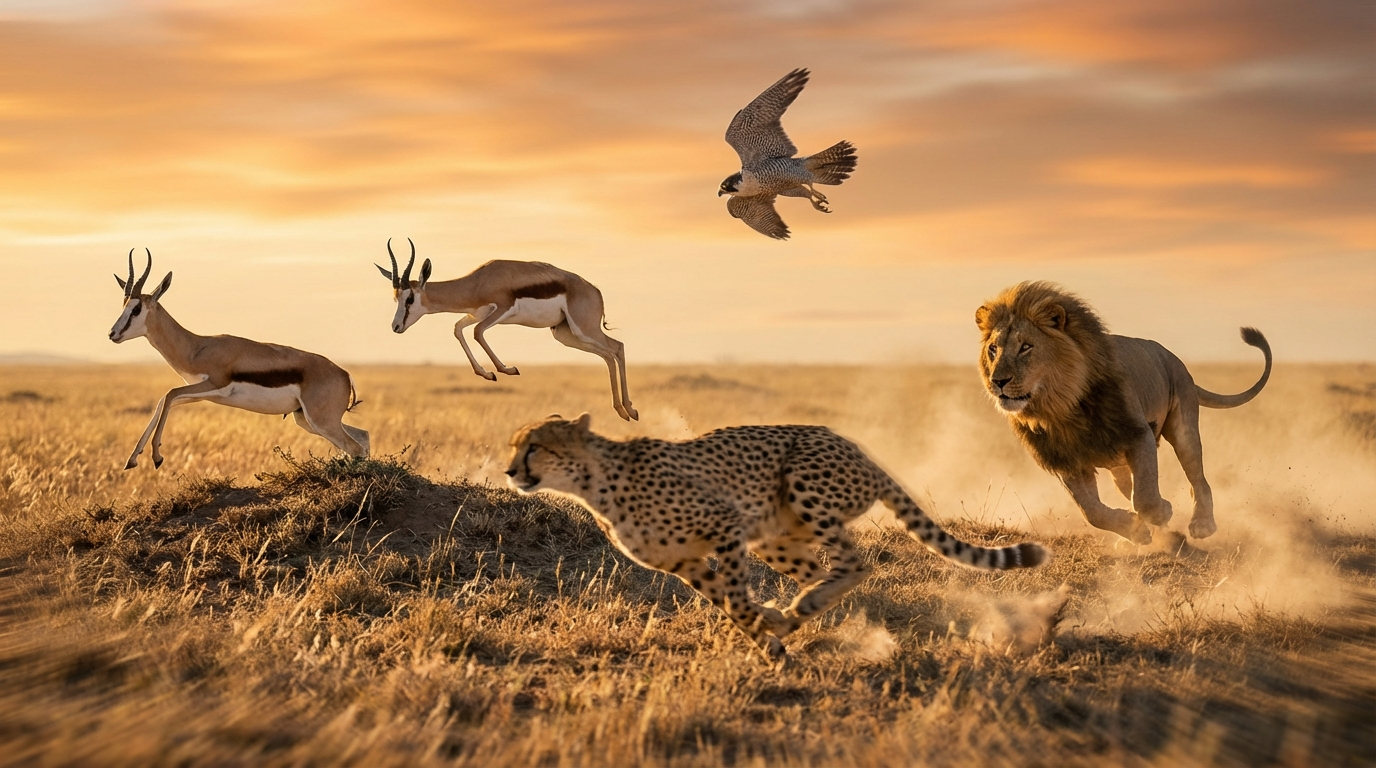
Speed fascinates us. From race cars to fighter jets, humans constantly chase velocity. However, the fastest animals in the wild reached breathtaking speeds long before engines existed. In nature, speed means survival.
Some animals sprint to catch prey. Others rely on rapid acceleration to escape predators. Therefore, evolution has shaped bodies into aerodynamic machines built for efficiency and power.
While many species move quickly, only a few break true speed records. In this guide, we rank the top five speed champions and explain how they dominate their environments.
How Speed Is Measured in Nature
Before exploring the fastest animals in the wild, we need to define speed clearly. Scientists measure maximum recorded velocity under natural conditions. However, acceleration, endurance, and maneuverability also matter.
For example, some animals reach extreme speeds in short bursts. Others maintain high velocity over longer distances. Consequently, rankings typically focus on peak speed rather than stamina.
Additionally, environmental factors influence movement. Wind resistance, terrain, and gravity all play critical roles. Birds dive with gravity’s help, while land animals fight friction and air drag.
Now, let’s count down the top five speed masters.
5. Springbok – The Speedy Leaper
The springbok ranks among the fastest land mammals. This agile antelope reaches speeds up to 55 miles per hour. However, its advantage goes beyond raw speed.
Springboks perform a behavior called “pronking.” During this movement, they leap high into the air repeatedly. As a result, predators struggle to predict their direction.
Unlike pure sprinters, springboks combine agility and stamina. They can sustain fast runs across open plains. Therefore, they often outrun large predators in African savannas.
Although they are not the absolute fastest animals in the wild, their speed and evasive skill make them incredibly difficult to catch.
4. Lion – The Explosive Predator
Lions symbolize power. Yet many people underestimate their speed. A lion can sprint up to 50 miles per hour in short bursts.
However, lions cannot maintain that pace for long. Instead, they rely on stealth. First, they stalk prey quietly. Then, they launch explosive attacks at close range.
Because of their muscular build, lions accelerate rapidly. This quick burst gives them the edge during hunts. Nevertheless, if prey escapes the initial sprint, the chase usually ends quickly.
Even though lions are not endurance runners, their raw acceleration secures their place among the fastest animals in the wild.
3. Pronghorn Antelope – The Endurance Speedster
The pronghorn antelope often surprises people. While it does not reach the top burst speeds of some predators, it sustains 55 miles per hour longer than almost any land animal.
In fact, pronghorns can maintain high speeds for miles. Scientists believe this endurance evolved to outrun now-extinct predators.
Unlike sprinters that tire quickly, pronghorns possess oversized lungs and a powerful heart. Consequently, they deliver oxygen efficiently during high-speed runs.
Although they rank third among the fastest animals in the wild, their stamina makes them one of nature’s most impressive athletes.
2. Cheetah – The Land Speed Champion
When discussing the fastest animals in the wild, the cheetah instantly comes to mind. It reaches speeds of up to 70 miles per hour in short bursts.
Cheetahs accelerate from 0 to 60 miles per hour in about three seconds. That acceleration rivals many sports cars. However, they can sustain top speed for only 20 to 30 seconds.
Their lightweight frame, long legs, and flexible spine create a powerful stride. Additionally, semi-retractable claws provide traction during high-speed turns.
Despite their incredible speed, cheetahs face challenges. They tire quickly and often lose prey to stronger predators. Still, on land, no animal runs faster.
1. Peregrine Falcon – The True Speed King
While the cheetah dominates land, the peregrine falcon owns the sky. During hunting dives, known as stoops, peregrine falcons exceed 200 miles per hour.
Gravity assists this breathtaking dive. First, the falcon climbs high above its target. Then, it folds its wings and plunges downward like a missile.
Aerodynamic body structure minimizes air resistance. As a result, the falcon achieves unmatched speed in the animal kingdom.
Because of its diving velocity, the peregrine falcon stands at the top of the fastest animals in the wild. No other creature approaches its record.
Why Speed Evolves in Different Ways
Speed serves different purposes across species. For predators, velocity increases hunting success. For prey, rapid movement boosts survival rates.
However, not all speed looks the same. Some animals rely on explosive acceleration. Others depend on endurance. Meanwhile, birds combine gravity and aerodynamic efficiency.
Environmental context also matters. Open plains favor long-distance runners. Dense forests reward quick directional changes. Therefore, evolution shapes speed based on habitat demands.
Interestingly, body design reveals speed strategy. Long legs increase stride length. Flexible spines enhance propulsion. Streamlined bodies reduce drag.
Although we focus on the fastest animals in the wild, many other species evolved specialized speed for survival.
Land vs. Air vs. Water Speed
Land animals face friction from the ground and air resistance. Consequently, even the fastest runners rarely exceed 70 miles per hour.
Birds, however, use gravity and air currents to their advantage. Therefore, diving species achieve far higher speeds than terrestrial animals.
Water presents another dynamic entirely. Marine animals move through dense fluid, which increases resistance. Nevertheless, species like the sailfish can reach impressive speeds underwater.
Comparing environments highlights how remarkable the fastest animals in the wild truly are. Each habitat demands different adaptations.
How Humans Compare
Humans cannot compete naturally with these speed specialists. The fastest recorded human sprint reaches about 28 miles per hour. That speed falls far below top animal athletes.
However, humans compensate with intelligence and technology. We build vehicles that exceed animal capabilities by enormous margins.
Still, raw biological speed remains astonishing. Evolution fine-tuned muscles, bones, and tendons over millions of years. As a result, these creatures achieve feats that seem almost mechanical.
Studying the fastest animals in the wild inspires innovations in robotics and engineering. Nature often serves as the ultimate design blueprint.
Threats to Speed Specialists
Unfortunately, many high-speed animals face environmental threats. Habitat loss reduces open spaces needed for sprinting or diving.
Climate change also alters ecosystems. For instance, shifts in prey populations affect predator survival. Consequently, conservation efforts become critical.
Cheetahs, for example, experience declining populations due to habitat fragmentation. Similarly, some bird species struggle with pollution and human interference.
Protecting biodiversity ensures that the fastest animals in the wild continue thriving in their natural habitats.
Conclusion: Nature’s Need for Speed
The fastest animals in the wild demonstrate how evolution rewards efficiency and precision. From the soaring peregrine falcon to the explosive cheetah, speed defines survival.
Each species developed unique adaptations. Some excel at endurance. Others dominate in short bursts. Yet all showcase nature’s extraordinary engineering.
Although humans admire speed for sport, animals depend on it for life itself. Therefore, understanding these creatures deepens our appreciation of the natural world.
Ultimately, velocity in the wild represents more than numbers. It reflects balance, adaptation, and survival in action.
FAQ
- What is the fastest creature on the planet?
The peregrine falcon holds the record during its high-speed hunting dive. - Which land animal runs the quickest?
The cheetah reaches the highest sprint speed on land. - Why can’t cheetahs run long distances?
They overheat quickly and rely on short, explosive bursts of speed. - Are any marine species faster than land mammals?
Some fish, like sailfish, swim very quickly but generally do not exceed diving falcon speeds. - How do scientists measure animal speed?
Researchers use tracking technology, high-speed cameras, and field observations to calculate maximum velocity.