
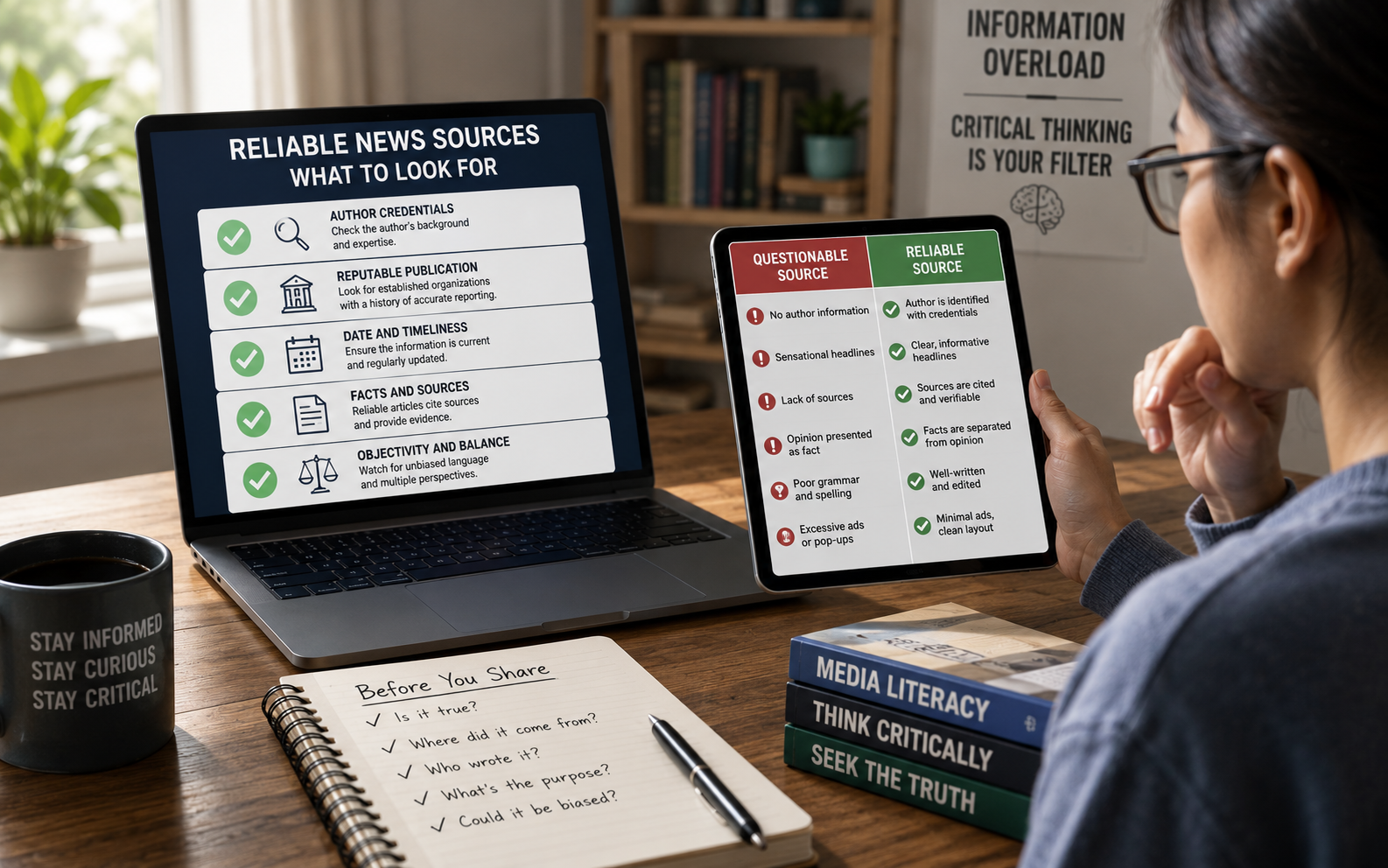
News now reaches people through websites, social media, search engines, videos, newsletters, podcasts, and messaging apps. With so much information available, identifying reliable news sources has become an essential skill. A professional-looking page does not automatically make a story accurate, while a viral post can spread widely before anyone verifies its claims.
The challenge becomes greater during breaking events. Early reports may contain incomplete information because journalists, officials, witnesses, and researchers are still learning what happened. Meanwhile, misleading posts can use old photographs, edited videos, or unsupported claims to attract attention.
Fortunately, readers do not need professional investigative training to evaluate everyday news. Simple habits can reveal important warning signs.
You can check who published a story, examine its evidence, compare independent reporting, and distinguish news from opinion. Furthermore, understanding how credible journalism works can make these checks faster.
The goal is not to distrust everything. Instead, it is to develop informed trust.
Start by Checking Who Published the Story
Before focusing on a dramatic headline, look at the organization behind it. Established news outlets usually provide information about their editorial operations, ownership, contact details, and standards.
However, reputation alone should not decide whether you trust a particular story.
Even reliable news sources can publish mistakes. Therefore, readers should consider both the publication and the evidence supporting an individual report.
Visit the site’s About page. Look for clear information about who operates it and how its journalism is produced. A legitimate organization should generally make its identity reasonably easy to determine.
Be cautious when a website closely copies the name, design, or web address of a recognized publication. Impersonation can make misleading content appear legitimate.
Also consider the publication’s purpose. Is it primarily reporting news, publishing satire, promoting products, advocating for an organization, or expressing political opinions?
Knowing who created the content provides useful context before you evaluate what it claims.
Look for a Real Author and Relevant Expertise
Credible articles commonly identify the journalist or journalists responsible for the reporting.
Click the author’s name when possible. A biography may explain their role, previous work, subject expertise, and contact information.
Strong reliable news sources usually provide enough transparency for readers to understand who produced important reporting.
However, an author’s credentials should match the topic. A journalist does not need to be a scientist to report on science, for example. Still, strong science reporting should rely on qualified researchers and appropriate evidence.
Anonymous reporting requires additional context. Credible organizations sometimes protect journalists or sources for legitimate safety reasons. Nevertheless, the publication should generally explain its editorial responsibility for the material.
Also watch for fabricated biographies. A profile photograph and impressive title do not prove that someone exists.
When an unfamiliar author makes extraordinary claims, searching for their professional background can provide useful additional information.
Read Beyond the Headline
Headlines have limited space. Therefore, they simplify complicated stories.
Social media makes this problem worse because users frequently share articles without reading them.
One of the easiest ways to evaluate reliable news sources is simply to open the article and examine whether the headline accurately represents the reporting.
A dramatic headline might imply certainty while the article describes an early investigation. Likewise, a headline can remove qualifications that significantly change the meaning.
Read the opening paragraphs, but continue far enough to understand the evidence and context.
Ask whether the article actually supports its main claim. Does it explain where the information came from? Are important limitations mentioned?
Good headlines attract attention while remaining connected to the facts.
If the headline makes a shocking claim that barely appears in the article itself, caution is appropriate.
Check the Publication Date and Context
Old information often returns to social media as though it happened recently.
A photograph from a previous disaster might appear during a new storm. Similarly, an old political quote can circulate without its original date.
Therefore, checking dates is essential when evaluating reliable news sources and individual posts.
Look at the publication date and any update timestamp. Then consider whether the article describes the same event currently being discussed.
Context matters just as much. A real video can become misleading when someone gives it a false description.
Search for earlier appearances of suspicious images or quotations when necessary. Reverse-image search tools can sometimes reveal that a photograph predates the event attached to it.
News articles themselves may also receive updates as more information becomes available.
Consequently, the newest version of a developing story may contain corrections or additional context that earlier screenshots lack.
Examine the Evidence Behind Major Claims
Strong journalism should give readers some way to understand where important information originated.
Evidence may include official documents, court records, interviews, public datasets, research papers, photographs, videos, or direct observations.
When evaluating reliable news sources, pay particular attention to evidence supporting the article’s central claim.
Does the report link to an original document when one is publicly available? Does it name relevant organizations or experts? Does it distinguish confirmed facts from allegations?
Anonymous sources require careful handling. Legitimate journalists sometimes rely on unnamed sources when revealing identities could create serious consequences. However, reputable publications generally have editorial standards governing such use.
Be suspicious when an article repeatedly uses vague phrases such as “experts say” without explaining who those experts are.
Extraordinary claims require especially strong evidence.
A story should not become believable simply because it contains many links. Readers should examine whether those links actually support what the article says.
Distinguish Primary and Secondary Sources
A primary source provides information directly connected to an event or subject. Examples include official records, original research, direct interviews, legal documents, and firsthand observations.
A secondary source interprets or reports information obtained elsewhere.
Both can be valuable.
However, reliable news sources should represent primary evidence accurately when they rely on it.
Suppose an article reports findings from a scientific study. If possible, examine the original research or information from the institution that conducted it. You do not need to understand every technical detail. Instead, check whether the headline matches the study’s actual conclusions.
For legal stories, court documents can provide valuable context. For government announcements, official releases can confirm what was formally stated.
Still, primary sources are not automatically neutral. Governments, companies, individuals, and organizations may present information in ways that support their interests.
Journalism adds value by examining those claims rather than simply repeating them.
Compare Independent Reporting
One of the strongest verification techniques is checking whether other credible organizations report the same core facts.
Major events usually attract coverage from multiple outlets.
When assessing reliable news sources, compare reporting from organizations that conduct their own journalism rather than websites that simply copy one another.
Look for agreement on basic facts such as names, locations, dates, official statements, and confirmed outcomes.
Differences do not automatically mean someone is lying. Reporters may have different sources, publish at different times, or emphasize different aspects of an event.
Breaking stories especially can change rapidly.
However, caution is appropriate when an extraordinary claim appears on only one obscure website and lacks supporting evidence elsewhere.
International stories can benefit from comparing local reporting with major international organizations.
Using several independent sources reduces the risk of relying on one publication’s mistake or incomplete information.
Understand the Difference Between News and Opinion
News organizations often publish several types of content under one brand. Straight reporting may appear beside editorials, columns, analysis, reviews, and sponsored material.
Readers should know which one they are viewing.
Professional reliable news sources generally label opinion and analysis clearly, although formatting differs between publications.
A news report primarily explains what happened and presents verified information. Analysis provides interpretation and context. An opinion column argues for a particular viewpoint.
Opinion journalism can still be valuable. Experts and commentators may provide useful perspectives. However, their arguments should not be confused with neutral reporting.
Look for labels such as Opinion, Editorial, Commentary, Analysis, or Review.
Also examine the language. Highly emotional wording and direct attempts to persuade may indicate commentary.
Understanding content type helps readers evaluate it according to the right standard instead of expecting every article to serve the same purpose.
Watch for Manipulative Emotional Language
News can naturally provoke strong emotions. Wars, disasters, crime, elections, and economic hardship involve real human consequences.
Nevertheless, some publishers deliberately amplify emotional reactions to increase clicks or shares.
When identifying reliable news sources, examine how the article uses language.
Does the story provide specific facts, or does it rely heavily on words designed to make you angry or afraid? Does it describe people accurately, or use insulting labels?
Be especially cautious when a headline tells you how you should feel before explaining what happened.
Emotional manipulation can reduce critical thinking. People are more likely to share information quickly when it confirms their beliefs or triggers outrage.
Therefore, strong emotional reactions can serve as a reminder to verify rather than immediately repost.
Credible journalism can be compelling without sacrificing precision.
Look for Corrections and Accountability
Journalists make mistakes because journalism is produced by humans, often under tight deadlines.
The important question is what happens afterward.
Many reliable news sources maintain formal correction policies. When significant errors occur, they update stories and explain what changed.
This transparency is a positive sign rather than proof that a publication cannot be trusted.
A website that never admits mistakes may simply be hiding them.
Look for correction notes near the beginning or end of an updated article. Some organizations also maintain dedicated corrections pages.
Minor spelling changes may not require detailed notices. However, factual errors that affect the meaning of a story should generally receive clear corrections.
Accountability also includes responding to legitimate complaints and distinguishing corrections from silent rewrites.
Trustworthy journalism does not require perfection. It requires a willingness to acknowledge and fix errors.
Be Careful With Screenshots
Screenshots are easy to create, edit, crop, and remove from their original context.
A screenshot of a headline may circulate even after the original article was corrected. Fake social posts can also imitate public figures or news organizations.
Therefore, screenshots should not replace reliable news sources or original evidence.
If someone shares a screenshot of an article, search for the publication directly. Confirm whether the headline exists and whether the story remains available.
For social posts, visit the person’s verified or official account when possible.
Cropping can also hide important information. A graph may look dramatic because someone removed its axis labels. Likewise, a quotation can appear shocking when surrounding sentences are missing.
Treat screenshots as leads rather than final proof.
The closer you can get to the original source, the easier it becomes to evaluate authenticity and context.
Verify Photos and Videos Before Believing Them
Visual evidence feels persuasive because people can see it. However, images and videos can mislead even when they have not been digitally altered.
Old footage may receive a new caption. A video from one country can be presented as an event in another.
Checking visual evidence is increasingly important when judging reliable news sources.
Start with context. Who originally posted the material? When and where was it recorded? Does the environment match the claimed location?
Reverse-image searches can help locate earlier versions of photographs.
Video verification can require additional work. Investigators may compare landmarks, weather, shadows, signs, or other details with known information.
Artificially generated and manipulated media add further challenges. However, do not assume every unusual image is AI-generated.
Verification should rely on evidence rather than visual intuition alone.
Understand How Breaking News Develops
Early information during major events is often incomplete.
Authorities may provide preliminary numbers that change later. Witnesses can misunderstand what they saw. Journalists may receive conflicting information.
Even reliable news sources can update details as a breaking story develops.
Therefore, readers should be cautious about treating the first report as the final account.
Look for language such as “according to preliminary information” or “officials have not yet confirmed.” These qualifications demonstrate appropriate uncertainty.
News organizations may also publish live updates. Check timestamps carefully because older entries can remain visible below newer information.
Waiting can be valuable. If a detail is not urgent for you personally, allowing journalists additional time to verify information can reduce confusion.
Accuracy often improves as more evidence becomes available.
The desire to know immediately should not outweigh the need to know correctly.
Recognize Satire and Parody
Satirical websites deliberately publish fictional or exaggerated stories for humor or commentary.
Problems occur when screenshots or excerpts travel beyond their original context.
Readers unfamiliar with the publication may mistake satire for genuine news.
Checking reliable news sources can quickly resolve this confusion.
Visit the original website and read its About or Disclaimer page. Satirical publishers often identify their purpose clearly.
Consider the story itself as well. Absurd details may signal humor, although reality can occasionally sound unusual too.
Do not assume a story is satire simply because you disagree with it. Verification remains necessary.
Similarly, parody social accounts can imitate politicians, celebrities, companies, and journalists.
Check usernames carefully. Small spelling differences can be easy to miss.
Satire has a legitimate role in culture, but it should not be used accidentally as evidence for real-world claims.
Be Skeptical of Viral Social Media Posts
Social media rewards content that attracts reactions. Accuracy does not always spread as quickly as surprise, anger, or humor.
A post can receive millions of views without undergoing any editorial review.
That is why reliable news sources remain important even when social platforms provide the first alert about an event.
When a viral post makes a significant claim, search for independent confirmation.
Check whether the account has direct knowledge of the event. A person reposting a video from another account may not know where it originated.
Follower counts and verification badges are not substitutes for evidence.
Community notes and fact-checking labels can provide useful context where available. However, readers should still examine the underlying evidence.
Social media works well for discovering what people are discussing. It is less reliable as the sole source for confirming complex events.
Evaluate Statistics Carefully
Numbers can make a story appear authoritative. Yet statistics can become misleading when writers remove context.
Suppose a headline says something increased by 100 percent. That sounds dramatic, but an increase from one case to two also represents 100 percent.
Good reliable news sources provide enough context for readers to interpret numbers properly.
Look for absolute values alongside percentages. Check the time period and population being measured.
Graphs deserve similar attention. Examine axis labels, scales, starting points, and data sources.
Surveys require additional questions. Who conducted the research? How many people participated? How were respondents selected?
A statistic can be technically accurate while creating a misleading impression.
Therefore, numbers should be treated as evidence that needs interpretation rather than automatic proof.
Check Whether Experts Actually Support the Claim
Articles often quote experts to provide context. However, expertise is specific.
A respected professional in one field may not be qualified to speak authoritatively about another.
When assessing reliable news sources, consider whether quoted specialists have relevant backgrounds.
A climate scientist and a medical researcher are both scientists, but their areas of expertise differ.
Look for affiliations and job titles. Then, consider whether the article represents the broader evidence fairly or relies heavily on one unusual opinion.
Scientific consensus does not mean every expert agrees on every detail. However, responsible reporting should not create false balance by presenting fringe views as equally supported.
Experts can also have conflicts of interest. Financial or organizational relationships may be relevant and should be disclosed when appropriate.
Credentials help, but evidence still matters.
Pay Attention to Links and Citations
Hyperlinks can improve transparency by allowing readers to examine supporting material.
However, a link only helps when it leads to relevant evidence.
Strong reliable news sources often connect readers with documents, previous reporting, research, official statements, or additional context.
Click important links when a claim seems surprising.
Sometimes a secondary article cites another article, which cites another website, eventually leading to no original evidence. This circular sourcing can make a weak claim appear well supported.
Also check whether linked research actually says what the article claims.
A credible-looking citation should not receive automatic trust simply because it appears in blue text.
Following the evidence chain can take a few minutes, but it is especially useful before sharing consequential claims.
Create a Simple Verification Routine
Evaluating every article in exhaustive detail would be impractical. Instead, develop a quick routine for stories that matter.
First, identify the publisher and author. Next, check the date and read beyond the headline.
Then, determine what evidence supports the central claim.
When the story is important or surprising, compare it with other reliable news sources.
Finally, pause before sharing. Ask whether you understand the claim well enough to pass it to someone else.
The amount of verification should match the importance of the information. A celebrity entertainment story usually requires less scrutiny than medical advice, emergency information, election reporting, or financial claims.
Over time, these checks become faster.
Media literacy is not about becoming suspicious of every journalist. Instead, it helps you decide how much confidence particular information deserves.
Conclusion
Finding reliable news sources is increasingly important in an information environment filled with breaking updates, social posts, edited images, opinion pieces, and AI-generated content.
Fortunately, evaluating news does not require distrusting everything you encounter.
Start with basic questions. Who published the story? Who wrote it? What evidence supports the main claim? Is the information current? Do independent organizations confirm the essential facts?
Next, examine how the story communicates uncertainty. Credible journalism distinguishes confirmed information from allegations and preliminary reports.
Readers should also recognize their own emotional reactions. Content that makes you immediately angry, frightened, or triumphant deserves careful verification before sharing.
No publication is perfect. Trustworthy journalism can still contain mistakes. The strongest organizations demonstrate credibility by showing their evidence, correcting errors, and remaining transparent about how reporting was produced.
In the end, informed readers and responsible journalism support each other. Taking a few extra moments to verify important information can prevent misinformation from traveling much farther.
FAQ
1. What makes a news organization trustworthy?
Look for transparent ownership, identifiable journalists, clear sourcing, professional editorial standards, corrections policies, and a consistent record of evidence-based reporting.
2. Should I trust a story if several websites report it?
Not automatically. Several websites may copy the same original claim. Look for independent reporting or different sources confirming the essential facts.
3. How can I check whether a viral photograph is real?
Find the original post when possible, check its date and context, and use reverse-image searching to locate earlier appearances. Credible fact-checking organizations may also have investigated it.
4. Are opinion articles considered fake news?
No. Opinion journalism is a legitimate format when clearly identified. However, readers should distinguish arguments and commentary from straight factual reporting.
5. What should I do before sharing breaking news?
Read the full report, check its publication time, look for supporting evidence, and seek independent confirmation. If important facts remain uncertain, waiting for additional reporting is often best.