
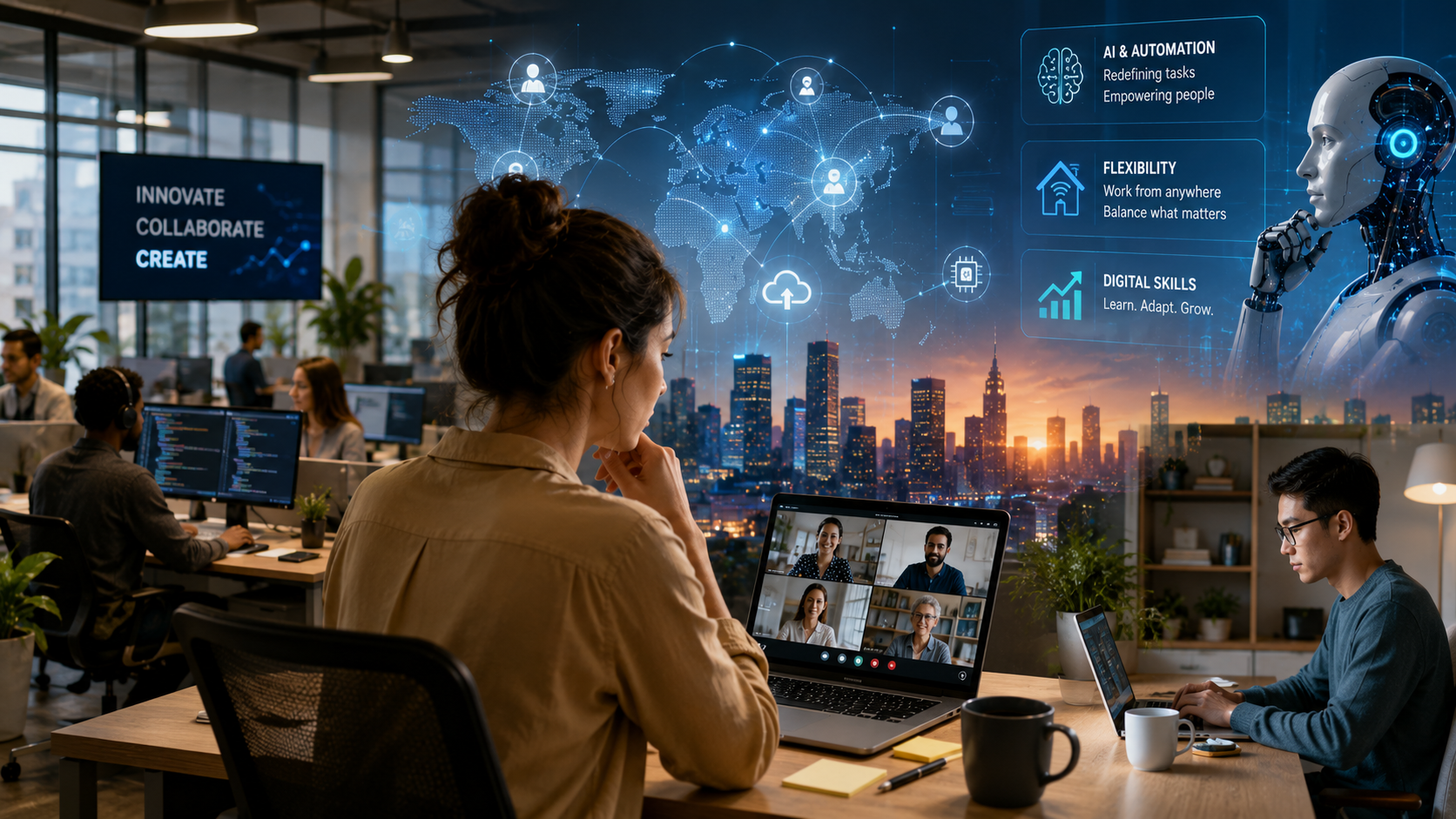
Technology has always influenced how people work. However, the pace of change has accelerated as artificial intelligence, cloud computing, automation, and digital collaboration become more common. The tech industry future of work now affects organizations far beyond traditional technology companies.
A retailer may use AI to forecast demand. A hospital can rely on digital systems to organize information. Meanwhile, a small business might operate with employees spread across several cities.
These developments create opportunities, but they also introduce challenges. Some tasks can become faster and easier. Other roles may change significantly as software handles repetitive work.
Therefore, workers need more than technical knowledge. Communication, judgment, adaptability, and problem-solving remain valuable because technology rarely operates without human decisions.
Companies face similar responsibilities. Buying new software does not automatically improve productivity. Teams need training, clear processes, security practices, and realistic goals.
Understanding how technology is reshaping work can help both employers and employees make better decisions about what comes next.
Artificial Intelligence Is Changing Everyday Tasks
Artificial intelligence has moved from specialized research environments into everyday workplace tools. Employees can now use AI systems to summarize documents, organize information, draft text, analyze data, and support customer service.
This development has become central to the tech industry future of work because AI can affect tasks across many occupations.
However, automation does not always eliminate an entire job. More often, technology changes particular activities within a role.
A marketer may use AI to organize research while still deciding which strategy makes sense. Likewise, a programmer can use coding assistance while remaining responsible for architecture, testing, and security.
Human review remains important because AI systems can produce inaccurate or misleading outputs.
Companies should therefore define where AI is appropriate and where additional oversight is required.
Workers who learn to combine technology with professional judgment may become more productive without surrendering responsibility for their work.
Automation Is Reshaping Repetitive Work
Automation existed long before today’s AI boom. Factories have used machines for decades, while offices have relied on software to automate calculations and administrative processes.
New technologies are expanding those possibilities.
Within the tech industry future of work, repetitive digital tasks are particularly suitable for automation. Software can transfer information between systems, generate routine reports, sort requests, or trigger standard workflows.
This can free employees to spend more time on work that requires judgment or creativity.
However, poorly designed automation can create new problems. An incorrect automated process may repeat the same mistake hundreds of times before someone notices.
Organizations should therefore monitor automated systems and maintain clear accountability.
Workers also need opportunities to develop new skills as their responsibilities change.
The most useful automation strategies do not simply ask, “What jobs can we remove?” Instead, they ask which repetitive tasks can be handled more efficiently while people focus on higher-value work.
Remote Work Has Expanded Employment Options
Digital collaboration tools allow many employees to work from locations outside traditional offices.
Video meetings, cloud storage, messaging platforms, and project management systems make distributed teamwork possible.
Remote work has consequently become an important part of the tech industry future of work.
For employees, remote arrangements can reduce commuting and provide access to jobs outside their immediate location. Employers may also recruit from wider talent pools.
However, remote work introduces challenges.
Communication can become fragmented when information is spread across email, chat, meetings, and project tools. New employees may also find it harder to learn informal workplace practices.
Managers need to focus on outcomes rather than simply observing who sits at a desk.
Not every job can be performed remotely, either. Manufacturing, healthcare, construction, hospitality, logistics, and many other industries still require substantial physical presence.
Therefore, remote work represents one model among several rather than a universal replacement for workplaces.
Hybrid Work Is Becoming More Structured
Many organizations combine remote work with regular office attendance.
Hybrid arrangements can offer flexibility while preserving opportunities for in-person collaboration. However, they require thoughtful design.
As the tech industry future of work develops, companies are learning that hybrid work involves more than choosing which days employees visit an office.
Teams need clear reasons for meeting physically. If workers commute only to spend the entire day on video calls, the benefits may be limited.
In-person time can instead support activities such as planning, training, creative workshops, relationship building, and complex discussions.
Digital documentation also becomes essential. Important decisions should not remain accessible only to people who happened to attend a particular conversation.
Companies should consider fairness as well. Remote employees should have comparable opportunities to contribute and receive recognition.
Successful hybrid workplaces intentionally connect physical and digital collaboration instead of treating one as secondary.
Digital Skills Are Becoming Basic Workplace Skills
Digital literacy once referred mainly to knowing how to operate a computer. Today, the concept is much broader.
Workers may need to manage cloud documents, online meetings, collaboration platforms, cybersecurity practices, data tools, and AI systems.
That shift makes digital literacy fundamental to the tech industry future of work.
However, employees do not need to become software engineers to remain valuable.
A salesperson may need strong customer relationship software skills. A designer might learn AI-assisted creative tools. Meanwhile, an accountant may need greater familiarity with automated financial systems.
The required skills depend on the occupation.
Employers can support workers through practical training rather than assuming everyone will learn new tools independently.
Training should also explain why a technology is being introduced. People adapt more effectively when they understand how a tool improves their work.
Digital confidence grows through repeated use, clear guidance, and opportunities to ask questions.
Human Skills Remain Extremely Important
As technology handles more routine tasks, distinctly human abilities can become even more valuable.
Communication, empathy, leadership, negotiation, creativity, judgment, and problem-solving remain difficult to reduce to simple automated processes.
This balance is important to the tech industry future of work because technology changes which combinations of skills employers need.
A manager may use data dashboards to understand performance. However, numbers cannot conduct a difficult conversation with an employee.
Similarly, AI can suggest ideas, but humans still decide which ideas suit the audience, brand, budget, and ethical standards.
Technical knowledge and interpersonal abilities should therefore develop together.
Workers who can explain complicated information clearly may become especially valuable. The same applies to people who can collaborate across technical and nontechnical teams.
The future workplace is unlikely to reward only people who know how to use software. It will also reward those who know when, why, and how technology should be used.
Cybersecurity Is Becoming Everyone’s Responsibility
As workplaces become more digital, they also create more opportunities for cyberattacks.
Phishing, stolen credentials, malicious software, insecure devices, and social engineering can disrupt organizations of every size.
Cybersecurity therefore plays a major role in the tech industry future of work.
Security teams remain essential, but employees throughout an organization also influence risk.
A worker who clicks a convincing phishing message can unintentionally expose company information. Weak passwords and reused credentials can create similar problems.
Regular training can help employees recognize common threats. Multi-factor authentication and appropriate access controls provide additional protection.
Remote work adds further considerations because employees may connect from home networks or use multiple devices.
However, security policies need to remain practical. If procedures become unnecessarily difficult, employees may search for shortcuts.
Strong cybersecurity combines technology, education, and sensible processes.
Cloud Computing Supports Distributed Organizations
Cloud services allow businesses to access software, storage, and computing resources through internet-connected systems.
This model has reduced the need for every organization to maintain all technology locally.
Cloud computing supports the tech industry future of work by making information and tools available across locations.
Employees can collaborate on shared documents without sending multiple versions through email. Businesses can also scale certain computing resources according to changing needs.
However, moving to cloud services does not eliminate responsibility.
Organizations still need to manage access, backups, security settings, vendor relationships, and regulatory requirements.
Service interruptions can also affect work when teams depend heavily on online systems.
Therefore, businesses should understand which services are critical and develop appropriate continuity plans.
Cloud technology is powerful because it increases flexibility. Yet that flexibility works best when organizations combine convenient access with careful governance.
Data Is Influencing More Workplace Decisions
Modern businesses generate large amounts of information.
Sales systems record customer activity. Websites measure user behavior. Operations platforms track workflows, while financial systems monitor costs and revenue.
Data analysis has therefore become central to the tech industry future of work.
Managers can use information to identify patterns and make more informed decisions. For example, a retailer may examine demand trends before ordering inventory.
However, more data does not automatically create better decisions.
Poor-quality information can produce misleading conclusions. Metrics can also encourage undesirable behavior when employees focus only on whatever the company measures.
Context remains essential.
Privacy deserves attention as well. Organizations should collect and use employee or customer information responsibly and follow applicable regulations.
The strongest data-driven workplaces combine quantitative evidence with professional judgment.
Numbers can reveal what is happening, but people often need additional context to understand why it is happening.
The Gig Economy Is Expanding Flexible Work
Digital platforms have made it easier for businesses to hire freelancers and independent professionals for specific projects.
Writers, designers, developers, consultants, tutors, and many other professionals can work with clients across geographic boundaries.
This flexibility contributes to the tech industry future of work.
For workers, independent work can offer greater control over schedules and clients. However, income may be less predictable, and benefits available to traditional employees may not be included.
Businesses can access specialized expertise without creating permanent positions for every temporary need.
Still, organizations need to classify workers correctly according to applicable laws.
Freelancers also need clear contracts, payment terms, deadlines, and project expectations.
Digital platforms can make connections easier, but they do not remove the need for professional working relationships.
Flexible work will likely remain important, although its benefits and risks differ substantially between occupations and individuals.
Technology Is Changing Recruitment
Hiring processes increasingly rely on digital tools.
Employers use online applications, video interviews, applicant tracking systems, assessments, and professional networking platforms.
AI-assisted tools are also entering recruitment.
These changes make hiring technology another part of the tech industry future of work.
Automation can help organize large numbers of applications. However, hiring decisions can have major consequences for people’s lives.
Therefore, companies should carefully evaluate automated systems for accuracy, fairness, transparency, and relevance.
A tool trained on biased historical information may reproduce existing patterns rather than improve them.
Human judgment remains essential, particularly when assessing complex experience and potential.
Candidates also benefit from transparent processes. They should understand what information is required and what stages the recruitment process involves.
Technology can improve efficiency, but hiring should still treat applicants as people rather than entries in a database.
Continuous Learning Is Becoming Normal
Traditional career paths often assumed that workers would learn a profession early and use largely similar skills for decades.
Rapid technological change makes that model less realistic for many occupations.
Continuous learning has therefore become a defining feature of the tech industry future of work.
Workers may need to update existing skills or learn entirely new tools throughout their careers.
Fortunately, learning does not always require another full university degree.
Short courses, certifications, workplace training, workshops, mentorship, documentation, and hands-on projects can all support development.
Employers benefit when they provide structured learning opportunities. Training can be more effective than constantly replacing employees whenever technology changes.
Workers should also focus on transferable abilities. Critical thinking, communication, research, and problem-solving remain useful across many tools.
Specific software may change quickly. The ability to learn new systems can last much longer.
Technology Can Improve Accessibility
Digital tools can make workplaces more accessible for some employees.
Speech-to-text software, screen readers, captions, flexible work arrangements, and customizable interfaces can remove barriers.
Accessibility should therefore be included in discussions about the tech industry future of work.
However, technology can also create barriers when designers ignore accessibility.
A workplace platform that cannot function properly with assistive technology may exclude employees. Poorly designed video meetings can create similar difficulties when captions are unavailable.
Organizations should consider accessibility when selecting and developing tools rather than adding it afterward.
Employees with disabilities should also be included in these conversations because they understand practical barriers directly.
Accessible technology often benefits more people than initially expected. Captions, for example, can help users in noisy environments as well as those with hearing impairments.
Inclusive design creates workplaces where more people can participate effectively.
Smaller Businesses Can Access Powerful Technology
Advanced business technology was once available mainly to large organizations with substantial IT budgets.
Cloud software and subscription services have changed that situation.
Small businesses can now use sophisticated tools for accounting, marketing, customer management, design, communication, and analytics.
This accessibility expands the tech industry future of work beyond major corporations.
A small online store can automate order notifications. A local service company may use scheduling software, while a small creative agency can collaborate remotely.
However, too many tools can create complexity.
Businesses should avoid purchasing software simply because competitors use it. Every tool should solve a clear problem or improve a defined process.
Integration also matters. Employees lose time when they repeatedly copy the same information between disconnected systems.
The best technology stack is not necessarily the largest. Instead, it should be understandable, secure, affordable, and appropriate for the organization.
Managers Need New Leadership Skills
Managing technology-enabled teams requires different habits from supervising work based primarily on physical presence.
Leaders need to communicate expectations clearly and document important decisions.
Management practices will therefore influence the tech industry future of work just as much as software will.
Remote and hybrid teams benefit from clear goals. Employees should understand what successful work looks like without needing constant monitoring.
Trust matters too.
Excessive surveillance can damage morale and encourage people to focus on appearing busy rather than producing useful results.
Managers also need to recognize signs of overload. Digital communication can make work feel continuous because messages arrive outside normal working hours.
Healthy teams establish reasonable boundaries.
Technology can help managers coordinate work, but leadership still depends on communication, fairness, judgment, and the ability to support people.
New Careers Will Continue to Emerge
Technological change can reduce demand for some tasks while creating demand for others.
Entire occupations have emerged around software development, cybersecurity, cloud infrastructure, digital marketing, data analysis, and online content.
New roles will continue appearing as the tech industry future of work evolves.
AI may create demand for professionals who evaluate systems, integrate tools, manage data, develop policies, or oversee specialized applications.
Meanwhile, traditional roles can develop technical components.
Healthcare professionals may use advanced digital systems. Teachers can incorporate educational technology, while manufacturing workers increasingly interact with automated equipment.
Predicting exact job titles years in advance is difficult.
Therefore, workers may benefit from building adaptable skill combinations rather than preparing for one narrowly defined future role.
Learning how technology affects your existing profession can be more useful than chasing every new trend.
Workplace Ethics Will Become More Important
Technology can increase efficiency, but not every possible use is appropriate.
Organizations need to consider privacy, fairness, transparency, accountability, and employee rights when introducing new systems.
Ethics is therefore essential to the tech industry future of work.
For example, AI systems may help managers analyze information. However, using opaque algorithms to make major employment decisions can create fairness concerns.
Workplace monitoring presents similar questions. Some security and operational monitoring may be necessary, but excessive surveillance can damage trust.
Companies should explain how important technologies are being used and who remains responsible for decisions.
Employees also need ways to raise concerns without unnecessary risk.
Responsible technology adoption considers both what a system can do and what it should do.
Productivity Will Depend on Better Technology Choices
Adding more software does not guarantee that employees will accomplish more.
Constant notifications, duplicate tools, unnecessary meetings, and complicated workflows can reduce productivity.
This creates an important challenge for the tech industry future of work.
Organizations should evaluate whether technology genuinely saves time.
A new platform may automate one task while creating additional administrative work elsewhere. Therefore, teams need to measure real outcomes rather than relying on marketing promises.
Reducing unnecessary tools can sometimes improve performance more than adding new ones.
Employees should also receive enough training to use essential systems efficiently.
The goal of workplace technology should be to make valuable work easier.
When technology creates additional confusion, companies should reconsider how it fits into the overall workflow.
Preparing for the Future of Work
No one can predict exactly how workplaces will look ten or twenty years from now.
However, individuals and organizations can prepare for change.
Understanding the tech industry future of work begins with accepting that learning will remain necessary.
Workers can strengthen both technical and human skills. Learn relevant digital tools, but also develop communication, critical thinking, adaptability, and professional judgment.
Businesses should invest in people alongside technology.
Before automating a process, understand how that process currently works. Before introducing AI, establish clear standards for accuracy, privacy, security, and human oversight.
Organizations should also listen to employees. People performing the work often understand practical problems better than executives selecting new software.
The strongest workplaces will not simply adopt the newest technology first.
Instead, they will choose tools carefully and build systems where people and technology complement each other.
Conclusion
The tech industry future of work is not simply a story about robots replacing people. It is a broader transformation involving AI, automation, remote collaboration, cloud computing, cybersecurity, data, accessibility, and changing skill requirements.
Some repetitive tasks will become increasingly automated. At the same time, new responsibilities and occupations will emerge.
Workers can prepare by developing adaptable skills rather than depending entirely on one tool. Technical knowledge matters, but communication, creativity, judgment, and problem-solving remain equally important.
Employers have responsibilities as well. Technology should improve meaningful work rather than create unnecessary complexity or surveillance. Training, transparency, security, and ethical standards need to accompany new systems.
The future workplace will continue changing as technology evolves. However, people will remain responsible for deciding how those technologies are designed, implemented, and governed.
The most successful organizations will combine technological capability with human expertise. That balance can create workplaces that are more productive, flexible, accessible, and prepared for whatever comes next.
FAQ
1. Will artificial intelligence replace most jobs?
AI is more likely to automate or change specific tasks across many jobs than eliminate every role entirely. The impact will vary greatly by occupation and industry.
2. What skills will be valuable in future workplaces?
Digital literacy, communication, critical thinking, adaptability, problem-solving, cybersecurity awareness, collaboration, and the ability to learn new tools will remain useful.
3. Will remote work continue in the future?
Remote and hybrid work will likely remain important for jobs that can be performed digitally. However, many occupations still require employees to work in physical locations.
4. How can businesses prepare employees for automation?
Companies can provide training, redesign roles thoughtfully, explain how technology will be used, and help employees develop skills for responsibilities that require greater judgment.
5. How should workers prepare for technological change?
Stay informed about tools affecting your profession, develop transferable skills, continue learning, and practice using new technology without depending on it blindly.