
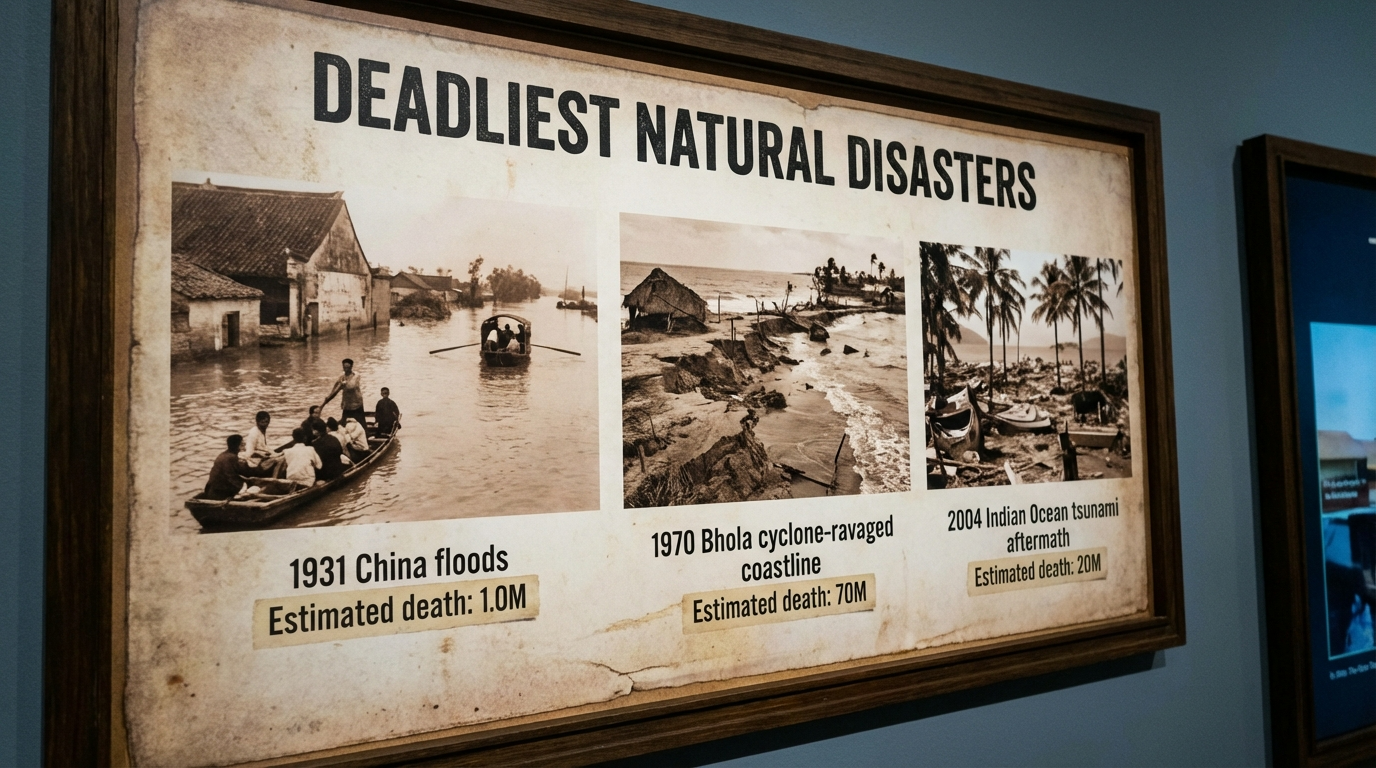
Throughout history, nature has demonstrated immense power. Earthquakes, floods, storms, and pandemics have altered civilizations in moments. The Deadliest Natural Disasters stand as tragic reminders of how vulnerable humanity can be. Because these events cause massive loss of life and infrastructure damage, they leave lasting scars on societies.
However, beyond destruction, such catastrophes often reshape cities, policies, and scientific understanding. As a result, lessons learned from these tragedies influence modern disaster preparedness. By examining the Deadliest Natural Disasters in human history, we gain perspective on both loss and resilience.
In this article, we explore five catastrophic events that caused unprecedented devastation. Each disaster not only claimed countless lives but also transformed global awareness of risk and recovery.
1. The 1931 China Floods
The 1931 China floods remain among the Deadliest Natural Disasters ever recorded.
Scale of the Catastrophe
Heavy rainfall combined with snowmelt caused the Yangtze, Yellow, and Huai rivers to overflow. Consequently, vast regions submerged for months. Estimates suggest that between one and four million people lost their lives.
Because floodwaters destroyed crops and homes, famine followed swiftly. Additionally, disease outbreaks worsened the humanitarian crisis.
Long-Term Impact
This disaster prompted China to invest heavily in flood control systems. Although technology was limited at the time, awareness of river management increased significantly.
The tragedy remains one of the most devastating examples of large-scale flooding in the Deadliest Natural Disasters record.
2. The 1887 Yellow River Flood
Another catastrophic event occurred in 1887 when the Yellow River burst its banks.
Cause and Consequences
Heavy rains overwhelmed outdated levees. As a result, floodwaters spread across thousands of square miles. Historical accounts estimate over 900,000 deaths.
Because the region was densely populated, destruction affected millions. Crops failed, and widespread displacement occurred.
Infrastructure Lessons
After the disaster, officials recognized the need for stronger flood defenses. Therefore, future engineering projects prioritized levee reinforcement.
This tragedy secured its place among the Deadliest Natural Disasters due to both scale and long-term consequences.
3. The 1556 Shaanxi Earthquake
The Shaanxi earthquake remains the deadliest earthquake in recorded history.
Seismic Devastation
Striking China’s Shaanxi province, the quake reportedly killed around 830,000 people. Because many residents lived in cave dwellings carved into soft rock, collapse proved catastrophic.
Additionally, aftershocks and landslides worsened destruction across surrounding regions.
Historical Significance
This event reshaped architectural practices. Communities began reconsidering building materials and structural design.
Among all Deadliest Natural Disasters, the Shaanxi earthquake stands out for its staggering mortality rate.
4. The 2004 Indian Ocean Tsunami
The Indian Ocean tsunami shocked the modern world.
Massive Underwater Earthquake
A 9.1 magnitude earthquake triggered powerful waves across coastal regions. Consequently, countries including Indonesia, Sri Lanka, and Thailand suffered immense loss.
Over 230,000 people died, and millions were displaced. Because early warning systems were limited, communities had little time to react.
Global Response
This disaster sparked international cooperation. Early warning systems and tsunami detection networks expanded rapidly afterward.
The 2004 event ranks prominently among the Deadliest Natural Disasters of the modern era.
5. The 1918 Influenza Pandemic
While often categorized as a health crisis, the 1918 influenza qualifies as one of the Deadliest Natural Disasters due to its global impact.
Rapid Global Spread
The virus infected roughly one-third of the world’s population. Estimates suggest 50 million deaths worldwide.
Because medical knowledge was limited, containment proved difficult. Additionally, World War I troop movements accelerated transmission.
Public Health Transformation
The pandemic influenced modern healthcare systems. Governments strengthened disease surveillance and research initiatives.
Its enormous toll ensures its place among the Deadliest Natural Disasters in recorded history.
Why Natural Disasters Cause High Fatalities
Several factors influence casualty numbers.
Population density increases risk significantly. Additionally, poor infrastructure amplifies destruction.
Limited communication systems also delay response efforts. Consequently, preparedness plays a vital role in reducing loss.
By analyzing patterns in the Deadliest Natural Disasters, experts improve forecasting and mitigation strategies.
The Role of Technology in Disaster Prevention
Modern tools reduce risk.
Early warning systems provide crucial time for evacuation. Satellite monitoring tracks storms and seismic activity.
Additionally, improved building codes enhance resilience. Because preparedness saves lives, technological advancement remains essential.
Lessons from the Deadliest Natural Disasters continue shaping safety protocols worldwide.
Climate Change and Future Risks
Climate change intensifies certain natural hazards.
Rising sea levels increase flood vulnerability. Moreover, stronger storms pose growing threats.
Therefore, proactive adaptation strategies become more important. Investment in infrastructure and environmental protection can reduce impact.
Understanding historical disasters helps inform future planning.
Human Resilience and Recovery
Despite devastation, communities rebuild.
International aid accelerates recovery. Additionally, local solidarity strengthens rebuilding efforts.
Because human resilience persists even after tragedy, societies often emerge stronger and more prepared.
Studying the Deadliest Natural Disasters highlights both vulnerability and strength.
Preparedness and Personal Responsibility
Governments play a role in disaster management. However, individuals also share responsibility.
Emergency kits, evacuation plans, and awareness reduce personal risk. Furthermore, community drills enhance coordination.
Preparation cannot eliminate disasters, but it can reduce casualties significantly.
Conclusion: Learning from History
The Deadliest Natural Disasters remind us that nature’s force exceeds human control. Floods, earthquakes, tsunamis, and pandemics have shaped civilizations across centuries.
Each tragedy carried immense human cost. However, they also inspired innovation, preparedness, and global cooperation.
By understanding these catastrophic events, we strengthen our ability to respond effectively. Moreover, we honor those lost by committing to improved safety measures.
While natural disasters will continue to occur, knowledge and preparedness reduce their impact. Ultimately, history teaches us that awareness and resilience remain our greatest defenses.
FAQ
1. What qualifies as a natural disaster?
A natural disaster is a catastrophic event caused by natural processes that results in significant loss of life or damage.
2. Why were historical disasters so deadly?
Limited technology, poor infrastructure, and slow communication increased fatalities.
3. How do early warning systems save lives?
They provide advance notice, allowing communities to evacuate and prepare.
4. Are natural disasters becoming more frequent?
Some events, such as severe storms, may increase due to climate change.
5. What can individuals do to stay prepared?
Create emergency plans, maintain supply kits, and stay informed about local risks.