
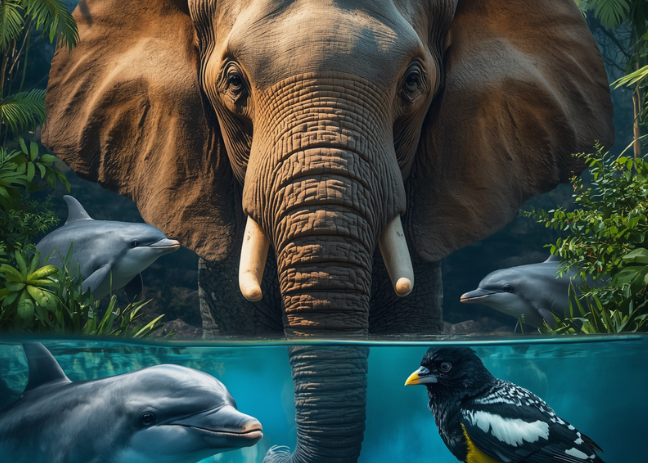
When people think about intelligence in nature, they often picture problem-solving, communication, or tool use. However, memory is one of the clearest signs of a sharp and adaptable mind. The animals with best memory skills do far more than remember where food is hidden. They recognize individuals, learn from danger, follow migration routes, understand social relationships, and adapt to changing environments. In many cases, memory is not just impressive. It helps animals survive, protect their families, and thrive in complex habitats.
Across the animal kingdom, memory appears in many different forms. Some species remember places with incredible detail, while others recognize voices, faces, or emotional events. For example, an elephant may remember a watering hole after many years. A dolphin may recognize another dolphin’s signature whistle long after separation. Meanwhile, a bird may store thousands of food locations and return to them months later. These abilities show that memory is not limited to humans. Instead, it is shaped by each animal’s needs, surroundings, and lifestyle.
The animals with best memory skills also remind us that intelligence is not one simple trait. A species can be brilliant at one type of recall and average at another. Therefore, ranking animal memory means looking at several factors. These include long-term recall, spatial memory, social recognition, learning speed, and the ability to use past experience in new situations.
Why Memory Matters in the Wild
Memory helps animals make better choices. A strong memory can guide an animal back to food, away from danger, or toward a trusted companion. In the wild, these small decisions often have major consequences. One remembered route may lead a herd to water. One remembered face may help a bird avoid a threat. One remembered sound may reconnect dolphins after years apart.
Because every species faces different challenges, memory does not look the same everywhere. Some animals need strong social recall. Others need detailed maps of their environment. A few need both. With that in mind, the following five species stand out as some of nature’s most remarkable memory experts.
Elephants and Their Extraordinary Long-Term Recall
Elephants are often the first animals people think of when memory comes up, and for good reason. Their reputation is more than a popular saying. These large mammals live in social groups, travel across wide landscapes, and depend on older herd members for survival knowledge. As a result, memory plays a huge role in their daily lives. Among the animals with best memory abilities, elephants are especially famous for long-term recall linked to family, migration, and survival.
How Elephants Remember People and Places
An elephant’s memory helps it recognize other elephants, even after long periods apart. This skill matters because elephant societies are highly social. Herds may separate and reunite, so individuals need to know relatives, allies, and possible threats. Older females, known as matriarchs, often guide the herd because they remember routes, water sources, and safe areas. During dry seasons, this knowledge can mean the difference between life and death.
Large landscapes also demand strong spatial recall. In dry regions, elephants may travel many miles to reach water sources they visited years before. Such memory requires a mental map of the land, awareness of seasonal changes, and the ability to connect past experience with present need. Since elephants live long lives, they can store and use information gathered across decades.
Why Elephant Memory Helps the Herd Survive
Another reason elephants rank high among animals with best memory skills is their emotional recall. They appear to remember loss, danger, and familiar individuals in ways that affect behavior. For instance, elephants may react strongly when they encounter the bones or remains of other elephants. Although we should avoid describing their feelings exactly like human emotions, their responses suggest a deep awareness of past social bonds.
Young elephants also learn by watching older herd members. Through repeated experience, they discover where to go, how to respond to threats, and how to behave within the group. Therefore, elephant memory is not only personal. It becomes practical group knowledge that can pass from one generation to the next.
Dolphins and Powerful Social Memory
Dolphins are another clear example of animals with best memory skills, especially when it comes to social recognition. These marine mammals live in fluid social networks, communicate through sounds, and build relationships that can last for many years. Their memory helps them recognize companions, coordinate behavior, and navigate a world where sound is often more useful than sight.
How Dolphins Recognize Each Other
One of the most fascinating parts of dolphin memory is their ability to remember signature whistles. A signature whistle works almost like an individual sound label. Dolphins use these unique whistles to identify themselves and others. Research has shown that dolphins can recognize the whistles of former companions after long separations. That suggests a strong form of long-term social memory.
This ability matters because dolphin groups are not always fixed. Individuals may travel, separate, and later rejoin others. As a result, remembering who is familiar helps dolphins manage relationships in a changing social world. It may also help them avoid conflict, cooperate during hunting, and maintain bonds with trusted companions.
Why Sound-Based Memory Matters in the Ocean
Dolphins also show strong learning ability. They can remember trained behaviors, understand signals, and adapt to new tasks. Yet their memory is not just about performance in training settings. In the wild, dolphins use experience to improve hunting methods. Some groups develop special techniques, such as using marine sponges to protect their snouts while searching for food on the seafloor. Learned behaviors like these can pass through generations, which shows how memory and culture can work together.
Among animals with best memory abilities, dolphins stand out because their recall is deeply connected to communication. Rather than simply remembering a place or object, a dolphin can remember sounds linked to specific individuals. Since dolphins live in a sound-based world, this skill fits their environment perfectly.
Corvids and Food-Hiding Genius
Birds may not always be the first animals people associate with strong memory. However, corvids prove that bird brains can be astonishingly powerful. This group includes crows, ravens, jays, and magpies. Many corvids are known for problem-solving, tool use, planning-like behavior, and excellent recall. When discussing animals with best memory skills, corvids deserve special attention because of their remarkable spatial memory.
How Corvids Remember Hidden Food
Some corvids hide food in many different places, a behavior called caching. Later, they return to these hidden stores when food is harder to find. At first, this may sound simple. In reality, a bird may hide hundreds or even thousands of food items across a wide area. To recover them, it must remember location, timing, and sometimes even the type of food stored.
Certain jays appear able to remember not only where they hid food, but also what they hid and when they hid it. That means their memory includes several layers of information. Instead of simply following a scent or random search pattern, they use detailed recall to make better choices.
How Crows Use Memory to Avoid Risk
Corvids also show social memory. They can recognize individual birds and may adjust their behavior if another bird watched them hide food. For example, a bird that has stolen food before may be more likely to re-hide its own food after being observed. Past experience changes the bird’s actions, which makes its memory practical and strategic.
Crows and ravens also recognize human faces. In some cases, they can remember people associated with danger and respond differently to them later. This kind of recognition shows that corvid memory is not limited to food. It can also help them avoid threats and learn from experience in cities, forests, and coastal habitats.
Among animals with best memory abilities, corvids are unique because their memory often looks highly practical. They use recall to store food, protect it, recover it, and avoid risk. Their brains may be small compared with those of many mammals, but their mental performance is extraordinary.
Great Apes and Memory Close to Home
Great apes, including chimpanzees, bonobos, orangutans, and gorillas, are among the animals most closely related to humans. Because of that connection, their memory abilities often feel familiar. They remember individuals, solve problems, use tools, learn from observation, and understand parts of their social world in impressive ways. Among animals with best memory skills, great apes stand out because their recall supports flexible thinking.
How Apes Use Memory for Learning
Chimpanzees can remember where food is located, recognize group members, and learn complex tasks. In some studies, young chimpanzees have shown remarkable short-term visual memory. They can remember number positions on a screen after seeing them for only a brief moment. This does not mean chimpanzees think exactly like humans, but it does show that their memory can be extremely fast and accurate in certain tasks.
Orangutans also show strong memory, especially in relation to food and movement through forest habitats. In the wild, they must remember where fruit trees are located and when those trees are likely to produce food. Since fruit availability changes with seasons, this memory helps them plan travel and conserve energy.
Why Social Recall Matters for Apes
Gorillas use memory in social groups as well. They recognize individuals, learn routines, and respond to social signals. Although gorillas may not show the same tool use patterns as chimpanzees in every setting, they still rely on memory for group life and environmental knowledge. Bonobos also use recall to support social relationships, communication, and learning.
Great apes rank among animals with best memory skills because their recall connects with problem-solving. They do not simply remember isolated facts. Instead, they often use memory to make decisions. A chimpanzee may remember how a tool worked before and apply that knowledge again. An orangutan may remember which branches can support its weight or where a certain food source appeared in the past.
Octopuses and Surprising Problem-Solving Recall
Octopuses are very different from the other animals on this list. They are not mammals or birds, and they do not live in long-term family groups like elephants or apes. Even so, they are famous for intelligence, curiosity, and problem-solving. When ranking animals with best memory abilities, octopuses deserve a place because their memory works in a completely different body and brain structure.
How Octopuses Learn From Experience
An octopus can learn from experience. It can remember how to solve puzzles, open containers, move through mazes, and distinguish between different shapes or objects. In laboratory settings, octopuses have shown the ability to learn tasks and improve through repeated attempts. This matters because it shows more than instinct. It shows flexible learning supported by memory.
Their nervous system is unusual. A large portion of an octopus’s neurons are located in its arms, not just in its central brain. Because of this, its body processes information in a very different way from mammals. Yet despite this unusual structure, octopuses can still remember, explore, and adapt.
Why Octopus Memory Is So Different
In the wild, memory helps octopuses find dens, avoid predators, and search for food. They often move through complex underwater environments filled with rocks, coral, shells, and hiding places. Remembering safe routes and useful shelters can improve survival. Since many octopuses are solitary, they rely heavily on individual learning rather than group teaching.
Octopuses also show strong recognition skills. Some can learn to distinguish between individual humans, especially in repeated care or research settings. They may respond differently to familiar and unfamiliar people. While this does not mean they form memories like social mammals, it does show that they can connect experience with recognition.
Their problem-solving recall is one reason they belong among animals with best memory skills. An octopus may learn that a jar can be opened, that a certain path leads to food, or that a particular object is useful. Later, it can apply that information in a new situation. This ability helps it handle challenges in creative ways.
What These Memory Experts Teach Us
The animals with best memory skills are not impressive for the same reason. Elephants shine through long-term social and spatial recall. Dolphins stand out for acoustic and social recognition. Corvids amaze with food caching and strategic memory. Great apes show flexible recall tied to learning and problem-solving. Octopuses reveal that memory can appear in a completely different nervous system.
Memory Solves Real Survival Problems
This variety matters because memory evolves to solve real-life problems. An animal remembers what helps it survive. For elephants, that may mean water routes and family members. For dolphins, it may mean whistles and social bonds. Birds may depend on hidden food and memories of watching rivals. Apes may rely on tools, relationships, and forest resources. Octopuses may need dens, puzzles, and danger signals.
Memory also shows how animals experience their world. A strong memory allows an animal to connect past, present, and future behavior. It can avoid old threats, return to useful places, and make better decisions. Therefore, memory is not just storage. It is an active survival tool.
Why Animal Memory Changes How We See Nature
Comparing animal memory is not always simple. Each species has a different body, environment, lifespan, and social structure. A dolphin’s memory cannot be measured in the exact same way as a crow’s memory. Likewise, an octopus does not need the same kind of recall as an elephant. Because of this, the fairest approach is to look at how well each animal uses memory for its own life.
The animals with best memory abilities also challenge how humans define intelligence. For many years, people ranked animals mostly by how closely they seemed to think like us. Today, it is clearer that intelligence comes in many forms. A bird hiding thousands of food stores, a dolphin recognizing a whistle after years, and an elephant guiding a herd across dry land all show different kinds of brilliance.
These animals also encourage deeper respect for wildlife. Once we understand that animals remember places, individuals, and experiences, we begin to see them as more complex beings. Their behavior is not random. It often reflects learning, history, and awareness. That perspective should influence how we protect habitats, manage human-wildlife conflict, and treat animals in care.
In the end, memory is one of nature’s quiet superpowers. It does not always look dramatic, yet it shapes survival every day. The animals with best memory skills prove that the natural world is filled with minds that learn, remember, and respond with surprising depth. From elephants on dry plains to octopuses in ocean dens, memory helps life adapt in beautiful and intelligent ways.
FAQ
- Which Animal Has the Strongest Long-Term Recall?
Elephants are often considered one of the strongest animals for long-term recall. They can remember family members, migration routes, water sources, and past dangers over many years. Their long lifespan also gives them more time to gather and use important survival knowledge.
- Do Dolphins Really Remember Each Other for Years?
Yes, dolphins can remember the signature whistles of other dolphins after long separations. This ability helps them recognize past companions and manage social relationships in changing ocean groups. Their sound-based memory is one of the most impressive examples in marine life.
- Why Do Crows and Ravens Have Such Good Memory?
Crows and ravens need strong recall to survive in complex environments. These birds remember food hiding places, recognize threats, and learn from past experiences. Some can also recognize individual human faces, which helps them avoid people linked to danger.
- Are Apes Better at Memory Than Monkeys?
Great apes often show more advanced memory in tasks linked to social learning, tools, and problem-solving. However, memory varies by species and situation. Many monkeys also have strong recall, especially for social relationships and food locations.
- How Can an Octopus Remember Without a Mammal-Like Brain?
An octopus has a very different nervous system, with many neurons in its arms. Even so, it can learn from experience, solve problems, and remember useful information. That shows strong memory can evolve in very different ways across animal life.