
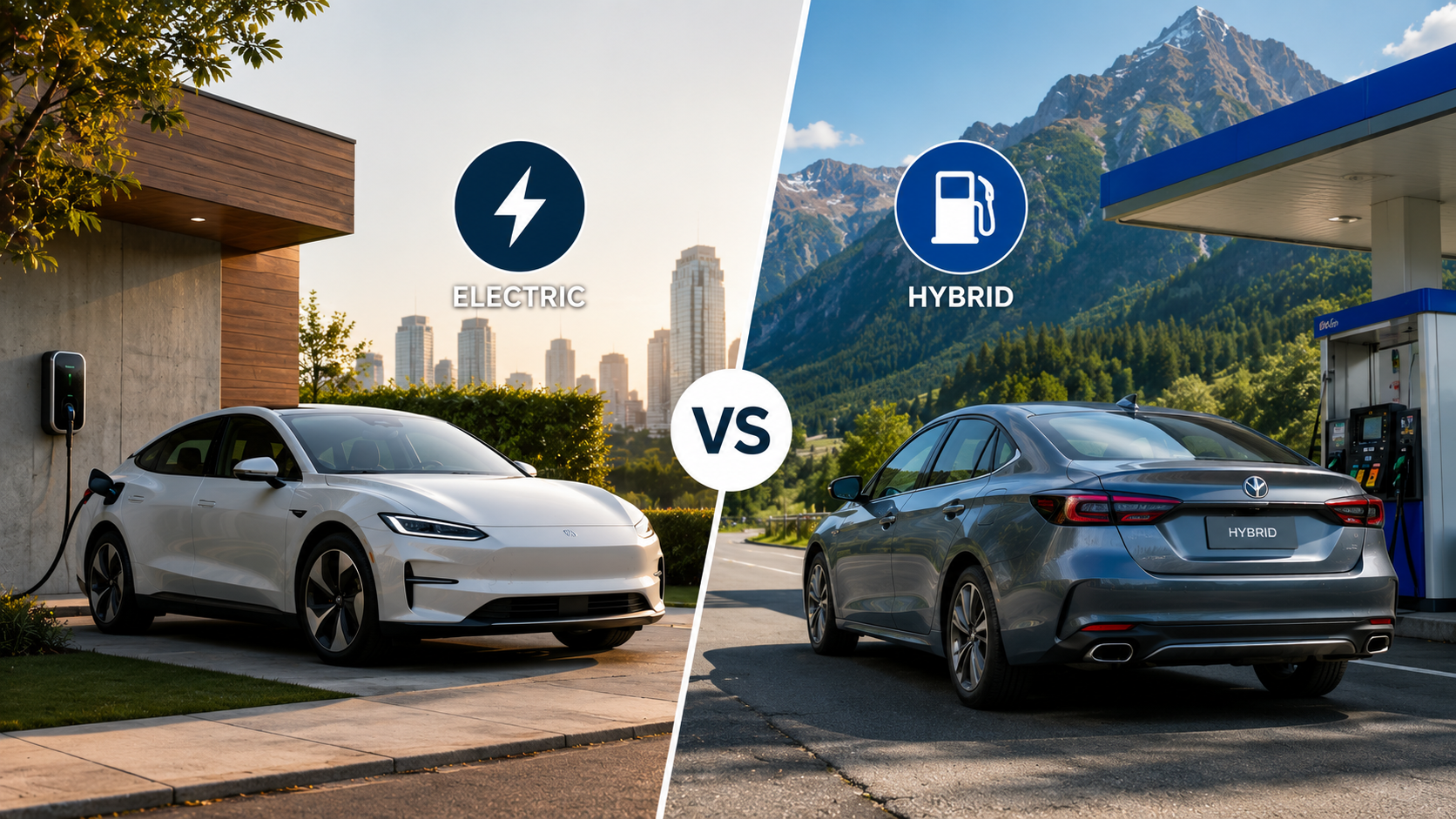
Choosing a new vehicle now involves more than comparing size, price, and fuel economy. For many buyers, electric vs hybrid cars have become a central part of the decision. Both can reduce gasoline use, yet they achieve that goal in very different ways. Therefore, the better choice depends heavily on how and where you drive.
A fully electric vehicle runs on electricity stored in a battery. It has no gasoline engine and must recharge from an external power source. A conventional hybrid combines an internal combustion engine with an electric motor and battery. However, it generally does not need to be plugged in.
Plug-in hybrids sit between those two categories. They have larger batteries that drivers can charge externally. Once their electric range runs out, their gasoline engines allow them to continue traveling.
Each option offers clear advantages. Still, everyday practicality matters more than choosing the technology that sounds most advanced.
Understanding the Basic Differences
Before comparing costs or convenience, drivers should understand how each system operates.
Fully electric vehicles use battery packs to power one or more electric motors. Because there is no conventional engine, they do not burn gasoline while driving. Instead, owners recharge them at home or at public charging locations.
When comparing electric vs hybrid cars, conventional hybrids work differently. They combine gasoline engines with smaller batteries and electric motors. The vehicle automatically switches between or combines these power sources according to driving conditions.
Regenerative braking helps hybrids recharge their batteries. Therefore, drivers usually treat a standard hybrid much like a traditional gasoline vehicle.
Plug-in hybrid electric vehicles add another option. Their batteries can support a certain amount of electric-only driving before the gasoline engine becomes necessary.
Consequently, buyers actually have three major electrified vehicle types to consider. Understanding these differences makes the rest of the comparison much easier.
Daily Driving and Commuting
Your normal driving routine should strongly influence your choice.
Electric vehicles can work particularly well for predictable daily commutes. If your regular mileage fits comfortably within the vehicle’s available range, you may rarely need public charging.
The electric vs hybrid cars comparison changes when drivers regularly make unpredictable or lengthy trips. Hybrids can refuel at ordinary gas stations, so they require less planning in areas with limited charging infrastructure.
Traffic conditions also matter. Electric motors operate efficiently during stop-and-go driving. Regenerative braking can recover some energy when the vehicle slows.
Hybrids also benefit from regenerative braking. Furthermore, their electric motors can reduce gasoline consumption during urban driving.
Drivers should examine a typical week rather than focusing on occasional unusual journeys. How far do you commute? Can you charge where you park? How often do you take long trips?
Answering those questions provides a better foundation for choosing a suitable vehicle.
Charging Access Can Determine the Best Choice
Charging is one of the biggest differences between electric and hybrid ownership.
An EV can be especially convenient when you have reliable home charging. Instead of visiting a fuel station, you can connect the car when you return home.
Therefore, discussions about electric vs hybrid cars should always consider where the vehicle will be parked overnight.
Drivers living in apartments or condominiums may face additional challenges. Some buildings offer charging stations, while others do not. Installing a private charger may also require permission or electrical upgrades.
Public charging networks can help. However, charger availability, speed, reliability, and pricing vary by location.
Standard hybrids avoid this issue because their batteries recharge while driving. Plug-in hybrids can also operate without regular external charging, although failing to charge them may reduce the benefits of having a larger battery.
Before buying an EV, drivers should investigate actual charging options around their homes, workplaces, and frequent travel routes.
Range and Long-Distance Travel
Driving range remains an important concern for many vehicle shoppers. Modern electric cars can cover substantial distances, but their practical range varies.
Speed, temperature, terrain, climate control, cargo, and driving style can all influence energy consumption.
When evaluating electric vs hybrid cars, hybrids generally provide easier long-distance flexibility. Once the fuel level becomes low, drivers can stop at a gasoline station and continue traveling shortly afterward.
Electric road trips require more planning. Drivers may need to identify compatible charging locations and allow additional time for charging.
However, charging networks continue to expand in many regions. Fast-charging technology has also improved, making long-distance EV travel more practical on supported routes.
Still, advertised range should not be treated as a guaranteed distance under every condition. Drivers should maintain a comfortable buffer.
For people who rarely take long trips, this difference may have little impact. Frequent road travelers, however, should examine charging coverage carefully.
Fuel and Electricity Costs
Running costs vary dramatically depending on location. Gasoline prices, electricity rates, charging fees, and vehicle efficiency all affect the final calculation.
For electric vs hybrid cars, there is no universal answer about which costs less to operate.
EV owners with affordable home electricity may spend relatively little on energy. On the other hand, frequent use of expensive public fast chargers can change the calculation.
Hybrid drivers still purchase gasoline. However, efficient models may travel much farther on a liter or gallon than comparable conventional vehicles.
Plug-in hybrids introduce another variable. Owners who charge regularly and make short trips may complete much of their daily driving on electricity. However, long journeys will still require gasoline.
Instead of relying on general claims, buyers should calculate expected annual costs. Start with yearly mileage. Then compare local fuel and electricity prices with realistic efficiency figures for the vehicles under consideration.
This approach produces a far more useful estimate.
Purchase Price and Available Incentives
Initial cost remains one of the biggest considerations for most buyers.
Battery technology can make some electric vehicles more expensive than comparable gasoline models. However, prices vary significantly by manufacturer, vehicle size, battery capacity, and market.
The purchase-price side of electric vs hybrid cars also changes as manufacturers introduce more models. Some hybrids carry modest premiums, while others belong to higher-priced vehicle categories.
Government incentives can affect affordability as well. Depending on the country or region, qualifying electrified vehicles may receive tax benefits, rebates, reduced registration fees, or other incentives.
However, programs frequently change. Eligibility may depend on vehicle price, manufacturing location, battery specifications, buyer income, or other requirements.
Therefore, shoppers should verify current local rules rather than assuming a vehicle qualifies.
The sticker price also tells only part of the story. Financing, insurance, energy, maintenance, depreciation, and potential incentives all contribute to the true cost of ownership.
Maintenance Requirements
Electric vehicles have fewer traditional engine components. They do not need engine oil changes, spark plugs, or many other services associated with internal combustion engines.
This simplicity can favor EVs in the electric vs hybrid cars maintenance comparison.
However, electric cars still require maintenance. Tires, brakes, suspension components, air-conditioning systems, cabin filters, and other parts need inspection or replacement.
EV tires may also experience different wear patterns because electric vehicles can be relatively heavy and deliver immediate torque. Driving style plays an important role as well.
Hybrids contain gasoline engines plus electrical systems. Therefore, they still require conventional engine maintenance. Nevertheless, regenerative braking can reduce wear on friction brakes in many driving situations.
Battery cooling and electronic systems also require appropriate servicing.
Drivers should check manufacturer maintenance schedules before purchasing. Furthermore, access to qualified service centers may matter in regions where electrified vehicles remain relatively uncommon.
Battery Life and Replacement Concerns
Battery longevity often worries first-time EV and hybrid buyers. However, automotive batteries are designed differently from small consumer electronics.
Modern vehicles use battery management systems that control temperature, charging, and energy use.
Battery considerations remain important when comparing electric vs hybrid cars, particularly for used vehicles. Battery age, mileage, climate exposure, charging habits, and vehicle design can influence long-term condition.
Battery capacity may gradually decline over time. Therefore, an older electric vehicle may offer less driving range than it did when new.
Manufacturers commonly provide specific warranties for high-voltage batteries. However, coverage terms vary considerably. Buyers should read the actual warranty rather than relying on assumptions.
Replacement costs can also vary by model. In some cases, repairs may involve individual modules rather than an entire battery pack.
For used electrified vehicles, obtaining information about battery health can be especially valuable. A professional inspection may provide additional confidence before purchase.
Environmental Impact Goes Beyond the Tailpipe
Electric vehicles produce no tailpipe emissions while driving. Hybrids still burn gasoline, although efficient models can consume less fuel than similar conventional cars.
However, a complete environmental comparison is more complicated.
The environmental side of electric vs hybrid cars includes vehicle manufacturing, battery production, electricity generation, fuel production, vehicle efficiency, mileage, and eventual recycling.
Producing large battery packs requires raw materials and energy. Therefore, electric vehicles can have substantial manufacturing impacts before reaching the road.
Once operating, the emissions associated with EV charging depend partly on how electricity is generated. Cleaner electricity generally improves their environmental advantage.
Hybrids use smaller batteries but continue consuming gasoline throughout their operating lives.
Consequently, environmental performance should be evaluated over the vehicle’s full life cycle. Local electricity sources and individual driving habits can significantly influence the comparison.
Driving Experience and Performance
Electric motors can deliver torque immediately. As a result, even ordinary electric vehicles may feel responsive when accelerating from a stop.
EVs are also generally quiet because they lack traditional engine noise.
In terms of driving feel, electric vs hybrid cars can offer noticeably different experiences. Hybrids may switch between electric and gasoline power automatically. Drivers can sometimes hear or feel the engine starting as more power becomes necessary.
Manufacturers tune these systems differently. Therefore, two hybrid models can feel very different even when their basic technology is similar.
Regenerative braking also changes the driving experience. Some electric vehicles allow strong regeneration when the driver releases the accelerator. This feature can reduce the need to use the brake pedal frequently.
Other vehicles provide more familiar settings.
A test drive remains important. Specifications cannot fully explain seating comfort, visibility, steering feel, braking behavior, road noise, or control layout.
The best technology still needs to feel comfortable during everyday use.
Cold and Hot Weather Considerations
Temperature affects all vehicles, but batteries can be particularly sensitive to extreme conditions.
Cold weather can reduce an electric vehicle’s usable range. Heating the cabin also requires energy from the battery.
Therefore, climate deserves attention in any electric vs hybrid cars decision. Drivers living in areas with severe winters should consider how much range they realistically need during cold periods.
Hot climates present different challenges. Battery thermal management systems help protect components, but high temperatures can still affect efficiency and long-term battery health.
Parking conditions may also matter. Covered parking can reduce exposure to extreme heat in some locations.
Hybrids experience many of the same environmental challenges as conventional cars while also managing a high-voltage battery.
Fortunately, manufacturers design vehicles for a range of operating conditions. Still, shoppers should research model-specific performance in climates similar to where they live.
Real-world owner experiences can provide useful additional context.
Home Charging Makes EV Ownership Different
Home charging changes the traditional relationship between drivers and fuel.
Instead of waiting until the battery is nearly empty, many EV owners simply recharge whenever the vehicle is parked overnight.
This difference can make electric vs hybrid cars surprisingly difficult to compare using old fueling habits.
A dedicated home charger can provide faster charging than a standard household outlet where supported. However, installation costs depend on electrical capacity, parking location, local regulations, and equipment.
Some homes may require electrical upgrades. Therefore, prospective EV buyers should investigate installation before finalizing a purchase.
Drivers with solar panels may also consider how home energy production interacts with vehicle charging.
Smart chargers can sometimes schedule charging during lower-cost electricity periods. This capability may reduce operating expenses where time-based electricity pricing is available.
For drivers without dependable home charging, however, an EV may require considerably more planning.
Which Option Works Better for City Drivers?
Urban driving often suits electrified vehicles well. Frequent braking allows regenerative systems to recover energy, while lower speeds can support efficient operation.
In dense cities, the electric vs hybrid cars choice often depends more on parking and charging than driving distance.
An EV can be convenient for drivers with a private parking space and charger. Daily distances may be short enough that charging becomes an occasional concern.
However, street parking can complicate ownership. Public charging availability varies widely between neighborhoods.
Hybrids offer an easier transition for drivers who cannot charge at home. They provide improved fuel efficiency without requiring changes to fueling routines.
Vehicle size should also matter. Large vehicles can be difficult to park regardless of their powertrain.
City drivers should therefore consider the entire ownership experience. Parking, congestion, charging, fuel prices, local regulations, and typical mileage all influence which vehicle makes more sense.
Which Option Works Better for Frequent Road Trips?
Drivers who regularly travel long distances have different priorities.
Hybrids can offer excellent flexibility because they use existing gasoline infrastructure. Stops are usually familiar and relatively quick.
That advantage remains important in the electric vs hybrid cars comparison for frequent road travelers.
Electric vehicles can still handle long journeys, especially where fast-charging networks cover major routes. However, trip planning becomes more important.
Charging speed matters as much as battery range. An EV with excellent fast-charging capability may complete a road trip more conveniently than a vehicle with slightly longer range but slower charging.
Weather and towing can also influence range. Therefore, drivers who tow trailers or carry heavy loads should research real-world performance carefully.
For someone who takes only one or two road trips each year, occasional charging stops may be acceptable. However, people who travel hundreds of kilometers regularly may value a hybrid’s flexibility more highly.
Plug-In Hybrids Offer a Middle Ground
Plug-in hybrids attempt to combine the benefits of both systems.
Their larger batteries provide electric-only driving for shorter journeys. Once the battery reaches its usable limit, the gasoline engine allows the trip to continue.
For some buyers comparing electric vs hybrid cars, a plug-in model can provide an appealing compromise.
A driver might commute primarily on electricity during the week and use gasoline for occasional long journeys. However, this strategy works best when the vehicle gets charged regularly.
If owners rarely plug in, they may carry the weight and cost of a larger battery without receiving its full benefits.
Plug-in hybrids also contain both electric and combustion systems. Therefore, their mechanical complexity can exceed that of a pure EV.
Buyers should compare electric range carefully. Some plug-in hybrids can cover substantially more electric-only distance than others.
The right choice depends on whether that range matches typical daily driving.
Resale Value and Long-Term Ownership
Predicting resale value is difficult because the vehicle market changes constantly.
Fuel prices, technology improvements, incentives, consumer preferences, and new model availability can all influence used-car demand.
Rapid technological development adds another factor to electric vs hybrid cars. New electric models may offer longer range or faster charging than older vehicles. Consequently, some buyers worry about technological obsolescence.
However, condition, reliability, mileage, brand reputation, and local demand remain important for every vehicle.
Battery health can become a particularly important selling point for used EVs. Clear diagnostic information may help buyers understand remaining capacity.
Hybrids have been available in many markets for longer periods. Therefore, consumers may feel more familiar with their used-car characteristics.
Drivers planning to keep a vehicle for many years may care less about short-term resale fluctuations. Instead, reliability and total operating cost may become more important.
How to Decide Which Vehicle Fits Your Life
There is no single winner for every driver.
The easiest way to choose is to examine your real transportation habits. Start by recording your normal daily and weekly mileage. Then, identify where the vehicle spends most nights.
Next, compare electric vs hybrid cars based on realistic local conditions. Check home charging possibilities, nearby public chargers, electricity rates, gasoline prices, insurance estimates, and available service centers.
Consider your longest regular trips as well. Occasional vacations should matter, but they should not automatically outweigh hundreds of routine commuting days.
Budget should include more than the purchase price. Estimate financing, energy, insurance, maintenance, and likely depreciation.
Finally, test-drive several vehicles. A technically efficient car is not useful if it does not fit your passengers, cargo, comfort needs, or driving preferences.
The best vehicle is the one that fits naturally into your actual lifestyle.
Conclusion
The debate over electric vs hybrid cars does not have one universal answer. Electric vehicles can offer quiet operation, convenient home charging, fewer traditional engine maintenance needs, and zero tailpipe emissions. However, reliable charging access is crucial.
Hybrids provide excellent flexibility. They can reduce gasoline consumption while allowing drivers to refuel almost anywhere conventional fuel is available. Consequently, they remain practical for people without home charging or those who frequently travel long distances.
Plug-in hybrids offer another path. They can handle many shorter journeys using electricity while retaining a gasoline engine for longer travel.
Before choosing, examine how you actually drive. Consider daily mileage, road trips, parking, local energy prices, charging infrastructure, purchase cost, and climate.
Technology matters, but convenience matters too. A vehicle should make everyday transportation easier rather than forcing you into a routine that does not fit your life.
FAQ
1. Is an electric vehicle cheaper to run than a hybrid?
It can be, especially when home electricity is affordable. However, energy prices, public charging costs, mileage, efficiency, insurance, and maintenance all affect total expenses.
2. Do hybrids need to be plugged in?
Conventional hybrids do not. Their batteries recharge through the engine and regenerative braking. Plug-in hybrids have larger batteries that can also receive power from an external charger.
3. Are electric vehicles practical without home charging?
They can be, but convenience depends heavily on reliable workplace or public charging. Drivers should examine local charger availability before purchasing.
4. Which type is better for frequent long-distance driving?
Hybrids can be more convenient where charging networks remain limited. However, modern EVs can handle long trips effectively when reliable fast chargers are available along the route.
5. How should I choose between an EV and a hybrid?
Compare your daily mileage, charging access, road-trip frequency, budget, local energy prices, climate, and preferred models. A test drive can also reveal important differences in comfort and driving feel.