
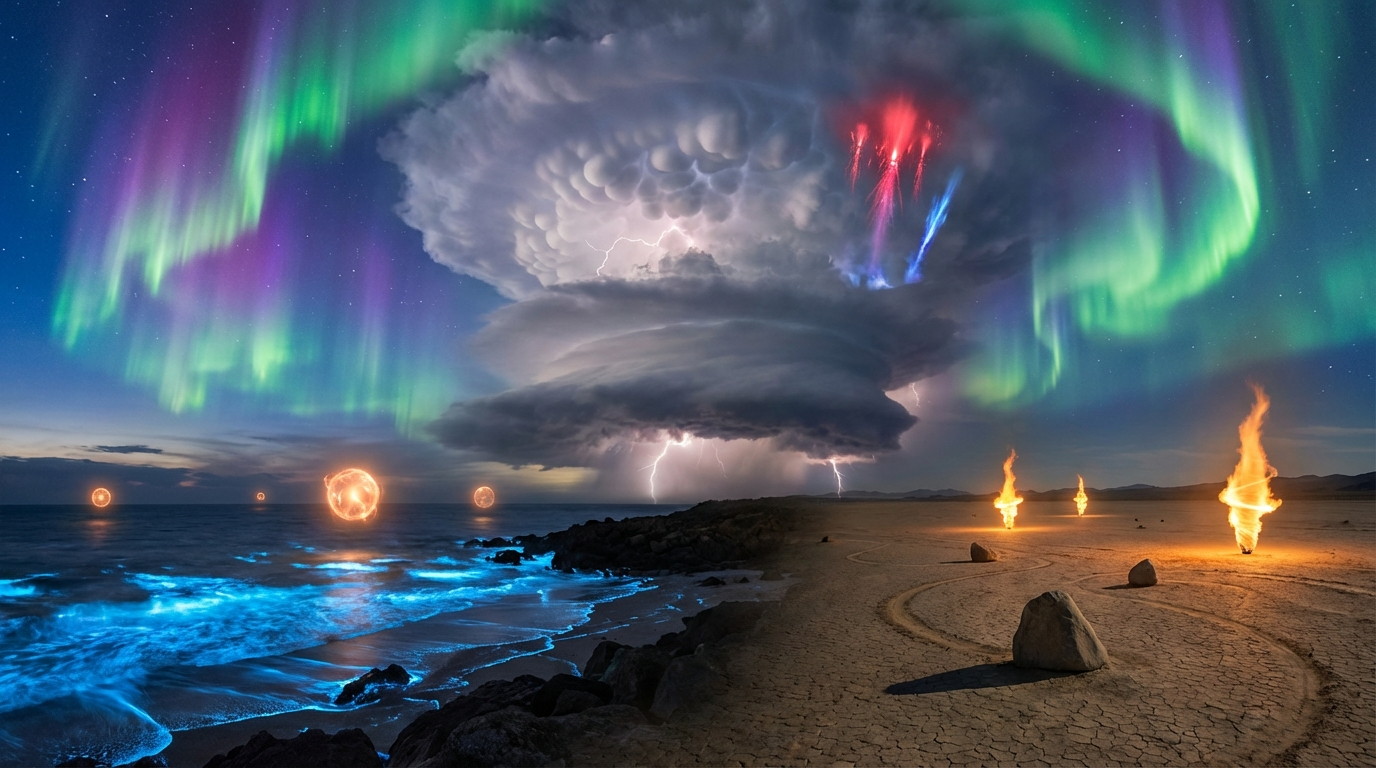
Nature never stops surprising us. Across the planet, mysterious natural phenomena continue to puzzle scientists and captivate curious minds. Although research has explained many environmental processes, some events remain partially understood.
From glowing lights in remote valleys to moving stones in dry deserts, these occurrences challenge logic. Because they defy simple explanations, they inspire both scientific investigation and cultural myths.
While technology improves every year, certain events still resist complete answers. Therefore, exploring mysterious natural phenomena helps us appreciate how much we have yet to learn about our world.
Let’s uncover five extraordinary events that continue to spark fascination and debate.
Why Some Natural Events Remain Unexplained
Science explains much of the natural world. However, not every observation fits neatly into established models. Mysterious natural phenomena often occur under rare or extreme conditions.
First, environmental complexity makes study difficult. Remote locations limit access for researchers. Additionally, unpredictable timing prevents consistent observation.
Second, limited historical data complicates analysis. Some events occur only once every few decades. Therefore, scientists rely on partial evidence.
Moreover, natural systems interact in intricate ways. Climate, geology, and atmospheric chemistry influence each other constantly.
Because of these variables, full explanations sometimes take years to develop. Even so, curiosity drives continued investigation.
Now, let’s examine five of the most fascinating cases.
1. The Northern Lights (Aurora Borealis)
The Northern Lights rank among the most visually stunning mysterious natural phenomena. These glowing waves of color appear in polar skies during geomagnetic activity.
Scientists understand that charged solar particles collide with Earth’s atmosphere. However, variations in intensity and color still surprise observers.
Green hues dominate most displays. Yet pink, purple, and red occasionally appear. Because solar storms vary unpredictably, auroras change rapidly.
Historically, cultures interpreted the lights as spiritual signs. Today, researchers monitor solar wind patterns to predict activity.
Although much of the process is understood, its dynamic beauty continues to inspire awe worldwide.
2. Sailing Stones of Death Valley
In California’s Death Valley, large rocks appear to move across dry lakebeds. For decades, this ranked among the most debated mysterious natural phenomena.
Long trails in cracked mud mark each stone’s path. However, no one witnessed movement directly for many years.
Eventually, researchers discovered a combination of thin ice sheets and strong winds enables slow sliding. Even so, the conditions remain rare and precise.
Because movements occur infrequently, earlier generations proposed supernatural explanations.
Today, time-lapse photography confirms natural causes. Nevertheless, the image of giant rocks gliding silently across desert floors still captivates visitors.
3. The Bermuda Triangle
Few mysterious natural phenomena attract as much attention as the Bermuda Triangle. Located in the Atlantic Ocean, this region became famous for ship and aircraft disappearances.
Although popular culture dramatized the mystery, scientific explanations point to weather patterns and human error.
Sudden storms, strong currents, and navigational challenges contribute to accidents. Additionally, methane gas releases may affect buoyancy in certain cases.
Because shipping traffic remains heavy, incidents occasionally occur. However, most experts agree the area is not uniquely dangerous.
Even so, the legend persists. Stories continue fueling imagination and speculation.
4. Ball Lightning
Ball lightning stands among the rarest mysterious natural phenomena reported worldwide. Witnesses describe glowing spheres appearing during thunderstorms.
These luminous balls reportedly float briefly before disappearing. However, capturing reliable footage proved difficult for years.
Some scientists suggest plasma formations explain the phenomenon. Others explore chemical reactions in the atmosphere.
Because sightings remain rare and unpredictable, data remains limited.
Although laboratory experiments recreate similar effects, full consensus has not yet emerged. Consequently, ball lightning continues intriguing researchers.
5. Bioluminescent Waves
In certain coastal regions, ocean waves glow blue at night. This breathtaking display results from microscopic organisms called dinoflagellates.
When disturbed by motion, they emit light. Therefore, crashing waves appear illuminated.
While scientists understand the chemical process, predicting intensity remains challenging. Environmental conditions influence bloom frequency and brightness.
Because these glowing waters appear unexpectedly, they rank among the most enchanting mysterious natural phenomena on Earth.
Tourists often travel long distances hoping to witness the spectacle firsthand.
The Role of Scientific Curiosity
Curiosity fuels discovery. Mysterious natural phenomena inspire scientists to develop better tools and methods.
For example, satellite monitoring now tracks solar activity more precisely. Similarly, high-speed cameras capture rare atmospheric events.
Advancements in technology often reveal hidden patterns. Therefore, what once seemed supernatural gradually becomes understandable.
However, unanswered questions remain valuable. They motivate further exploration.
Cultural Interpretations Through History
Before scientific frameworks developed, societies created myths to explain unusual events. Northern Lights symbolized spirits in some cultures.
Similarly, glowing ocean waters inspired legends of sea gods.
Because humans seek meaning, mysterious natural phenomena often gained spiritual significance.
Although modern science explains much, cultural stories remain important parts of heritage.
Why Mystery Still Matters
Complete understanding does not diminish wonder. Even when science explains mechanisms, emotional impact persists.
For instance, knowing auroras result from solar particles does not reduce their beauty.
Moreover, mystery encourages humility. It reminds us that nature exceeds human control.
As a result, ongoing research deepens appreciation rather than replacing awe.
The Future of Exploration
Technological progress accelerates discovery. Drones, satellites, and advanced sensors expand observation capabilities.
Because climate change alters ecosystems, new patterns may emerge. Therefore, continued monitoring becomes essential.
Scientists collaborate globally to study rare occurrences. Consequently, explanations may develop faster than before.
Still, Earth will likely continue surprising us.
Conclusion: Nature’s Endless Enigma
Mysterious natural phenomena remind us that the planet holds countless secrets. From glowing skies to moving stones, these events spark curiosity across generations.
Although science explains many aspects, complete certainty sometimes remains elusive. Yet that uncertainty enriches human experience.
By studying these events, we expand knowledge while preserving wonder.
Ultimately, mysterious natural phenomena demonstrate the beauty and complexity of our world. They challenge assumptions and inspire exploration, ensuring fascination endures for years to come.
FAQ
- Are unusual natural events always unexplained?
No, many once-mysterious occurrences now have scientific explanations. - What causes glowing ocean waves?
Microscopic organisms emit light when disturbed by movement. - Is the Bermuda Triangle truly dangerous?
Most experts attribute incidents to weather and navigational factors. - Can ball lightning be recreated in labs?
Some experiments produce similar effects, but full understanding remains limited. - Why do rare events capture human attention?
Because unpredictability sparks curiosity and invites deeper investigation.