
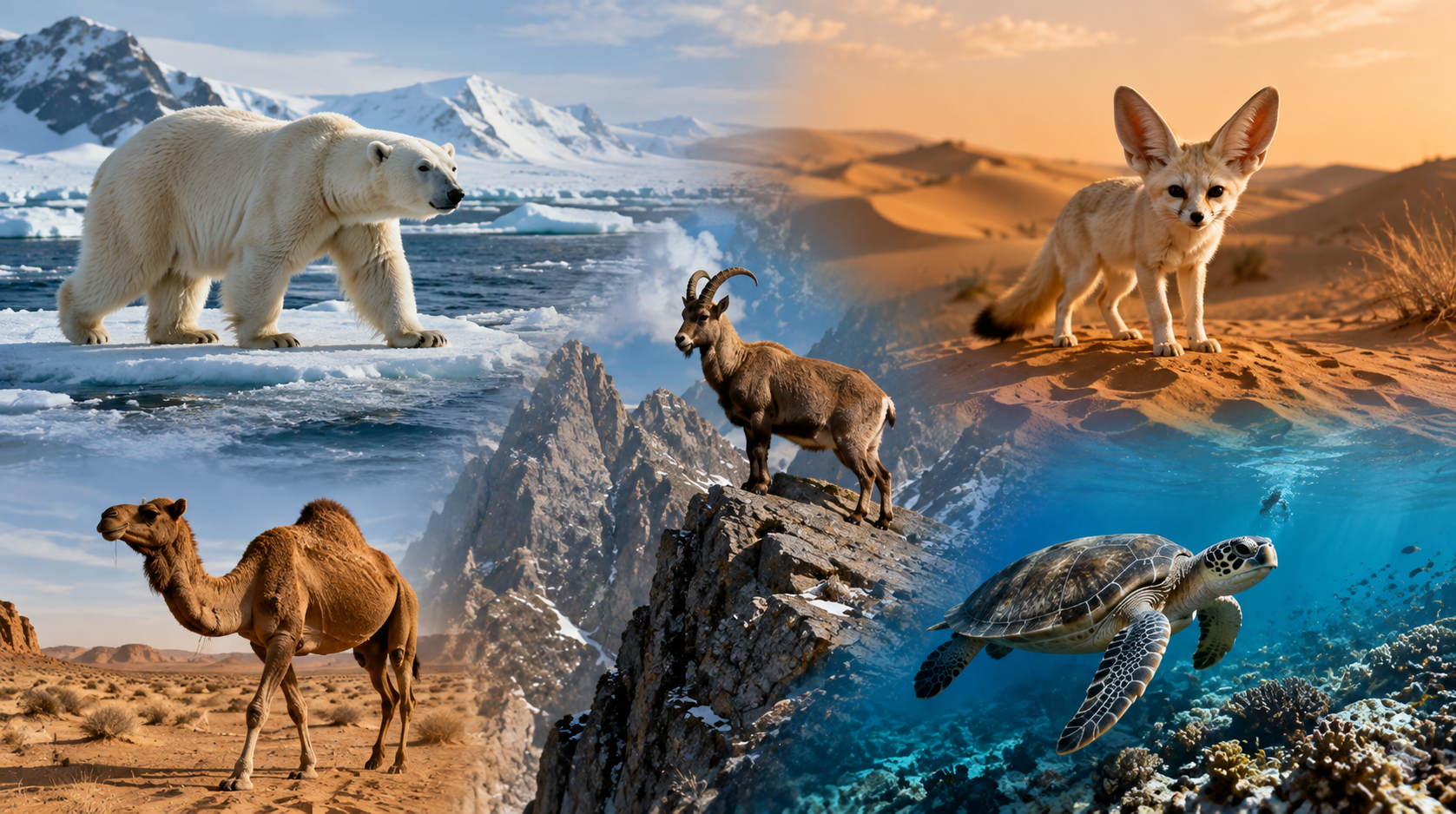
Earth contains environments that seem almost impossible to inhabit. Scorching deserts, frozen polar regions, deep oceans, and towering mountains all challenge survival. Yet remarkable wildlife adaptations allow animals to live and reproduce in these demanding places.
An adaptation is a characteristic that improves an organism’s ability to survive and reproduce in a particular environment. Over many generations, natural selection can make helpful inherited traits more common within a population.
These traits can involve an animal’s body, internal functions, or behavior. For example, thick insulation can help conserve heat. Meanwhile, nocturnal activity can help desert animals avoid dangerous daytime temperatures.
Animals do not consciously choose evolutionary adaptations because they need them. Instead, populations contain inherited variation. Individuals with traits that work well under local conditions may leave more offspring.
Therefore, extreme environments provide some of the clearest examples of evolution at work. By examining animals from deserts to ocean depths, we can see how life responds to extraordinary environmental pressures.
Surviving the Heat of the Desert
Deserts create several problems at once. Temperatures can become extremely high, water may be scarce, and food can be unpredictable. In addition, some deserts become surprisingly cold after sunset.
Desert wildlife adaptations often focus on conserving water and avoiding excessive heat.
Many small mammals remain underground during the hottest part of the day. Burrows provide more stable temperatures than the exposed surface. These animals may emerge after sunset when conditions become cooler.
Other species obtain much of their water from food. Efficient kidneys can also reduce water loss by producing highly concentrated urine.
Body shape can help with temperature regulation. Large ears, for example, may provide greater surface area for releasing heat in some desert mammals.
Behavior remains equally important. Animals can seek shade, reduce activity during extreme heat, or change feeding times.
Together, these strategies allow wildlife to occupy environments where access to water and comfortable temperatures cannot be taken for granted.
How Camels Handle Dry Environments
Camels have become famous symbols of desert survival, and for good reason. Their bodies contain several features suited to hot, dry environments.
Contrary to a common myth, their humps do not store water. Instead, they primarily store fat.
These specialized wildlife adaptations help camels manage periods when food or water is limited.
Camels can tolerate substantial changes in hydration and body temperature. Their physiology helps reduce unnecessary water loss under harsh conditions.
Long eyelashes and nostril structures can provide protection in dusty environments. Broad feet also help distribute body weight over soft ground.
Their coats offer additional advantages. Hair can provide insulation from intense environmental heat while also helping during cooler desert nights.
However, no single feature explains camel survival. Their success comes from a combination of anatomy, physiology, and behavior.
That combination is a recurring theme in extreme environments. Animals often rely on several complementary traits rather than one extraordinary ability.
Life in the Arctic Requires Excellent Insulation
Polar environments present the opposite temperature challenge. Animals must maintain body heat despite freezing air, ice, snow, and cold water.
Arctic wildlife adaptations frequently involve insulation.
Polar bears have thick fur and a substantial layer of body fat. Their relatively large bodies also help reduce heat loss because larger animals generally have less surface area relative to their volume.
Seals rely heavily on fat for insulation, especially in cold water.
Smaller Arctic animals may use dense fur and sheltered spaces beneath snow. Snow can trap air and provide insulation from colder conditions above.
Behavior matters as well. Animals may curl their bodies, seek protected locations, or reduce exposure during severe weather.
Food availability creates another challenge because Arctic productivity changes dramatically with the seasons.
Consequently, many species coordinate migration, breeding, and feeding with seasonal conditions.
Survival in the Arctic depends on conserving energy as carefully as conserving heat.
Seasonal Coats Provide Flexible Protection
Some animals live in environments that transform dramatically between summer and winter.
A permanent coat suited only to one season would create disadvantages during another. Therefore, several species change their fur throughout the year.
These seasonal wildlife adaptations can provide both insulation and camouflage.
Arctic foxes are well-known examples. Their dense winter coats help protect against extreme cold. Seasonal changes in coat appearance can also make them less visible against different landscapes.
Snowshoe hares similarly undergo seasonal coat changes in regions with snowy winters.
However, changing coat color requires appropriate timing. If snow arrives late or melts early, an animal with a white coat may become easier for predators to see against dark ground.
Climate change can therefore create new challenges when environmental timing shifts faster than some populations can respond.
Seasonal adaptations demonstrate how closely wildlife can be connected to predictable environmental cycles.
Migration Helps Animals Escape Seasonal Extremes
Not every animal remains in one place when conditions become difficult.
Migration allows species to move between habitats as seasons, food availability, rainfall, or breeding opportunities change.
Migration is one of the most dramatic behavioral wildlife adaptations found in nature.
Birds may travel thousands of kilometers between breeding and wintering grounds. Whales can move across vast ocean regions, while large herbivores may follow seasonal vegetation and rainfall.
These journeys require considerable energy. Therefore, animals need access to suitable feeding and resting locations along the route.
Navigation can involve multiple cues. Depending on the species, animals may use the sun, stars, Earth’s magnetic field, landmarks, odors, or learned routes.
Migration also creates conservation challenges. Protecting only one habitat may not be enough when an animal depends on several regions throughout its life.
A migratory species needs connected landscapes and safe routes across its entire journey.
Hibernation Helps Animals Conserve Energy
Winter can create problems beyond cold temperatures. Food may also become scarce.
Some animals respond by dramatically reducing their energy requirements.
Hibernation and related forms of dormancy are important wildlife adaptations for surviving periods when maintaining normal activity would consume too much energy.
During true hibernation, an animal’s metabolism can decrease significantly. Heart rate and other physiological processes may slow.
Different species use dormancy in different ways. Therefore, the word hibernation should not be applied identically to every animal that becomes less active during winter.
Before entering prolonged dormancy, animals often need to build energy reserves.
A secure shelter is also essential because inactive animals remain vulnerable.
Dormancy demonstrates that survival does not always require actively fighting difficult conditions. Sometimes reducing energy expenditure until the environment improves is a highly effective strategy.
Mountain Animals Must Cope With Thin Air
High-altitude environments create a unique combination of challenges. Temperatures can be low, terrain may be steep, vegetation can be limited, and oxygen availability decreases with elevation.
Mountain wildlife adaptations therefore involve both movement and physiology.
Some high-altitude animals have features that support efficient oxygen use. Changes involving blood, lungs, circulation, or cellular processes can help species function where oxygen is less available.
Physical structure matters too.
Mountain goats and similar animals have specialized hooves that provide traction on steep, rocky terrain. Strong limbs and excellent balance allow them to navigate slopes that would be difficult for many other mammals.
Thick coats can provide protection from cold and wind.
However, mountains are not uniform environments. Conditions change rapidly with elevation, slope direction, and season.
Animals living there often need flexibility as well as specialization.
Snow Leopards Are Built for Mountain Terrain
Snow leopards inhabit rugged mountain regions across Central and South Asia. Their environment combines cold temperatures, rocky terrain, and widely dispersed prey.
Several wildlife adaptations help them function in these landscapes.
Their thick fur provides insulation, while broad paws can help them move across snow and uneven surfaces.
Powerful hind limbs support jumping across steep terrain. Meanwhile, their long tails contribute to balance and can provide additional protection from cold when wrapped around the body.
Their coloration also blends with rocky and snowy landscapes.
However, physical adaptation alone cannot guarantee survival. Snow leopards require sufficient prey, suitable habitat, and opportunities to reproduce.
Human activity can affect these requirements through habitat disturbance, conflict, and changes in prey populations.
The snow leopard demonstrates an important conservation principle: even highly specialized animals remain vulnerable when their environments change rapidly.
Deep-Sea Animals Live Under Enormous Pressure
The deep ocean is one of Earth’s most extreme habitats. Sunlight disappears with depth, temperatures are often cold, food can be scarce, and water pressure becomes enormous.
Deep-sea wildlife adaptations can therefore look very different from those found on land.
Many species have bodies suited to high-pressure environments. Some lack structures that would function poorly under intense pressure.
Because sunlight cannot reach the deepest zones, vision may become less important for certain animals.
Other species possess extremely sensitive sensory systems that help detect movement, chemicals, or faint light.
Food scarcity also shapes behavior. Deep-sea predators may have large mouths or expandable stomachs that help them take advantage of rare feeding opportunities.
Scientists continue discovering new deep-sea organisms. Therefore, our understanding of these ecosystems remains incomplete.
The deep ocean shows how life can persist under conditions dramatically different from those humans experience at the surface.
Bioluminescence Creates Light in Darkness
Sunlight cannot penetrate the deepest parts of the ocean. Nevertheless, darkness does not mean the environment contains no light.
Many marine organisms produce their own illumination through bioluminescence.
Among deep-sea wildlife adaptations, this ability is particularly striking.
Different animals use light for different purposes. Some attract prey. Others communicate, confuse predators, or provide camouflage.
The anglerfish provides a famous example. Certain species possess a luminous lure that can attract potential prey close enough to capture.
Other organisms produce flashes when disturbed, which may startle predators or draw attention to the attacker.
Bioluminescence usually involves chemical reactions within an organism or relationships with light-producing bacteria.
Although it appears extraordinary to humans, biological light is widespread in marine ecosystems.
This adaptation demonstrates how evolution can use chemical processes to solve the problem of communication and survival in darkness.
Marine Mammals Must Breathe While Living at Sea
Whales, dolphins, seals, and other marine mammals face a basic challenge. They live or feed in water, yet they breathe air.
Their bodies must therefore manage oxygen efficiently during dives.
These physiological wildlife adaptations allow some species to remain underwater for extended periods.
Marine mammals can store oxygen in their blood and muscles. During diving, physiological changes may help prioritize oxygen delivery to essential organs.
Their streamlined bodies also reduce resistance while swimming.
However, diving abilities vary greatly among species. Some remain relatively close to the surface, while others descend to remarkable depths.
Returning to the surface remains essential because these animals cannot extract oxygen directly from water like fish.
Marine mammals show how evolution can modify the bodies of air-breathing animals for a predominantly aquatic lifestyle without eliminating their need to breathe atmospheric oxygen.
Antifreeze Proteins Help Some Fish Avoid Freezing
Ocean water in polar regions can remain below the freezing point of ordinary freshwater.
That creates a serious challenge for fish living in these environments.
Certain species produce specialized proteins that help prevent damaging ice formation within their bodies.
These biochemical wildlife adaptations provide an extraordinary example of survival at the molecular level.
Antifreeze proteins interact with tiny ice crystals and can help prevent them from growing.
This allows some fish to remain active in water cold enough to threaten other species.
However, different polar fish use different physiological strategies. Evolution has produced multiple solutions to similar environmental problems.
These adaptations are especially interesting because they cannot be easily observed from an animal’s appearance.
Many of nature’s most important survival mechanisms operate inside cells, tissues, blood, and other biological systems.
Animals in Caves Adapt to Permanent Darkness
Caves can create isolated environments with little or no sunlight.
Food may be scarce, temperatures can remain relatively stable, and visual information becomes less useful.
Cave wildlife adaptations often reflect these unusual conditions.
Some species have reduced eyes or pigmentation. Maintaining structures that provide little benefit can consume energy, so those traits may become reduced over evolutionary time.
Other senses can become more important.
Animals may rely heavily on touch, vibration, smell, or chemical signals to navigate and locate food.
Bats offer a familiar example of navigating darkness, although many bats are not permanent cave specialists. Echolocation allows them to use returning sound waves to detect objects and prey.
Cave ecosystems can be extremely sensitive to disturbance because they often contain species found nowhere else.
Pollution, tourism, changes in water flow, or habitat destruction can therefore threaten highly specialized populations.
Nocturnal Behavior Helps Animals Avoid Extreme Heat
Sometimes the simplest way to survive dangerous daytime temperatures is to avoid them.
Many desert animals become active primarily after sunset.
Nocturnal activity is one of the most effective behavioral wildlife adaptations for reducing heat exposure.
Nighttime temperatures can be dramatically lower than daytime temperatures. Therefore, animals may lose less water and expend less energy regulating body temperature.
Large eyes can help some nocturnal species gather available light. Others rely more strongly on hearing or smell.
Burrows provide shelter during daylight hours.
However, nighttime creates different challenges. Predators may also be active, and visual information becomes limited.
Consequently, nocturnal animals often combine behavior with specialized sensory abilities.
This illustrates an important principle: an animal does not always need to physically tolerate the most extreme condition if it can avoid encountering that condition altogether.
Camouflage Helps Wildlife Survive Harsh Habitats
Extreme environments often contain limited vegetation or distinctive backgrounds. Animals that visually match those surroundings may gain an advantage.
Camouflage can help predators approach prey or allow prey animals to avoid detection.
These visual wildlife adaptations appear in deserts, forests, mountains, oceans, and polar habitats.
Color is only one component. Patterns, body shape, posture, and behavior can also influence how easily an animal is detected.
Some species resemble rocks, leaves, bark, sand, or snow.
Others can change appearance under certain circumstances.
However, camouflage only works relative to the visual system of another animal. Colors that look similar to humans may appear very different to species that perceive ultraviolet light or other visual information differently.
Therefore, scientists often study camouflage from the perspective of predators and prey rather than relying solely on human vision.
Water Conservation Can Determine Desert Survival
Water is essential for animal life, but desert species cannot rely on frequent access to rivers or rainfall.
Consequently, conserving moisture becomes critical.
Water-saving wildlife adaptations can involve kidneys, skin, diet, behavior, and respiratory systems.
Some desert rodents produce highly concentrated urine and very dry waste. They may obtain much of the moisture they need from seeds or other foods.
Animals can also reduce water loss by resting in cooler burrows.
Certain species tolerate levels of dehydration that would be dangerous for many other mammals.
However, desert animals still need water in some form. They cannot survive without it indefinitely.
Their advantage comes from using limited supplies efficiently and reducing unnecessary loss.
These physiological strategies demonstrate how survival can depend on processes that humans rarely see.
Extreme Adaptations Come With Trade-Offs
Specialization can provide enormous advantages in a particular environment. However, it can also create limitations.
An animal perfectly adapted to cold conditions may struggle if temperatures rise significantly.
This trade-off is important when studying wildlife adaptations.
A highly specialized diet can reduce competition when the preferred food is abundant. Yet it can become a disadvantage if that food disappears.
Similarly, animals adapted to narrow temperature ranges may have limited flexibility when climate conditions change.
Evolution does not create perfect organisms. Instead, natural selection favors traits that improve reproductive success under existing conditions.
Every trait can involve costs.
Large bodies conserve heat but require more food. Thick insulation protects against cold but can create challenges during unusually warm periods.
Understanding these trade-offs prevents us from treating adaptations as magical solutions.
Animals remain dependent on environments that stay within certain biological limits.
Climate Change Creates New Survival Challenges
Climate conditions are changing rapidly in many ecosystems. Temperatures are shifting, sea ice is declining in some regions, rainfall patterns are changing, and extreme events can affect habitats.
Existing wildlife adaptations developed under past environmental conditions. Therefore, rapid change can create mismatches.
Seasonal camouflage provides one example. If snow cover becomes less predictable, animals that turn white at a fixed time may become more visible.
Migratory species can face similar problems. Their arrival may no longer coincide perfectly with peak food availability.
Marine organisms may experience changing water temperatures, oxygen conditions, and chemistry.
Some species can adjust behavior or move into new areas. Others may adapt genetically over generations if enough variation exists and change is not too rapid.
However, highly specialized or isolated species can face greater difficulties.
Protecting diverse, connected habitats can give wildlife more opportunities to move and respond as conditions change.
Why Protecting Extreme Habitats Matters
Extreme environments may appear empty compared with tropical forests, but they can contain highly specialized communities.
Polar regions, deserts, mountains, caves, and deep oceans support species found nowhere else.
Protecting these habitats preserves unique wildlife adaptations that developed over immense periods of evolutionary history.
Habitat protection also supports ecological relationships. A predator cannot survive without sufficient prey, while migratory animals may depend on multiple locations.
Human activities can affect even remote ecosystems. Climate change, mining, pollution, fishing, tourism, and infrastructure can reach places once considered isolated.
Conservation therefore requires understanding the entire system.
Scientists also learn valuable biological information from organisms living under extreme conditions. Their physiology can reveal how life functions at environmental limits.
Protecting these species preserves both biodiversity and opportunities for future discovery.
Conclusion
The diversity of wildlife adaptations demonstrates how remarkably flexible life can be. From desert mammals conserving water to deep-sea animals producing light, species have evolved countless ways to survive difficult conditions.
Some adaptations are visible. Thick fur, broad paws, camouflage, and specialized body shapes can be easy to recognize. Others operate internally through metabolism, blood chemistry, oxygen storage, or temperature regulation.
Behavior provides another powerful tool. Migration, nocturnal activity, burrowing, and dormancy allow animals to avoid conditions they cannot tolerate continuously.
However, adaptations have limits. A species suited to one environment may become vulnerable when that environment changes rapidly.
That reality makes habitat conservation increasingly important.
Extreme environments are not empty wastelands. They contain complex ecosystems shaped by millions of years of evolution. Protecting them preserves extraordinary animals, ecological relationships, and biological strategies that scientists are still working to understand.
By studying how wildlife survives Earth’s harshest places, we gain a deeper appreciation for both the resilience and vulnerability of life.
FAQ
1. What is an adaptation in animals?
An adaptation is an inherited characteristic that can improve an animal’s ability to survive and reproduce under particular environmental conditions.
2. How do desert animals survive without much water?
Different species use different strategies. These may include concentrated urine, moisture-rich food, burrowing, nighttime activity, and physiological tolerance of dehydration.
3. How do animals survive extremely cold climates?
Many cold-climate species rely on thick fur, body fat, sheltered resting areas, seasonal behaviors, migration, or changes in metabolism.
4. Why do some deep-sea animals produce light?
Bioluminescence can help animals attract prey, communicate, avoid predators, or camouflage themselves in dark marine environments.
5. Can animals adapt quickly to climate change?
Some species can change behavior or move to new habitats relatively quickly. Genetic adaptation generally occurs across generations, so rapid environmental change can exceed the ability of some populations to adjust.