
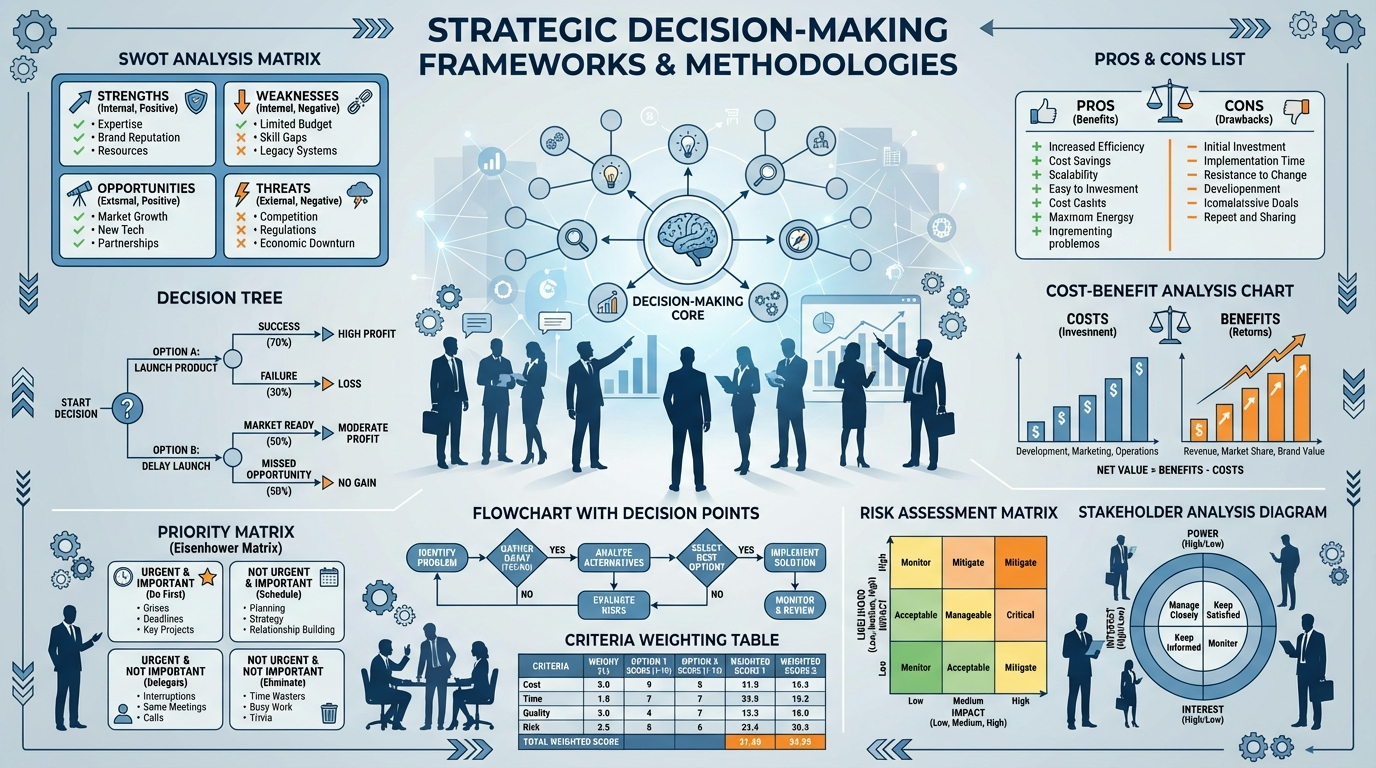
Strong leadership depends on clarity. However, complex situations often create uncertainty. That is where Decision-Making Frameworks become essential. These structured tools guide thinking, reduce bias, and improve outcomes.
Leaders face constant choices. Some decisions affect daily operations, while others shape long-term strategy. Because stakes vary, consistent methods ensure thoughtful evaluation. As a result, structured approaches prevent impulsive mistakes.
In this guide, we explore five proven tools that high-performing leaders rely on. Each method supports better analysis, risk management, and confident execution. By applying these Decision-Making Frameworks, professionals can approach challenges with focus and discipline.
Why Structured Decision Tools Matter
Every decision carries consequences. Without a clear process, emotions and assumptions can dominate reasoning. Therefore, structure brings balance.
First, frameworks create consistency. When teams follow the same approach, collaboration improves. Additionally, documentation increases accountability.
Second, structured thinking reduces cognitive bias. Humans naturally favor familiar patterns. However, guided analysis encourages broader evaluation.
Third, time efficiency improves. Although frameworks require preparation, they prevent repeated debate. Consequently, leaders move forward with confidence.
Because modern business environments shift rapidly, Decision-Making Frameworks provide stability during uncertainty.
Now, let’s examine five powerful tools used by experienced leaders.
1. SWOT Analysis
SWOT stands for Strengths, Weaknesses, Opportunities, and Threats. This simple matrix remains one of the most widely used Decision-Making Frameworks worldwide.
How It Works
Leaders divide analysis into four categories. Internal strengths and weaknesses appear on one side. External opportunities and threats fill the other.
Because this structure separates internal and external factors, clarity improves quickly.
Why Leaders Use It
SWOT encourages honest evaluation. Additionally, it supports strategic planning by highlighting competitive advantages.
For example, organizations often use SWOT before launching products or entering markets. Therefore, it remains a foundational tool among Decision-Making Frameworks.
2. The Eisenhower Matrix
Time management directly affects decision quality. The Eisenhower Matrix helps leaders prioritize effectively.
Urgent vs. Important
This model divides tasks into four quadrants: urgent and important, important but not urgent, urgent but not important, and neither.
Because visual categorization clarifies priorities, leaders reduce stress and distractions.
Improving Focus
High-performing executives focus primarily on important but not urgent tasks. Consequently, they prevent crises instead of reacting to them.
Among practical Decision-Making Frameworks, this method enhances daily productivity and long-term planning.
3. The OODA Loop
The OODA Loop stands for Observe, Orient, Decide, Act. Originally developed for military strategy, it now influences business leadership.
Rapid Adaptation
First, leaders observe current conditions. Next, they orient by analyzing context. Then, they decide on a course of action. Finally, they act.
Because environments change quickly, repeating this cycle allows continuous adjustment.
Strategic Advantage
Organizations that complete the OODA cycle faster often outperform competitors. Therefore, this framework supports agility.
When applied consistently, it becomes one of the most dynamic Decision-Making Frameworks available.
4. Cost-Benefit Analysis
Financial clarity often determines success. Cost-benefit analysis quantifies trade-offs.
Structured Evaluation
Leaders list potential costs alongside expected benefits. Additionally, they estimate both short-term and long-term impact.
Because numerical comparison reduces emotional influence, decisions become more objective.
Risk Management
While numbers do not eliminate uncertainty, they clarify potential outcomes. Consequently, organizations allocate resources more effectively.
Among analytical Decision-Making Frameworks, this method remains essential for budgeting and investment planning.
5. The 10/10/10 Rule
Emotional decisions often lead to regret. The 10/10/10 Rule encourages perspective.
Future Impact Reflection
Leaders ask three questions: How will this decision feel in 10 minutes? In 10 months? In 10 years?
Because time shifts perception, this technique reduces impulsivity.
Long-Term Thinking
Short-term discomfort may create long-term growth. Conversely, immediate convenience may cause future challenges.
Therefore, this reflective method ranks highly among personal Decision-Making Frameworks for executives and entrepreneurs.
How Bias Influences Leadership Choices
Cognitive bias affects everyone. Confirmation bias encourages people to favor familiar opinions. Meanwhile, loss aversion exaggerates fear of failure.
However, structured tools counteract these tendencies. By forcing analysis from multiple angles, leaders broaden perspective.
Because awareness strengthens judgment, combining Decision-Making Frameworks with self-reflection improves results.
Combining Frameworks for Greater Impact
No single tool fits every situation. Therefore, experienced leaders combine methods strategically.
For example, begin with SWOT to identify context. Then, apply cost-benefit analysis for financial clarity. Finally, use the 10/10/10 Rule for perspective.
Layered analysis reduces blind spots. Consequently, organizations improve both speed and quality of decisions.
Integrating multiple Decision-Making Frameworks ensures flexibility without sacrificing structure.
When to Use Each Tool
Different scenarios demand different approaches.
Use SWOT for strategic planning. Apply the Eisenhower Matrix for daily prioritization. Implement the OODA Loop during fast-moving situations.
Reserve cost-benefit analysis for financial evaluations. Meanwhile, rely on the 10/10/10 Rule for emotionally charged decisions.
Because context matters, choosing the right method increases effectiveness.
Building a Decision Culture
Leadership extends beyond personal judgment. Teams also benefit from shared processes.
Encourage open dialogue during analysis. Additionally, document outcomes for future learning.
When employees understand structured thinking, organizational consistency improves. Therefore, Decision-Making Frameworks strengthen culture as well as strategy.
Common Mistakes to Avoid
Overcomplicating analysis slows progress. Instead, keep frameworks practical.
Ignoring data undermines objectivity. Likewise, rushing without evaluation invites errors.
Balance structure with adaptability. Because excessive rigidity limits creativity, flexibility remains important.
Applying Decision-Making Frameworks thoughtfully prevents these common pitfalls.
Why Smart Leaders Rely on Structure
High-performing leaders do not rely solely on instinct. Although experience guides intuition, structure validates assumptions.
Frameworks reduce uncertainty. Moreover, they improve collaboration and communication.
When leaders document reasoning, accountability increases. As a result, trust strengthens within teams.
Ultimately, structured approaches separate reactive management from strategic leadership.
Conclusion: Clarity Creates Confidence
Every leader faces difficult choices. However, uncertainty does not require guesswork.
By applying proven Decision-Making Frameworks, leaders gain clarity and control. Structured tools promote thoughtful analysis, reduce bias, and encourage long-term thinking.
Each of the five methods discussed offers distinct advantages. Whether prioritizing tasks or evaluating strategy, these tools provide reliable guidance.
In a rapidly changing world, confident leadership depends on disciplined thinking. Therefore, mastering Decision-Making Frameworks empowers professionals to navigate complexity with precision and purpose.
Strong decisions shape strong outcomes. With the right framework, success becomes intentional rather than accidental.
FAQ
1. Why are structured decision tools important for leaders?
They provide clarity, reduce bias, and create consistent processes for evaluating complex situations.
2. Can one framework work for every situation?
No. Different challenges require different analytical approaches and perspectives.
3. How do these tools reduce bias?
They encourage structured evaluation, forcing leaders to consider multiple factors objectively.
4. Are decision models only useful in business?
Not at all. Individuals use similar methods for personal and financial choices.
5. How can teams adopt better decision processes?
Encourage shared frameworks, open discussion, and documentation of outcomes for continuous improvement.