
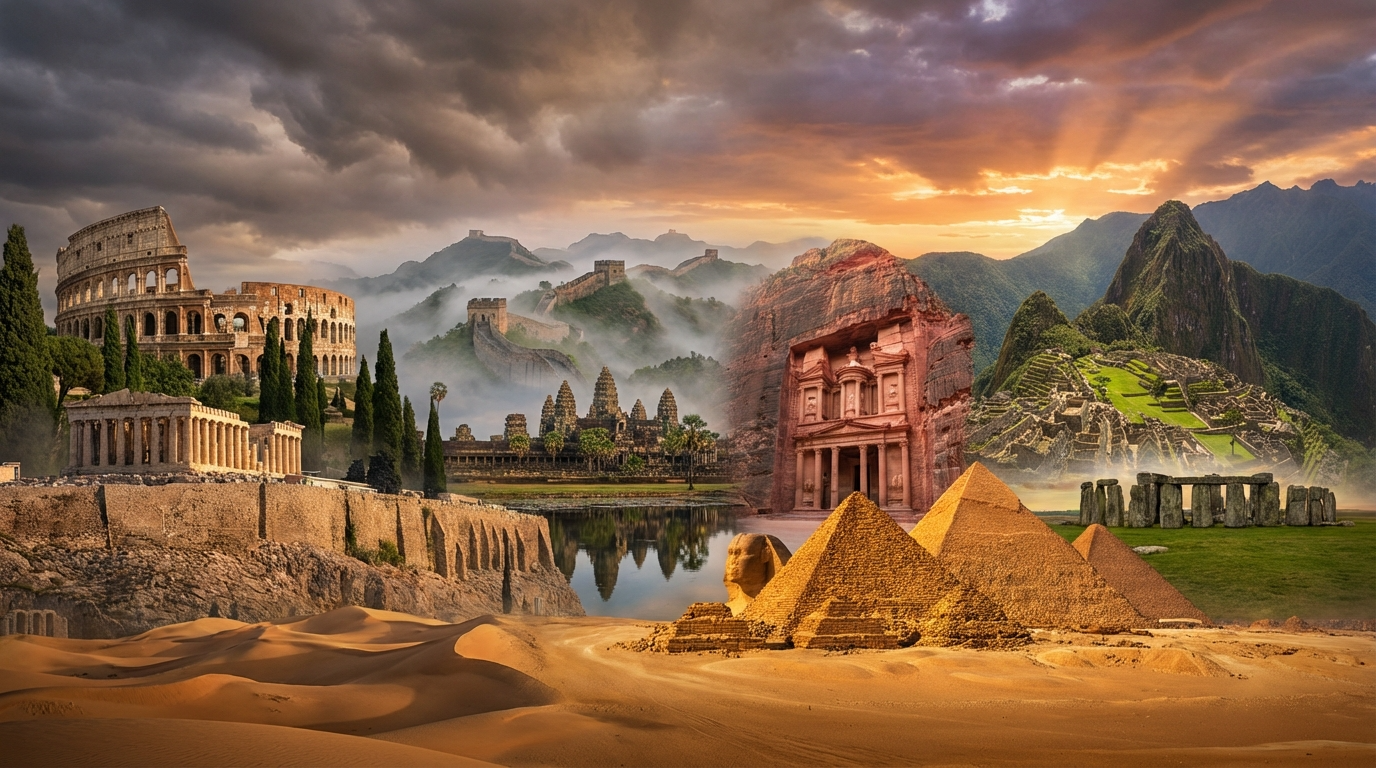
Ancient architectural wonders continue to captivate travelers, historians, and architects alike. These structures were built without modern technology, yet they still stand tall today. Because they reflect human ambition and ingenuity, they remain powerful symbols of cultural identity.
Across continents, civilizations created monuments that defied gravity, weather, and time. Some served religious purposes, while others displayed political power. However, all required advanced planning and extraordinary craftsmanship.
Although many ancient structures have crumbled, a select few survived centuries of conflict and climate change. Therefore, studying them offers insight into engineering methods that shaped early societies. Let’s explore five remarkable landmarks that still stand and continue to inspire awe.
The Great Pyramid of Giza
The Great Pyramid of Giza stands as one of the most iconic ancient architectural wonders ever constructed. Built around 2560 BCE in Egypt, it originally rose to 146 meters. Even today, it remains one of the tallest ancient structures on Earth.
Unlike modern buildings, the pyramid was constructed with massive limestone blocks. Each block weighed several tons. Yet workers transported and positioned them with incredible precision. Consequently, the structure has survived more than 4,500 years.
Many theories attempt to explain how ancient Egyptians achieved such accuracy. However, archaeological evidence suggests organized labor forces and innovative ramp systems played major roles. Because the pyramid aligned closely with celestial points, it also reflects advanced astronomical knowledge.
Despite erosion and missing outer casing stones, the Great Pyramid still dominates the desert skyline. As one of the most famous ancient architectural wonders, it continues to symbolize the power and sophistication of ancient Egypt.
The Parthenon in Athens
Perched atop the Acropolis, the Parthenon represents the height of classical Greek design. Constructed in the 5th century BCE, it honored the goddess Athena. However, its influence extends far beyond religion.
Architects designed the Parthenon with mathematical precision. Columns appear straight, yet subtle curves correct optical illusions. Therefore, the structure looks perfectly balanced from every angle.
Although wars and explosions damaged the building, much of it remains intact. Restoration efforts continue to preserve its integrity. As a result, visitors can still witness its grandeur.
Because of its proportional harmony and elegant simplicity, the Parthenon shaped Western architecture for centuries. Government buildings and museums worldwide reflect its design principles.
Among ancient architectural wonders, the Parthenon stands as a testament to philosophy, art, and democracy. It reminds us that architecture can embody cultural ideals as well as structural innovation.
The Colosseum in Rome
The Colosseum remains one of the most recognizable ancient architectural wonders in Europe. Completed in 80 CE, this massive amphitheater hosted gladiator contests and public spectacles.
Roman engineers used concrete, arches, and vaulting techniques to create a structure capable of seating around 50,000 spectators. Consequently, the Colosseum demonstrated engineering mastery far ahead of its time.
Unlike earlier stone-only constructions, Roman concrete allowed greater flexibility. Therefore, architects achieved larger spans and complex forms. The arena also featured an intricate underground system known as the hypogeum.
Although earthquakes and stone removal damaged parts of the structure, much of it still stands. Preservation efforts protect it from further deterioration. Today, millions visit each year.
Because it combined entertainment with engineering brilliance, the Colosseum remains a powerful example of how architecture reflects social values. It continues to rank among the most impressive ancient architectural wonders still standing.
Machu Picchu in Peru
High in the Andes Mountains, Machu Picchu showcases Incan ingenuity. Built in the 15th century, this city blends seamlessly into its natural surroundings.
Unlike many ancient cities, Machu Picchu features precisely cut stones fitted without mortar. As a result, the structures withstand earthquakes remarkably well. This technique, known as ashlar masonry, allowed flexibility during seismic movement.
In addition, the Incas designed advanced agricultural terraces and drainage systems. These innovations prevented erosion and ensured food production. Therefore, the site functioned as both a spiritual and practical center.
Although Spanish conquerors never discovered it, local communities preserved its existence. In the early 20th century, global attention returned to the site.
Among ancient architectural wonders, Machu Picchu stands out for its harmony with nature. It demonstrates that architectural brilliance can coexist with environmental sensitivity.
The Great Wall of China
Stretching thousands of miles, the Great Wall represents one of the largest construction projects in history. Various dynasties built and rebuilt sections over centuries.
Unlike a single structure, the wall consists of interconnected fortifications. Builders used earth, brick, and stone depending on local resources. Consequently, its design varies across regions.
The primary purpose was defense. However, the wall also controlled trade and migration. Watchtowers and signal systems enhanced communication along its length.
Although parts have eroded, significant sections remain accessible today. Restoration projects preserve critical areas for future generations.
Because of its scale and endurance, the Great Wall ranks among the most extraordinary ancient architectural wonders. It reflects collective effort, strategic planning, and national identity.
Why These Structures Survived
Not all ancient monuments endured. So why did these particular landmarks survive? First, many used durable materials such as stone and concrete. Second, their builders understood structural balance and load distribution.
Moreover, some sites benefited from geographic isolation. Machu Picchu, for instance, avoided large-scale destruction due to its remote location. Meanwhile, continuous cultural value encouraged restoration in cities like Rome and Athens.
Climate also played a role. Dry desert conditions in Egypt slowed erosion. However, even harsh environments could not completely destroy well-designed foundations.
Because of these factors, ancient architectural wonders continue to stand while others faded into history.
Engineering Lessons from the Past
Modern architects still study ancient construction methods. For example, Roman concrete inspires sustainable building research. Similarly, Incan stonework informs earthquake-resistant design.
Ancient builders lacked cranes and computers. Nevertheless, they mastered geometry and physics. Therefore, their achievements remain relevant today.
Additionally, these landmarks reveal the importance of planning. Massive projects required coordinated labor forces and resource management. Without organization, such feats would have failed.
While technology evolves, foundational principles remain consistent. Stability, symmetry, and environmental awareness continue shaping architecture worldwide.
Cultural Impact and Tourism
These monuments attract millions of visitors annually. Tourism supports local economies and funds preservation efforts. However, increased foot traffic also threatens structural integrity.
Therefore, conservation strategies balance accessibility with protection. For instance, visitor limits help reduce wear at Machu Picchu. Similarly, restoration teams reinforce weakened sections of the Colosseum.
Beyond economics, these sites foster global appreciation for shared heritage. They connect modern societies to ancient civilizations.
Because ancient architectural wonders transcend borders, they encourage cross-cultural understanding and historical awareness.
Preservation in the Modern Era
Preserving ancient landmarks requires advanced technology. Engineers now use laser scanning, 3D modeling, and non-invasive testing methods. As a result, restoration efforts minimize damage.
International organizations collaborate to protect heritage sites. UNESCO designations raise awareness and funding. Consequently, global cooperation strengthens conservation.
However, threats persist. Pollution, climate change, and urban expansion pose ongoing challenges. Therefore, long-term strategies remain essential.
Protecting ancient architectural wonders ensures future generations can experience these extraordinary achievements firsthand.
Conclusion: Enduring Symbols of Human Achievement
Ancient architectural wonders stand as proof of humanity’s creativity and resilience. From Egyptian pyramids to mountain cities in Peru, these structures survived centuries of change.
Although time erodes even the strongest materials, thoughtful design extends longevity. Each monument reflects cultural ambition, engineering brilliance, and artistic vision.
Today, they inspire architects, historians, and travelers alike. More importantly, they remind us that great achievements require vision and perseverance.
As we build the future, we can learn from the past. By respecting design principles and preserving heritage, we honor the legacy of ancient architectural wonders that still shape our world.
FAQ
- Which ancient structure is the oldest still standing?
The Great Pyramid of Giza is the oldest surviving large-scale monument on this list. - Why did Machu Picchu survive earthquakes?
Incan builders used mortar-free stonework that allows slight movement during seismic activity. - How do experts preserve historic landmarks today?
They use digital scanning, structural reinforcement, and careful restoration techniques. - Are all sections of the Great Wall original?
No, different dynasties rebuilt parts using various materials over centuries. - Why are historic monuments important today?
They connect us to human history, inspire innovation, and preserve cultural identity.