
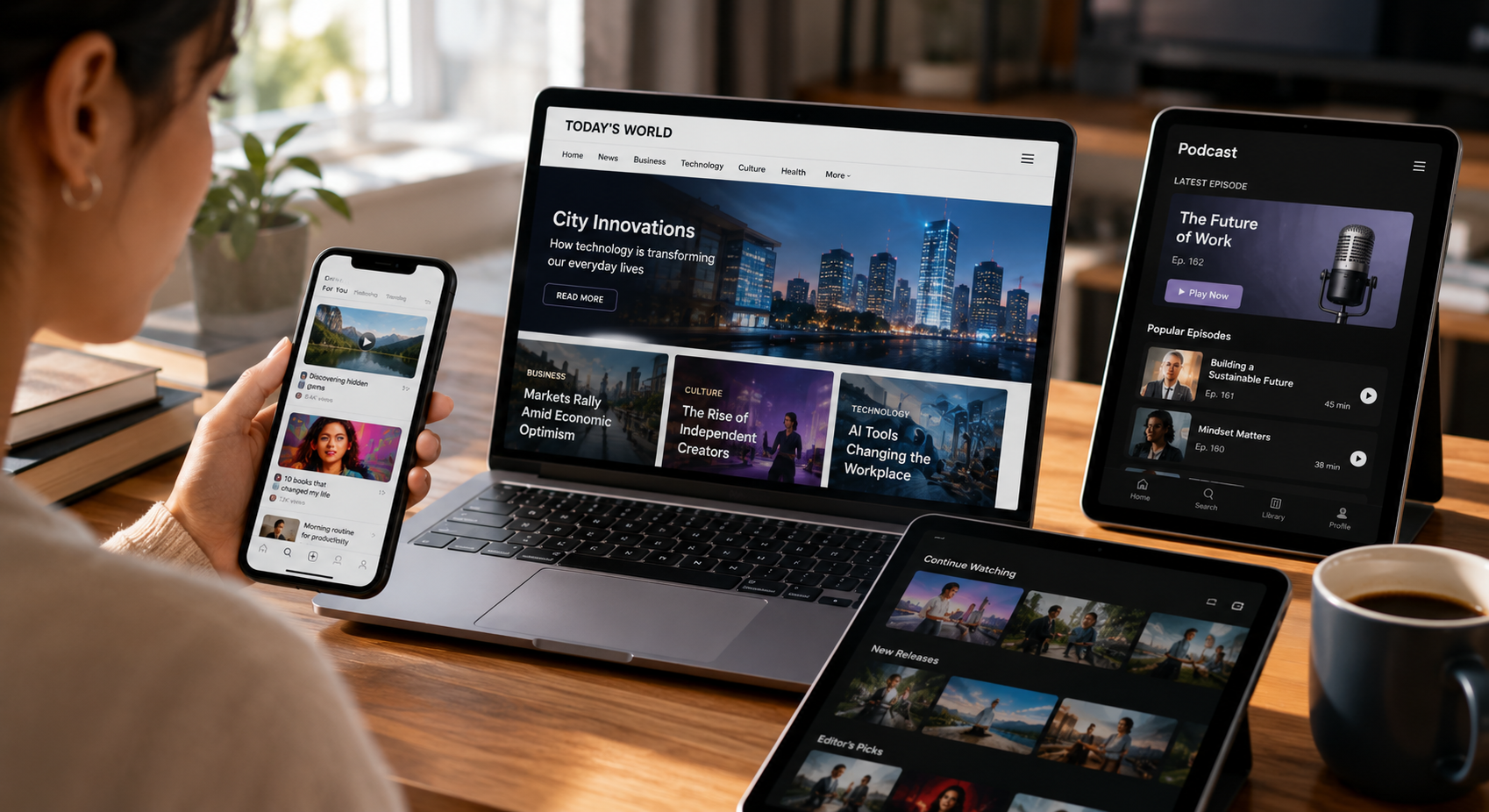
People once depended heavily on newspapers, magazines, radio, and scheduled television for information and entertainment. Today, smartphones provide immediate access to articles, videos, podcasts, newsletters, and social posts. As a result, digital media publishing has changed both how content reaches audiences and how people consume it.
Readers no longer need to wait for the morning newspaper or a monthly magazine. Instead, publishers can update stories within minutes. Audiences can also choose when, where, and how they consume information.
This flexibility creates enormous opportunities. Independent creators can reach international audiences without owning printing presses or broadcast networks. Small publishers can build communities around highly specific subjects.
However, competition has increased. Publishers now compete not only with similar websites but also with social networks, streaming platforms, creators, podcasts, games, and countless other sources of attention.
Therefore, successful publishing increasingly depends on quality, trust, accessibility, distribution, and a clear understanding of audience needs.
From Print Deadlines to Continuous Publishing
Traditional print publishing operates around production schedules. Newspapers prepare editions, while magazines may work weeks or months ahead.
Online publishing changed that rhythm.
With digital media publishing, organizations can release content whenever it is ready. Breaking stories can receive updates throughout the day, while evergreen guides can be revised as information changes.
This flexibility benefits readers because they can access newer information. However, speed can create pressure on editorial teams.
Being first may attract attention, yet inaccurate reporting can damage trust. Therefore, publishers need processes that balance speed with verification.
Continuous publishing also changes the lifespan of content. A printed article eventually becomes an archive. Online content can remain discoverable through search engines for years.
Consequently, publishers can maintain and improve older material instead of treating every article as disposable.
The digital publishing cycle is less about individual editions and more about managing an evolving library of information.
Mobile Devices Have Reshaped Reading Habits
Smartphones have become one of the primary ways people access online information.
Readers may discover an article while commuting, waiting for an appointment, or browsing social media. Therefore, content must work effectively on smaller screens.
Mobile behavior has significantly influenced digital media publishing.
Large blocks of poorly formatted text become difficult to read on a phone. Slow pages can frustrate users, while intrusive pop-ups may cover important content.
Publishers increasingly use responsive layouts that adapt to different screen sizes. Clear typography and logical headings also improve readability.
Mobile audiences often move between formats. Someone may begin with a short social post, open a full article, and later subscribe to a newsletter.
However, publishers should not assume mobile readers only want short content. Long-form journalism and detailed guides can still perform well when the information is valuable and the reading experience is comfortable.
Good mobile design supports the content rather than reducing its depth.
Social Media Changed Content Discovery
For many years, readers often visited a publication’s homepage directly. Search engines later became another major source of traffic.
Social platforms added a new discovery layer.
Today, digital media publishing often involves distributing content through several networks rather than waiting for audiences to visit a website.
A single article might become a short video, graphic, discussion post, newsletter section, or podcast topic. Each format can introduce the underlying idea to a different audience.
However, publishers do not control social platforms. Algorithms change, features disappear, and referral traffic can rise or fall unexpectedly.
Therefore, relying entirely on one social network creates risk.
Social media works best as one part of a broader distribution strategy. Publishers can use it to reach new audiences while building direct relationships through websites, email lists, memberships, or apps.
The platform may introduce the audience, but the publisher should create reasons for people to return.
Search Engines Remain Important
Search engines connect people with information when they actively need answers.
A reader might search for a product comparison, travel guide, explanation, recipe, tutorial, or breaking development.
Search visibility therefore remains important within digital media publishing.
However, useful search optimization involves more than inserting keywords repeatedly. Content needs to satisfy the reader’s actual question.
Clear titles help searchers understand what a page offers. Descriptive headings improve navigation, while accurate metadata provides additional context.
Technical performance also matters. Pages should load efficiently and work properly across devices.
Publishers should avoid creating large quantities of weak content solely to attract search traffic. Such strategies can damage quality and create a poor reader experience.
Strong search-focused publishing begins with understanding intent.
What does the reader actually need? What information would make the page genuinely useful?
Answering those questions creates a stronger foundation than chasing rankings alone.
Newsletters Have Restored Direct Audience Relationships
Email may seem old compared with newer platforms, yet newsletters have become increasingly valuable to publishers and creators.
Unlike social media followers, email subscribers provide a more direct communication channel.
This makes newsletters an important part of digital media publishing strategies.
A publisher can send selected stories directly to interested readers. Newsletters can also develop their own editorial identity through commentary, recommendations, summaries, or exclusive reporting.
Frequency matters. Some audiences prefer daily updates, while others may respond better to weekly or monthly editions.
Publishers should make expectations clear during signup.
Quality matters more than simply sending frequently. If every email feels promotional or repetitive, readers may unsubscribe.
A strong newsletter provides a reason to open the next edition.
Email lists also reduce dependence on external algorithms. Although deliverability rules and email platforms still matter, publishers generally have a more direct connection with subscribers.
Video Has Become a Major Publishing Format
Online video is no longer separate from publishing. News organizations, educational websites, magazines, brands, and independent creators increasingly produce video alongside written content.
This expansion has broadened digital media publishing beyond traditional articles.
Short videos can introduce topics quickly. Longer formats allow detailed explanations, interviews, documentaries, demonstrations, and commentary.
Video can also make certain subjects easier to understand. A repair tutorial, for example, may benefit from showing the process rather than describing every movement.
However, video requires different skills. Lighting, sound, editing, scripting, captions, and visual storytelling all influence quality.
Accessibility should remain a priority. Captions can help viewers with hearing impairments and people watching without sound.
Publishers also need to consider whether video genuinely improves the content.
Not every article needs to become a video. The format should match the information and audience.
Podcasts Have Expanded Audio Publishing
Audio content gives audiences the ability to consume information while performing other activities.
People can listen while commuting, exercising, cleaning, or relaxing.
Podcasts have therefore become another important branch of digital media publishing.
The format works particularly well for interviews, storytelling, commentary, education, and ongoing discussions.
Audio can also create a strong connection between hosts and listeners. Hearing someone’s voice regularly can make a publication feel more personal.
However, discoverability can be challenging. Podcasts often depend on recommendations, platform search, social promotion, and existing audiences.
Publishers can support discovery by creating useful episode titles and descriptions. Transcripts may also improve accessibility and provide searchable text.
As with video, audio should serve a clear purpose.
A successful podcast is not simply an article read aloud. It should take advantage of conversation, voice, sound, pacing, or storytelling.
Subscription Models Are Changing Publisher Economics
Advertising once supported much of online publishing. It remains important, but many organizations are diversifying their revenue.
Subscriptions, memberships, donations, events, affiliate partnerships, and premium products have become common.
This shift is changing the economics of digital media publishing.
A subscription model encourages publishers to focus on reader loyalty rather than simply maximizing page views.
However, convincing people to pay requires clear value. Exclusive reporting, specialist expertise, useful tools, premium newsletters, archives, or ad-free experiences can provide reasons to subscribe.
Publishers also need to decide how much content remains freely available.
A strict paywall can generate revenue from loyal readers but may reduce reach. A metered approach allows visitors to read a limited number of articles before subscribing.
There is no universal model.
The right strategy depends on the audience, subject, competition, costs, and value of the content.
Advertising Still Plays a Major Role
Many websites remain free because advertising generates revenue.
Digital advertising can help publishers monetize large audiences without charging every visitor.
However, advertising creates important challenges for digital media publishing.
Too many advertisements can damage the reading experience. Pop-ups, autoplaying media, and shifting page layouts may frustrate visitors.
Performance matters as well. Heavy advertising scripts can slow websites, particularly on mobile devices.
Publishers also need to distinguish advertisements clearly from editorial content. Sponsored articles should be labeled so readers understand the commercial relationship.
Privacy concerns have changed digital advertising too. Users and regulators increasingly expect greater transparency about tracking and personal data.
Therefore, publishers need to balance revenue with trust.
Advertising works best when it supports journalism or content creation without overwhelming the experience that attracted readers in the first place.
Artificial Intelligence Is Entering Publishing Workflows
AI tools can assist with research organization, transcription, brainstorming, translation, summarization, data analysis, and other publishing tasks.
Consequently, artificial intelligence is becoming part of digital media publishing workflows.
However, AI-generated output requires careful review.
Systems can produce factual errors, fabricated references, awkward language, or misleading conclusions. Therefore, publishers remain responsible for what they release.
AI should not become an excuse to publish enormous amounts of low-quality material.
Instead, organizations can identify specific tasks where technology improves efficiency while preserving human editorial judgment.
Transparency may also be appropriate when AI plays a substantial role in creating content, depending on the context and publication standards.
Copyright, privacy, accuracy, and sourcing require careful attention.
The strongest use of AI is likely to involve collaboration between technology and skilled editors rather than unsupervised automated publishing.
Personalization Can Make Content More Relevant
Digital platforms can customize what users see based on interests, subscriptions, location, or previous activity.
Personalization can help audiences discover relevant material within large content libraries.
This capability has become another feature of digital media publishing.
A sports publication might prioritize a reader’s preferred teams. A streaming service can recommend programs based on viewing history.
However, personalization requires data.
Publishers should collect only information they genuinely need and explain how it is used. Users should also receive appropriate controls where required.
Excessive personalization can create another problem. If people only see content similar to what they previously consumed, they may encounter fewer unexpected perspectives.
Therefore, recommendation systems should balance relevance with discovery.
Good personalization helps readers navigate content. It should not manipulate them into endless consumption or unnecessarily compromise their privacy.
Analytics Help Publishers Understand Audiences
Print publishers historically had limited information about how individual readers interacted with specific pages.
Digital platforms provide far more detailed data.
Analytics can show how audiences discover articles, which pages receive attention, and where visitors leave.
This information has become valuable in digital media publishing.
Editors can identify topics that readers find useful. Product teams can discover technical problems, while marketers can understand which distribution channels perform well.
However, metrics require context.
A page with enormous traffic is not automatically high quality. A smaller article might attract a highly engaged specialist audience or generate more subscriptions.
Time on page can also be misleading. A long visit might indicate deep reading, or it could mean someone simply left the tab open.
Therefore, publishers should use multiple measures that connect with actual goals.
Data should inform editorial judgment rather than replace it.
Audience Trust Has Become a Competitive Advantage
The internet gives audiences almost unlimited choices. Therefore, publishers need reasons for readers to return.
Trust is one of the strongest reasons.
In digital media publishing, credibility develops through accurate information, clear sourcing, transparent corrections, and consistent editorial standards.
Readers should be able to distinguish reporting from opinion and advertising.
Corrections are especially important. Mistakes can happen, but responsible publishers explain significant changes rather than quietly hiding them.
Author information can also improve transparency. Readers benefit from knowing who created an article and what expertise or reporting supports it.
Trust takes time to build and can disappear quickly.
Clickbait may generate short-term traffic, but misleading headlines can weaken long-term relationships.
A publication that consistently respects its audience can create something far more valuable than a temporary spike in page views: habitual readers.
Independent Creators Can Compete With Large Publishers
Digital distribution has dramatically lowered the barriers to publishing.
A writer can launch a newsletter. A filmmaker can distribute videos online. A subject expert can create a podcast or specialist website.
This democratization is one of the defining changes in digital media publishing.
Independent creators can serve narrow audiences that traditional publishers may overlook.
They can also communicate directly without several layers of organizational approval.
However, independence creates additional responsibilities.
Creators may need to handle editing, marketing, design, analytics, customer service, and business operations alongside content production.
Financial stability can also be difficult when income depends on algorithms or inconsistent sponsorships.
Successful independent publishers often build several revenue streams and direct audience relationships.
Their growth demonstrates that publishing power is no longer concentrated entirely within large media institutions.
Multimedia Storytelling Can Improve Understanding
Some stories are best explained through a combination of text, photographs, maps, charts, video, and interactive elements.
Digital platforms allow these formats to exist on the same page.
Multimedia storytelling has therefore become a powerful capability of digital media publishing.
A climate story might include maps showing changing conditions. A sports article could combine written analysis with data visualizations.
Interactive graphics can allow readers to explore information themselves.
However, multimedia elements should clarify rather than decorate.
A complicated animation that adds no meaningful information may slow the page and distract readers.
Accessibility matters as well. Images need useful alternative text, while videos should include captions where appropriate.
Publishers should also consider users with slow internet connections or older devices.
The best multimedia experiences make complicated information easier to understand without making the page unnecessarily difficult to use.
Accessibility Is Essential for Modern Publishing
Digital content should work for as many people as reasonably possible.
Readers may use screen readers, keyboard navigation, captions, magnification tools, or other assistive technologies.
Accessibility therefore needs to be part of digital media publishing from the beginning.
Images should include useful alt text when they convey meaningful information. Videos can provide captions, while audio content can include transcripts.
Clear headings improve navigation for everyone.
Color contrast and readable typography also matter. Publishers should avoid interfaces that depend entirely on color to communicate important information.
Accessibility benefits people beyond those with permanent disabilities. Captions can help someone watching a video in a noisy place. Clear navigation can help users on small screens.
Accessible publishing is not simply a technical requirement. It creates a better content experience for a broader audience.
Content Has a Longer Life Online
A printed newspaper article may have its greatest visibility on publication day. Online articles can continue attracting readers for months or years.
This longer lifespan changes digital media publishing strategy.
Evergreen guides, tutorials, explainers, reviews, and reference articles can remain valuable when maintained properly.
Publishers should periodically review important pages. Outdated statistics, broken links, old screenshots, or obsolete recommendations can reduce usefulness.
Updating existing material may sometimes provide more value than publishing another article on the same topic.
However, updates should be transparent when changes significantly affect the original content.
Archives also matter because they preserve a publication’s history.
Digital publishing allows old and new material to exist side by side. Therefore, maintaining a trustworthy content library becomes an ongoing editorial responsibility.
Publishers Must Avoid Chasing Every Platform
New platforms and content formats appear regularly. Publishers can feel pressure to establish a presence everywhere.
However, spreading resources too widely can reduce quality.
A sustainable digital media publishing strategy focuses on channels that genuinely serve the target audience.
A specialist business publication may benefit from newsletters and professional networks. An entertainment publisher might prioritize video and social platforms.
The right combination depends on audience behavior.
Publishers should test new channels, measure results, and leave platforms that consume substantial resources without delivering meaningful value.
Owned channels deserve particular attention. Websites, email lists, and direct subscriptions can reduce dependence on external platforms.
No distribution strategy is completely independent. Still, publishers should avoid allowing one algorithm to control their entire relationship with readers.
Quality Matters More as Content Volume Grows
The internet already contains enormous amounts of content. Generative technology makes producing additional material faster than ever.
Therefore, simply publishing more is unlikely to create a lasting advantage.
The future of digital media publishing will increasingly depend on usefulness, originality, expertise, and trust.
Publishers can differentiate themselves through firsthand reporting, specialist knowledge, original research, strong editing, useful tools, or distinctive perspectives.
Human experience can also provide value that generic summaries cannot easily reproduce.
Editors play an important role by deciding what deserves publication and improving clarity, accuracy, and structure.
Publishing less but producing better work may create stronger audience loyalty than filling a website with repetitive articles.
As content becomes abundant, attention becomes scarcer.
Quality gives readers a reason to spend that attention with a particular publication.
The Future Will Be Multi-Format
Audiences increasingly move between formats throughout the day.
Someone may read a newsletter in the morning, listen to a podcast during a commute, watch a short video at lunch, and read a detailed article in the evening.
Therefore, the future of digital media publishing will not belong to one format.
Publishers can begin with a strong core idea and adapt it appropriately for different channels.
However, adaptation should not mean copying the same content everywhere.
A video needs visual storytelling. A podcast needs effective audio structure. Social content should communicate quickly, while an article can provide depth.
Technology will continue changing how content is created and distributed. Yet audience needs remain relatively familiar.
People want useful information, compelling stories, entertainment, clarity, and trustworthy voices.
Publishers that meet those needs across appropriate formats will be better positioned for long-term relevance.
Conclusion
Digital media publishing has transformed content from a scheduled, largely one-way product into a continuous relationship between publishers and audiences.
Mobile devices allow people to consume information anywhere. Social platforms and search engines help audiences discover new material, while newsletters create more direct relationships.
Video, podcasts, interactive graphics, and other formats have expanded the meaning of publishing itself.
Meanwhile, subscriptions and memberships are changing how some organizations make money. AI is influencing production workflows, while analytics help teams understand how audiences interact with content.
However, technology does not remove the fundamentals of good publishing.
Accuracy, originality, useful information, accessibility, editorial judgment, and audience trust remain essential.
Publishers also need to avoid excessive dependence on platforms they do not control. Building direct relationships can create greater long-term stability.
The tools will continue changing. New platforms will emerge, and audience habits will evolve.
Yet the strongest publishers will continue doing something familiar: creating content worth someone’s time and making it easy for that person to find, understand, and trust.
FAQ
1. Why has online publishing become so important?
It allows organizations and creators to distribute content quickly, reach global audiences, update information, and publish across multiple formats without traditional printing or broadcasting infrastructure.
2. Are newsletters still useful for publishers?
Yes. Email provides a relatively direct audience relationship and can support traffic, subscriptions, memberships, brand loyalty, and recurring engagement.
3. How is artificial intelligence affecting content creation?
AI can assist with tasks such as transcription, organization, brainstorming, and analysis. However, human review remains important for accuracy, judgment, originality, and editorial responsibility.
4. Is written content becoming less important because of video?
No. Different formats serve different purposes. Text remains valuable for detailed information, search, reference material, accessibility, and readers who prefer written communication.
5. What makes an online publisher trustworthy?
Strong publishers prioritize accurate information, transparent sourcing, clear corrections, identifiable authorship, appropriate advertising labels, and consistent editorial standards.