
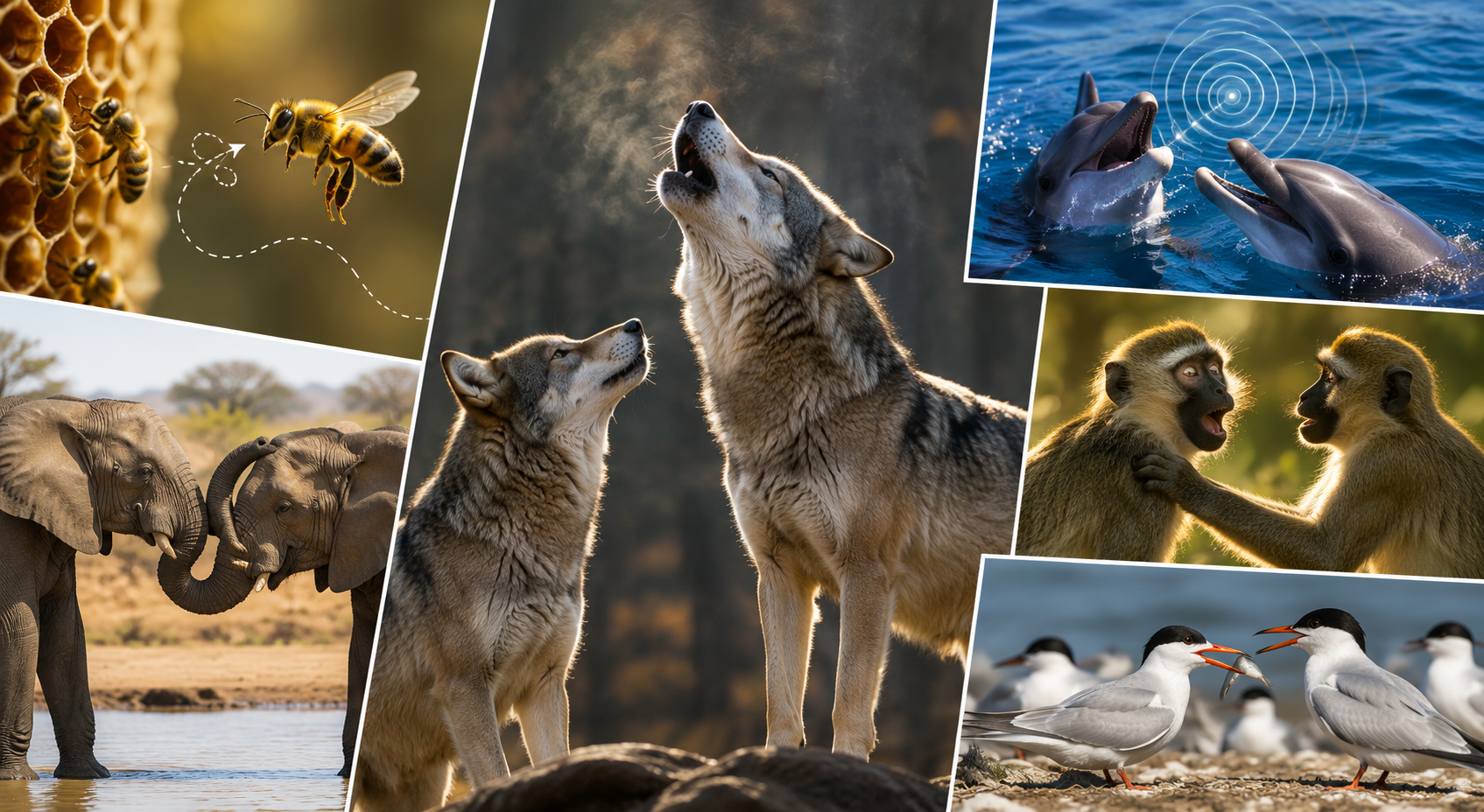
Understanding how animals communicate opens a fascinating window into the natural world. From a bird singing at sunrise to an elephant producing a deep rumble, wildlife constantly exchanges information. Animals use sounds, scents, body movements, colors, touch, vibrations, and even electrical signals. These messages can warn others about danger, attract mates, defend territory, locate food, or strengthen social bonds.
Communication is essential for survival. However, animals do not all rely on the same methods. Their environment, senses, social structure, and lifestyle shape the signals they use. A whale living in a vast ocean faces different challenges from an ant moving through a crowded colony. As a result, nature has produced an impressive variety of communication systems.
Scientists continue to study these signals to understand animal behavior better. Their discoveries show that wildlife communication can be complex, flexible, and surprisingly effective.
Why Communication Matters in the Animal World
Animals need information to make good decisions. Therefore, communication can affect almost every part of their lives. A warning call may help an animal escape a predator. Likewise, a courtship display can help an individual find a suitable mate.
Communication also helps animals manage relationships. Wolves, primates, elephants, dolphins, and many other social species live in groups. Consequently, they need ways to recognize individuals, maintain bonds, reduce conflict, and coordinate activities.
Territory provides another reason for sending signals. Many birds sing to announce that an area is occupied. Meanwhile, mammals may leave scent marks around important locations. These signals can prevent unnecessary physical fights because rivals receive information before approaching.
Understanding how animals communicate also helps researchers interpret wildlife behavior. A movement that appears simple to humans may carry important information to another animal. For example, posture can show fear, confidence, aggression, or willingness to interact.
Communication does not always require a deliberate conversation. Instead, one animal produces a signal that influences another animal’s behavior. The receiver detects that information and responds in a useful way.
Sound: One of Nature’s Most Powerful Signals
Sound is among the most familiar forms of animal communication. Birds sing, frogs call, wolves howl, insects chirp, and whales produce elaborate vocalizations. Sound works especially well when animals cannot see each other.
Birdsong offers a clear example of how animals communicate across distance. Many birds use calls to attract mates or defend territories. In addition, some species produce alarm calls when predators appear.
Sound can travel through forests, grasslands, and oceans. However, different environments affect it differently. Low-frequency sounds can travel particularly long distances under certain conditions. Elephants, for example, produce very low-frequency rumbles.
Marine animals also depend heavily on sound because visibility underwater can be limited. Whales and dolphins use vocal signals for social contact. Dolphins can produce individually distinctive whistles that help maintain contact with other members of their group.
Meanwhile, some animals use sound for both communication and navigation. Bats produce high-frequency calls for echolocation. Although echolocation primarily helps them understand their surroundings, bats also use vocalizations during social interactions.
Therefore, sound offers animals a flexible communication channel. It can work at night, across obstacles, and over considerable distances.
Body Language and Visual Signals
Animals do not always need to make noise. Instead, many communicate through posture, movement, facial expressions, gestures, and visual displays.
Body language provides another important example of how animals communicate without vocalizing. A wolf may change its posture during a social encounter. A bird may spread its feathers during courtship. Primates can use facial expressions and gestures during interactions with other group members.
Color can also carry information. Some animals display bright colors during breeding periods. Others reveal hidden patches of color when confronting rivals or courting potential mates.
Peacocks provide a famous example. A male displays his large train during courtship. The display provides visual information that females can assess when choosing mates.
Visual signals can also prevent conflict. Instead of immediately fighting, animals may use threat displays to communicate strength or willingness to defend themselves. Consequently, both individuals may avoid the risks of physical combat.
However, visual communication has limitations. The receiver usually needs a clear view of the sender. Therefore, species living in dense forests, underground environments, or dark habitats may depend more heavily on other communication methods.
Chemical Signals and the Hidden Language of Scent
Humans often overlook scent, yet chemical communication is widespread in nature. Animals can release chemical substances that other individuals detect through specialized sensory systems.
Chemical signals demonstrate how animals communicate even when the sender is no longer present. A scent mark can remain on a tree, rock, trail, or patch of ground long after an animal leaves.
Many mammals mark territories with scent. These marks may provide information about identity, reproductive condition, or territorial ownership. As a result, another animal can gather information without meeting the sender directly.
Insects are particularly skilled chemical communicators. Ants can deposit pheromone trails that guide colony members toward food. When workers discover a valuable resource, their chemical trail can help others reach it efficiently.
Moths provide another striking example. Some species use chemical signals to locate potential mates over considerable distances.
Chemical communication has several advantages. Scent signals can work in darkness and remain active for extended periods. However, they are usually slower than sounds or visual signals. Wind, water, temperature, and other environmental conditions can also influence how chemicals spread.
Touch Builds Social Connections
Physical contact can carry powerful information. Grooming, rubbing, nudging, tapping, and other forms of touch often help social animals maintain relationships.
Researchers studying how animals communicate frequently examine physical interactions within groups. Primates, for instance, groom one another. Grooming helps remove dirt and parasites, but it can also strengthen social bonds.
Elephants frequently touch each other with their trunks. These interactions can occur during greetings, reassurance, play, or social bonding. Similarly, many mammals use physical contact between parents and young.
Touch works best at close range. Therefore, it cannot replace long-distance calls or scent marks. Nevertheless, physical communication can provide immediate and direct information.
Social insects also use touch. Ants may contact one another with their antennae during encounters. Bees can exchange information through physical interactions inside a hive.
For highly social species, touch may help maintain group stability. Consequently, physical communication plays a major role even though humans may notice it less often than dramatic calls or displays.
The Remarkable Dance Language of Honeybees
Honeybees offer one of the best-known examples of information sharing in the animal kingdom. When a worker finds a valuable food source, it can return to the hive and perform movements that help other workers locate it.
This behavior provides fascinating insight into how animals communicate information about resources. The well-known waggle dance can convey information related to the direction and distance of food.
The bee performs the dance on the honeycomb. Other bees detect its movements and use the information when leaving the hive.
However, the dance is only part of the process. Bees can also use odors associated with flowers and food sources. Therefore, several types of information may work together.
The system demonstrates an important principle of animal communication. Signals do not need to resemble human words to carry useful information. Instead, evolution produces communication methods suited to each species’ sensory abilities and environment.
Vibrations: Messages Traveling Through Surfaces
Some communication happens through vibrations rather than airborne sound. Animals can send signals through soil, plants, spider webs, or other surfaces.
Vibrational signals are another fascinating part of how animals communicate beyond human perception. Spiders, for example, detect vibrations traveling through their webs. Those vibrations can provide information about prey, potential mates, or other disturbances.
Some insects communicate through plant stems. They produce vibrations that travel through the vegetation and reach other individuals. This method can work even when visual contact is impossible.
Elephants may also detect low-frequency vibrations traveling through the ground. Researchers have investigated how these vibrations could contribute to communication and environmental awareness.
Vibration offers several benefits. Signals can remain relatively private compared with loud calls. Moreover, they can travel through environments where airborne sound or vision may be less effective.
These hidden messages remind us that human senses reveal only part of what happens in nature.
Electrical Communication Beneath the Water
Some aquatic animals have evolved an even more unusual communication method: electrical signals.
Weakly electric fish can produce electric fields around their bodies. They use these fields primarily to sense nearby surroundings. However, changes in electrical patterns can also transmit social information.
This system expands our understanding of how animals communicate in environments where familiar methods may be less effective. Murky water can limit vision, while surrounding noise may interfere with sound.
Electrical signals can provide information about identity, social status, or reproductive condition in some species. Because these signals work at relatively short distances, they suit close interactions.
The ability shows how strongly habitat can influence communication. Natural selection does not produce one universal system. Instead, different species evolve methods that work within their particular surroundings.
Alarm Calls and Warnings About Predators
Danger creates a strong need for fast communication. Many animals produce alarm signals when predators approach.
Alarm behavior helps explain how animals communicate urgent information. Birds, primates, meerkats, and other social species can use distinctive calls when they detect threats.
In some cases, calls vary depending on the danger. Different predators may require different responses. For example, an aerial predator could require animals to seek cover. In contrast, a ground predator might require a different escape strategy.
Receivers benefit when they respond appropriately. However, producing an alarm can sometimes draw attention toward the caller. Therefore, warning behavior may involve both benefits and risks.
Animals can also listen to signals produced by other species. A bird may react to another species’ alarm call if the warning indicates a shared predator.
Consequently, natural environments contain networks of information. Wildlife does not always communicate only with members of its own species.
Courtship Signals and Finding a Mate
Reproduction drives some of nature’s most spectacular communication displays. Birds sing complex songs, frogs call repeatedly, insects release chemical signals, and many species perform elaborate movements.
Courtship is a major reason how animals communicate has become so diverse. Potential mates need ways to locate and evaluate one another.
Signals may provide information about health, size, condition, territory, or species identity. For example, bird songs can help females recognize suitable mates. Meanwhile, visual displays may reveal physical characteristics.
Competition also shapes these behaviors. Males of some species use calls or displays to discourage rivals. Therefore, the same signal can influence both potential mates and competitors.
Timing matters as well. Many species communicate more actively during breeding seasons. Environmental factors such as temperature, rainfall, daylight, and food availability may influence these periods.
Courtship communication demonstrates how signals can evolve into highly specialized behaviors over many generations.
Communication Within Animal Families
Parents and offspring must exchange information, especially when young animals depend heavily on adults.
Family interactions offer another clear example of how animals communicate for survival. Young birds may call when hungry. Mammal mothers can recognize signals from their offspring. Parents may also use warning signals when danger approaches.
Recognition is especially important in crowded colonies. Seabirds and seals may live among large numbers of other animals. In such environments, parents and offspring benefit from identifying each other’s calls, scents, or other signals.
Young animals also learn through social interaction. They watch adults, respond to warnings, and practice behaviors during play.
Communication may change as offspring mature. Signals that are important during infancy can become less necessary when juveniles become independent.
Therefore, family communication supports feeding, protection, recognition, learning, and social development.
Can Animals Communicate Across Species?
Communication does not always remain within one species. Animals often observe and respond to signals produced by other species.
This interaction adds another layer to how animals communicate within shared ecosystems. Different bird species, for example, may respond to each other’s alarm calls.
Predators can also intercept signals. A predator might listen for prey vocalizations or detect movement associated with communication. Consequently, animals must balance the benefits of signaling against the possibility of being detected.
Some species benefit from shared warning systems. When several animals monitor their surroundings, individuals may gain useful information without discovering every threat themselves.
Humans can also learn to recognize certain wildlife signals. Experienced researchers may identify alarm calls, courtship displays, or territorial behaviors. However, interpreting animal signals requires care because human assumptions can lead to mistakes.
Cross-species information sharing shows that communication can influence entire ecological communities rather than isolated groups.
How Scientists Study Wildlife Communication
Scientists use many methods to investigate animal signals. They record sounds, observe behavior, analyze chemicals, track movement, and conduct controlled playback experiments.
Modern technology has transformed research into how animals communicate. Sensitive microphones can capture sounds outside normal human hearing. Underwater hydrophones record marine animals, while specialized sensors detect vibrations.
Researchers can also play recorded signals to animals and observe their reactions. These experiments help determine whether a particular call or sound carries meaningful information.
Video technology allows scientists to study subtle movements and social interactions. Meanwhile, tracking devices help connect communication with movement patterns and environmental conditions.
Artificial intelligence and machine learning increasingly help researchers process large collections of recordings. These tools can identify patterns that would take humans much longer to examine manually.
However, technology does not automatically translate animal communication. Researchers still need careful experiments and biological context before drawing conclusions.
What Animal Communication Teaches Us About Nature
Studying how animals communicate reveals that nature contains far more information exchange than humans normally notice. Forests, oceans, grasslands, rivers, and even underground habitats contain signals moving between living creatures.
Some messages travel as sound. Others appear through movement, scent, touch, vibration, or electricity. Each method reflects the challenges and opportunities of an animal’s environment.
Communication also reveals the importance of social relationships. Animals cooperate, compete, warn, court, care for young, and defend resources. Signals help them perform these tasks while reducing uncertainty.
Most importantly, animal communication encourages people to observe wildlife more carefully. A bird call, scent mark, posture, or movement may have a purpose that is not immediately obvious.
As research improves, scientists will continue discovering new details about animal signals. Yet one lesson is already clear: wildlife lives in a world filled with information.
Conclusion
Learning how animals communicate changes the way we view wildlife. Animals are constantly sending and receiving signals that help them navigate complex environments.
Sound may carry a warning across a forest. Scent can mark a territory after its owner has left. A dance can guide bees toward food, while a vibration can travel through a web or plant. Meanwhile, touch can strengthen relationships within a social group.
These systems differ greatly from human language. Still, they perform essential functions with remarkable efficiency.
By studying animal signals, researchers gain valuable insight into behavior, evolution, social life, and ecosystems. Moreover, this knowledge can support conservation by helping scientists understand how human activity affects wildlife communication.
Nature is not silent. Instead, it contains countless messages moving around us every day. The more carefully we observe, the more we discover about the sophisticated ways animals share their world.
FAQ
1. What are the main ways animals send messages to each other?
Animals commonly use sound, visual displays, scent, touch, and vibrations. Some species also rely on electrical signals. The best method depends on the animal’s habitat and sensory abilities.
2. Do animals have languages like humans?
Animal communication can be highly complex, but scientists generally distinguish these systems from human language. Human language has unusual flexibility, grammar, and the ability to express an enormous range of abstract ideas.
3. Why do animals make alarm calls?
Alarm calls can warn nearby animals about predators. In some species, different signals may trigger different defensive responses depending on the type or location of a threat.
4. Can different animal species understand each other’s warnings?
Yes, some animals learn or instinctively respond to warning signals produced by other species. This behavior can provide valuable information about predators in a shared environment.
5. How do scientists understand what animal signals mean?
Researchers combine observation with recordings, playback experiments, tracking technology, and behavioral analysis. They compare an animal’s response to different signals before determining what information a signal may carry.