
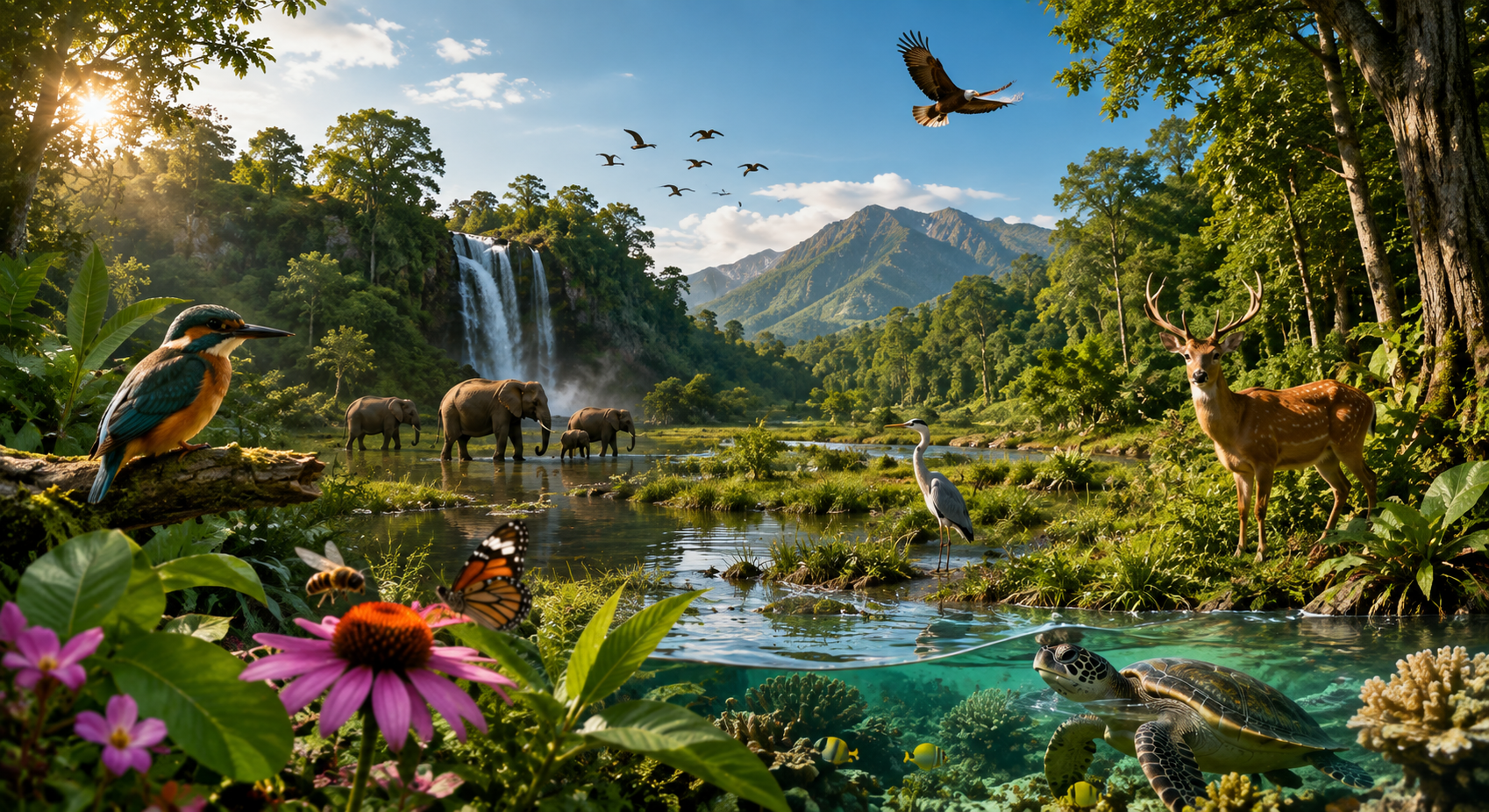
Every forest, wetland, grassland, coral reef, and river contains a network of living organisms. Understanding why biodiversity matters helps us see how these species support ecosystems that people also depend on. Plants, animals, fungi, and microorganisms interact in countless ways, creating systems that provide food, clean water, fertile soil, and other benefits.
Biodiversity describes the variety of life at several levels. It includes differences among species, genetic variation within species, and the diversity of ecosystems themselves. Therefore, biodiversity is much broader than simply counting how many animals live in one place.
Healthy ecosystems are not necessarily untouched by people. Humans have interacted with landscapes for thousands of years. However, rapid habitat loss, pollution, overexploitation, invasive species, and climate change can place intense pressure on natural systems.
Protecting biodiversity means protecting the relationships that allow ecosystems to function. Those relationships ultimately affect wildlife, communities, economies, and future generations.
What Biodiversity Really Means
Biodiversity can seem like an abstract scientific term. In practice, it describes the extraordinary variety found throughout the living world.
Species diversity is the most familiar level. A tropical forest, for example, may contain numerous plants, mammals, birds, insects, fungi, and microorganisms.
However, understanding why biodiversity matters also requires looking within individual species. Genetic diversity means members of the same species are not genetically identical. That variation can help populations respond to diseases and changing environmental conditions.
Ecosystem diversity provides another layer. Forests, deserts, wetlands, rivers, coastal habitats, and grasslands each support different communities.
These levels interact. A species depends on its habitat, while ecosystems depend on organisms performing different ecological roles.
Therefore, losing biodiversity is not simply about losing individual species. It can also weaken genetic variation and alter entire habitats.
Recognizing these connections helps explain why conservation often focuses on ecosystems rather than isolated animals.
Biodiversity Helps Ecosystems Function
An ecosystem contains countless relationships. Plants capture energy from sunlight. Herbivores consume vegetation, predators hunt other animals, and decomposers break down organic material.
Together, these processes move energy and nutrients through the environment.
This interconnectedness explains why biodiversity matters for ecosystem function. Different organisms can perform complementary roles. For example, various pollinators may visit different plants or remain active under different environmental conditions.
Likewise, diverse plant communities can use sunlight, water, and soil resources in different ways.
Greater diversity does not make an ecosystem immune to disruption. However, having multiple species performing overlapping functions can sometimes provide ecological resilience.
If one species declines, another may continue contributing to a similar process.
Relationships can be extremely complex. Therefore, removing one organism may create consequences that are difficult to predict.
Conservation scientists study these networks to understand which species, habitats, and interactions are particularly important for maintaining ecological processes.
Pollinators Support Plants and Food Systems
Pollination is one of the clearest examples of nature supporting both ecosystems and people.
Bees are famous pollinators, but they are not alone. Butterflies, moths, beetles, birds, bats, and other animals can move pollen between flowers.
Pollination demonstrates why biodiversity matters because different species support different plants. Some pollinators specialize in particular flowers, while others visit many species.
Wild plants depend on these interactions to reproduce. Those plants can then provide food and habitat for other organisms.
Agriculture also benefits. Many crops rely to varying degrees on animal pollination.
However, pollinator populations can face pressure from habitat loss, pesticide exposure, disease, invasive species, and changing climate conditions.
Supporting diverse flowering plants can provide food across different seasons. Meanwhile, protecting nesting habitat gives pollinators places to reproduce.
Conservation strategies work best when they consider entire habitats rather than focusing on a single popular species.
Healthy Soil Depends on Living Organisms
Soil may look like simple dirt, but healthy soil contains an enormous biological community.
Bacteria, fungi, insects, worms, and other organisms help break down organic matter. As materials decompose, nutrients can become available for plants and other organisms.
Soil provides another powerful example of why biodiversity matters beneath our feet.
Fungi can form relationships with plant roots, while microorganisms influence nutrient cycling. Earthworms and other soil animals can affect soil structure through their movement and feeding.
These processes support natural vegetation and agriculture.
However, soil can degrade through erosion, contamination, excessive disturbance, and poor land management. Once fertile topsoil disappears, rebuilding it can take considerable time.
Protecting vegetation can reduce erosion because roots help hold soil in place. Adding organic material and using appropriate land-management practices can also support soil health.
Biodiversity therefore exists even in places where we cannot easily see it.
Forests Depend on Complex Relationships
A forest is much more than a collection of trees. It contains layers of vegetation, animals, fungi, microorganisms, water, soil, and dead organic material.
Each component interacts with others.
Forests illustrate why biodiversity matters on a large scale. Birds and mammals may disperse seeds. Insects can pollinate flowers, while fungi help decompose fallen material.
Predators influence prey populations. Meanwhile, herbivores affect vegetation through feeding.
Dead trees also have ecological value. They can provide habitat for insects, fungi, birds, and other organisms while gradually returning nutrients to the soil.
Forest diversity varies considerably around the world. Tropical rainforests contain different communities from temperate or boreal forests.
Therefore, conservation strategies need to reflect local ecology.
Protecting a forest does not mean simply maintaining tree cover. A plantation containing one tree species is ecologically different from a diverse natural forest.
Species composition, structure, age, and ecological interactions all matter.
Wetlands Provide Essential Ecosystem Services
Wetlands include marshes, swamps, peatlands, mangroves, and other areas where water strongly influences the environment.
Although they were historically treated as wastelands in many places, wetlands perform important ecological functions.
Their value helps demonstrate why biodiversity matters for both wildlife and communities.
Wetlands can provide breeding and feeding habitat for fish, birds, amphibians, insects, and plants. Some also help store water during heavy rainfall.
Vegetation can slow water movement and trap sediments. Certain wetland processes can also influence water quality.
Coastal wetlands, including mangrove forests, can help reduce wave energy and provide nursery habitat for marine species.
However, wetlands face pressure from drainage, development, pollution, altered water flows, and climate change.
Restoration can help in some areas, but protecting healthy existing wetlands is often especially valuable.
These ecosystems show how wildlife conservation and human well-being can overlap.
Oceans Need Biodiversity Too
Marine biodiversity extends from microscopic plankton to enormous whales. Coral reefs, seagrass beds, mangroves, open oceans, and deep-sea habitats support very different communities.
Understanding marine ecosystems expands our view of why biodiversity matters far beyond land.
Plankton form the foundation of many marine food webs. Small fish consume smaller organisms, while larger predators depend on species lower in the food chain.
Coral reefs provide shelter and feeding areas for numerous organisms. Seagrass meadows can serve as nursery habitats for young marine animals.
People depend on oceans as well. Fisheries provide food and livelihoods for communities around the world.
Yet marine ecosystems face several pressures. Overfishing, plastic pollution, nutrient runoff, habitat destruction, warming waters, and ocean acidification can affect marine life.
Effective conservation may include sustainable fisheries management, pollution reduction, habitat protection, and action addressing climate change.
Because oceans connect across borders, international cooperation is often essential.
Genetic Diversity Helps Species Adapt
Members of a species may look similar, but their genes contain differences.
Genetic variation can influence characteristics such as disease resistance, physical traits, and responses to environmental conditions.
This is another reason why biodiversity matters over long periods.
When a population becomes very small, genetic diversity can decline. Reduced variation may limit its ability to respond to new diseases or environmental changes.
Habitat fragmentation can make this problem worse. Roads, cities, farms, or other barriers may separate populations that previously exchanged genes.
Wildlife corridors can sometimes reconnect habitats. These connections allow suitable species to move between areas.
Genetic diversity also matters in agriculture. Maintaining different crop varieties and livestock breeds can preserve traits that may become useful under future conditions.
Conservation therefore involves more than preventing immediate extinction. Maintaining healthy, connected populations can also preserve evolutionary potential.
Predators Can Shape Entire Ecosystems
Predators often receive negative attention because they hunt other animals. However, predation is a natural ecological process.
Large predators can influence prey numbers and behavior. Those effects may spread through food webs.
Predator-prey relationships help explain why biodiversity matters at multiple levels.
When prey animals change where or how they feed, vegetation can also be affected. Smaller predators may respond to the presence or absence of larger predators.
However, ecosystems are complex. Scientists should not assume every predator creates the same effects in every environment.
Human-wildlife conflict also needs careful management. Large predators may threaten livestock or create safety concerns near communities.
Conservation programs can use strategies such as secure livestock enclosures, compensation programs, monitoring, and community engagement.
The goal is not to romanticize predators. Instead, it is to recognize that they perform ecological roles and require thoughtful management where their habitats overlap with human activity.
Biodiversity Supports Food Security
Modern food systems rely on biological diversity more than supermarket shelves may suggest.
Crops depend on soil organisms, water cycles, genetic resources, and, in many cases, pollinators.
This connection shows why biodiversity matters to agriculture and food security.
Wild relatives of crops can contain useful genetic traits. Plant breeders may use those traits to develop varieties with improved resistance to pests, diseases, drought, or other challenges.
Diverse farming systems can also provide ecological benefits when managed appropriately.
For example, maintaining vegetation around agricultural areas may support pollinators and beneficial insects. Crop rotation can help manage soil fertility and certain pest problems.
However, agriculture also places pressure on biodiversity when natural habitats are converted or chemicals are used irresponsibly.
Finding a balance is essential. Food production must support a growing population while protecting the ecological systems on which agriculture ultimately depends.
Clean Water Is Connected to Healthy Ecosystems
Water does not exist separately from landscapes. Rain moves across forests, farms, wetlands, grasslands, and cities before reaching rivers, lakes, or groundwater.
Healthy vegetation and soils can influence how water moves through these environments.
This relationship provides another example of why biodiversity matters to everyday life.
Forested watersheds can help reduce erosion. Wetlands may capture sediments and nutrients under suitable conditions.
Plants along riverbanks can stabilize soil and provide shade for aquatic habitats.
However, ecosystems cannot remove unlimited amounts of pollution. Protecting water quality still requires controlling contamination at its source.
Agricultural runoff, industrial pollution, untreated wastewater, and urban development can overwhelm natural systems.
Therefore, watershed conservation works best alongside effective environmental regulation and infrastructure.
Protecting biodiversity in rivers, wetlands, and surrounding landscapes can support both wildlife and the water resources communities depend on.
Biodiversity Can Strengthen Climate Resilience
Climate change is altering temperatures, rainfall patterns, sea levels, fire conditions, and other environmental factors.
Species must respond by adapting, moving, or changing behavior. Some will struggle more than others.
Understanding this challenge reinforces why biodiversity matters for resilience.
Diverse ecosystems may contain species with different tolerances. Therefore, ecological functions may sometimes continue even as individual populations change.
Mangroves, wetlands, forests, and grasslands can also store carbon, although their capacity differs considerably.
Protecting these habitats can therefore support biodiversity while contributing to climate strategies.
However, conservation cannot substitute for reducing greenhouse gas emissions. Climate change itself is a major threat to ecosystems.
Instead, biodiversity protection and climate action should complement each other.
Maintaining connected habitats may help some species move as environmental conditions shift. Restoration can also improve degraded ecosystems and create additional habitat.
Resilient ecosystems give nature more opportunities to respond to change.
Habitat Loss Is a Major Threat
Animals and plants need suitable places to live. When forests, wetlands, grasslands, or other ecosystems disappear, species lose food, shelter, breeding areas, and migration routes.
Habitat destruction is therefore central to understanding why biodiversity matters in conservation planning.
Agricultural expansion, urban development, mining, infrastructure, and other land uses can transform natural habitats.
Fragmentation creates additional problems. A forest may still exist, but roads or development can divide it into isolated patches.
Smaller habitat patches may support fewer individuals. They can also make movement between populations difficult.
Conservation planning can reduce these impacts by protecting important areas and maintaining ecological connections.
Development and biodiversity protection do not always have to be complete opposites. Careful planning can sometimes reduce environmental damage while meeting legitimate human needs.
Nevertheless, some habitats are difficult or impossible to replace once destroyed. Avoiding damage can therefore be more effective than attempting restoration afterward.
Invasive Species Can Disrupt Ecosystems
Species naturally move over time. However, human activity can transport organisms far beyond their original ranges.
Some introduced species establish themselves without causing major problems. Others become invasive and significantly affect native ecosystems.
This issue highlights why biodiversity matters at the community level.
Invasive species may compete with native organisms for food or habitat. They can also introduce diseases, alter fire patterns, prey on vulnerable wildlife, or change ecosystem processes.
Islands can be particularly vulnerable because native species may have evolved without certain predators or competitors.
Preventing introductions is often easier than controlling established invasive populations.
Travelers can help by following biosecurity rules and avoiding the movement of plants, animals, seeds, soil, or untreated materials across regions.
Pet owners should never release unwanted animals into the wild.
Effective invasive-species management requires science, monitoring, and coordinated action rather than assuming every non-native organism is automatically harmful.
Pollution Affects Wildlife in Many Ways
Pollution takes many forms. Plastic waste, pesticides, industrial chemicals, excessive nutrients, oil, noise, and artificial light can all affect ecosystems.
Some pollutants harm organisms directly. Others alter habitats or interfere with natural behavior.
Pollution adds another dimension to why biodiversity matters because species respond differently to environmental contamination.
Plastic can entangle wildlife or enter food webs as it breaks into smaller pieces. Nutrient pollution can contribute to excessive algal growth in aquatic environments.
Artificial light may affect nocturnal animals and migrating species. Meanwhile, underwater noise can interfere with animals that rely heavily on sound.
Reducing pollution often provides benefits beyond conservation. Cleaner air, water, and communities can support human health and quality of life.
Individuals can reduce waste, but larger improvements also require effective infrastructure, responsible industry practices, and environmental policy.
Pollution prevention is generally easier than cleaning contaminated ecosystems after damage occurs.
Conservation Protects More Than Famous Animals
Conservation campaigns often feature elephants, whales, pandas, tigers, or other recognizable wildlife. These species can attract valuable public attention.
However, ecosystems also depend on less glamorous organisms.
Insects, fungi, plants, microorganisms, reptiles, amphibians, and small animals all contribute to ecological processes.
Recognizing why biodiversity matters means looking beyond a few charismatic species.
A tiny pollinator may support plant reproduction. A fungus can help recycle nutrients. A small fish may provide food for larger predators.
Conservation efforts can therefore protect entire habitats. Doing so supports many species simultaneously, including organisms scientists may know relatively little about.
Protected areas are one useful strategy. However, conservation must also occur outside reserves because wildlife moves across agricultural landscapes, cities, rivers, and coastlines.
Effective protection often involves governments, scientists, Indigenous peoples, local communities, landowners, businesses, and conservation organizations.
Biodiversity belongs to interconnected landscapes rather than isolated pockets.
Restoration Can Help Damaged Ecosystems Recover
Protecting healthy habitats should remain a priority. Still, many ecosystems have already experienced significant degradation.
Ecological restoration attempts to support their recovery.
Restoring native vegetation, reconnecting waterways, removing certain invasive species, and improving soil conditions can all contribute to recovery.
Restoration demonstrates why biodiversity matters through practical action. A project can create habitat while improving ecological functions.
However, planting trees alone does not automatically restore a forest. Species selection, soil, water, wildlife, and long-term management all matter.
Likewise, restoring wetlands requires understanding their natural hydrology. Without appropriate water conditions, simply adding plants may fail.
Monitoring is therefore essential. Scientists and communities need to track whether restoration actually produces the intended results.
Successful projects may require years or decades.
Restoration cannot perfectly recreate every lost ecosystem. Nevertheless, carefully designed projects can improve degraded landscapes and expand opportunities for wildlife.
What Individuals Can Do to Support Biodiversity
Large environmental challenges require government policies, conservation programs, scientific research, and responsible business practices. Still, individuals can contribute.
Start locally.
Learning why biodiversity matters becomes more meaningful when you understand the ecosystems near your own community.
If you have a garden, consider native plants appropriate for your region. They can provide food or shelter for local wildlife.
Reduce unnecessary pesticide use and follow product instructions carefully when treatment is necessary.
Keep cats and other pets managed responsibly so they do not disturb wildlife. Never release aquarium animals or exotic pets into natural environments.
Reduce waste and dispose of chemicals, electronics, and hazardous materials correctly.
When traveling, respect wildlife and protected areas. Avoid feeding wild animals or removing plants and natural objects.
You can also support reputable conservation organizations, participate in restoration projects, or contribute to citizen-science programs.
Small actions become more meaningful when many people participate.
Conclusion
Understanding why biodiversity matters reveals how deeply human life connects with the natural world. Biodiversity supports functioning ecosystems, pollination, soil processes, water systems, food production, and countless ecological relationships.
However, biodiversity is not simply a resource for people. Other species also have ecological roles and intrinsic value within the living world.
Habitat loss, climate change, pollution, invasive species, and unsustainable exploitation can weaken these systems. Therefore, conservation requires action at multiple levels.
Governments can protect habitats and strengthen environmental policies. Businesses can reduce harmful impacts. Scientists can improve our understanding, while communities can manage and restore local ecosystems.
Individuals also have a role through responsible consumption, wildlife-friendly practices, conservation support, and informed decisions.
Healthy ecosystems depend on connections. Protecting those connections gives species more opportunities to survive, adapt, and continue performing the ecological processes that sustain our planet.
FAQ
1. What are the three main types of biodiversity?
Scientists commonly discuss species diversity, genetic diversity, and ecosystem diversity. Together, these describe variation among organisms, within populations, and across different habitats.
2. What causes biodiversity loss?
Major pressures include habitat destruction, overexploitation, pollution, invasive species, and climate change. These factors can also interact and increase pressure on vulnerable populations.
3. How does biodiversity help people?
Healthy ecosystems can support food production, pollination, soil fertility, water systems, livelihoods, recreation, and other benefits that contribute to human societies.
4. Can damaged ecosystems recover?
Some can recover naturally or through restoration. However, recovery may take many years, and severely altered ecosystems may never return completely to their previous condition.
5. How can I help protect wildlife and ecosystems?
Support habitat conservation, use native plants where appropriate, reduce pollution and waste, manage pets responsibly, respect wildlife, and support credible environmental organizations or local restoration programs.